The short answer: match the operation to the problem
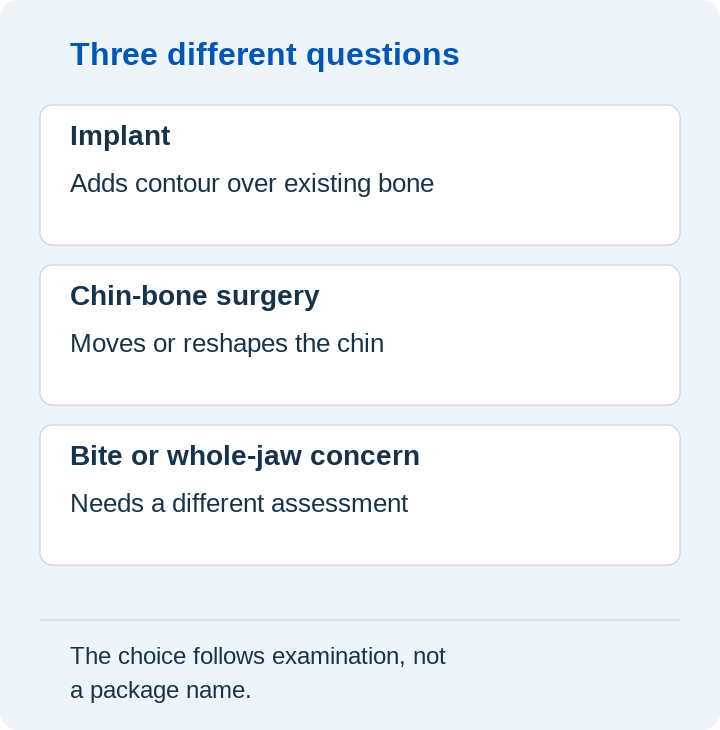
A chin implant and a sliding genioplasty are different ways to change the chin, not two versions of an identical result. An implant adds contour over the existing bone. A bony genioplasty moves or reshapes part of the chin itself. Neither isolated procedure is a substitute for correcting the relationship between the tooth-bearing jaws when that is the underlying problem.
Ask the surgeon to draw the direction of change
“A stronger chin” can mean more forward projection in profile, less height from the front, or a more centred chin point. Pick the view that matters to you and describe what you want to keep. Ask the surgeon to place an arrow on the drawing for each proposed change. An implant adds material around the existing chin, while a sliding genioplasty repositions a segment of your own bone. If the arrow is intended to change how the teeth meet, ask for a separate bite assessment before choosing between these two chin procedures.
Start with the change you want: more forward projection, less height, less width, better balance between the sides, or a different relationship between chin and lower lip. Then ask which findings support the proposed operation. This guide compares those decisions; it cannot select a procedure from a photograph. A careful assessment may support an implant, a particular bone movement, a dental or jaw-surgery opinion, or no treatment. The useful outcome of a consultation is an understandable explanation, not a promise that one method is always better.
Further reading: medlineplus.gov ↗ · www.jscmfs.org ↗
Two ways to alter the profile
A chin implant adds material to change the external contour, while osseous genioplasty changes the position or shape of the patient's chin bone. Both may be considered for selected concerns about chin balance, but they do not provide identical possibilities. The decision depends on anatomy, the dimensions needing change, prior procedures and personal preferences. Ask whether the problem is insufficient projection alone or a more complex combination of height, width and asymmetry.
Further reading: medlineplus.gov ↗ · www.baoms.org.uk ↗
What an implant can and cannot do
An implant can add contour over the existing skeleton. Its dimensions, material and placement determine the intended effect. It does not reposition the whole lower jaw or correct the bite. An implant selected for projection may also influence width, so front-view appearance deserves attention. Ask how the implant fits your anatomy, how it will be stabilized and what removal or replacement would involve. A standard product name does not tell you whether its shape suits your face.
Further reading: medlineplus.gov ↗ · www.baoms.org.uk ↗
What bone movement may offer
Genioplasty can allow movement of the bony chin in directions that an implant alone cannot reproduce, including selected vertical changes. It also introduces the demands of a bone operation, including fixation and healing. Moving the chin does not automatically change the tooth-bearing jaw relationship. Ask why the recommended movement is needed and whether the surgeon expects changes in lip support or the chin crease. A plan should address all relevant dimensions rather than focus on a profile photograph alone.
Further reading: medlineplus.gov ↗ · www.baoms.org.uk ↗
Different complication profiles
Implants can have problems related to position, infection, visibility, sensation or the surrounding tissues. Bone surgery can involve sensory changes, asymmetry, fixation issues and problems with healing, in addition to general surgical risks. Neither category is risk free. Ask about risks specific to the exact material or osteotomy being proposed, and about the clinic's approach if a result is unsatisfactory. Avoid comparing numerical rates from unrelated operations or different patient populations as if they were directly equivalent.
Further reading: medlineplus.gov ↗ · www.baoms.org.uk ↗
What previous procedures change
Existing filler, an old implant, prior genioplasty or earlier contouring may alter tissue planes and planning. Bring records of the product, surgery date and any complications if available. Removal of an implant does not guarantee an immediate return to the original appearance, and revision bone surgery may be more complex than a first operation. Ask whether additional imaging is needed and whether the proposed correction can be done in one stage or should be reassessed after removal or healing.
Further reading: medlineplus.gov ↗ · www.baoms.org.uk ↗
A useful comparison before deciding
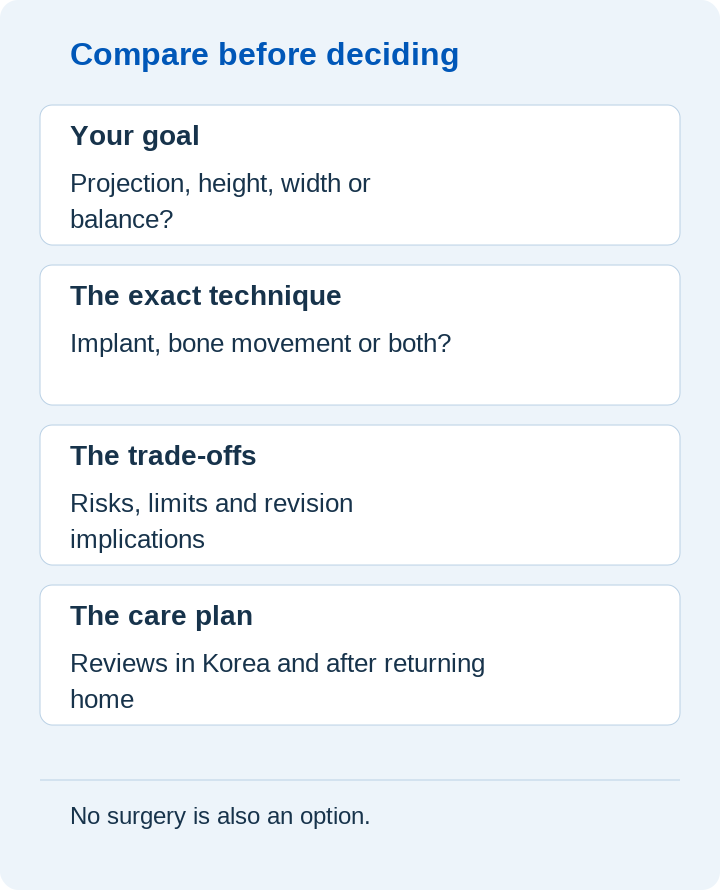
For each option, write down the expected change in projection, width and height; the likely need for fixation; the major risks; and the implications of future revision. Include no treatment as a legitimate comparator. If the main concern is a broad chin, an implant designed to add volume may not match the objective. If the concern includes the bite or whole-jaw position, neither an implant nor isolated genioplasty should be chosen without evaluating that larger relationship.
Further reading: medlineplus.gov ↗ · www.baoms.org.uk ↗
Ask what the surgeon means by genioplasty
Terminology is not perfectly consistent. Some sources use genioplasty broadly for chin surgery, including implants. Others use it specifically for an operation on the bone. A quote that says only “genioplasty” therefore leaves an important question unanswered. Request the exact technique in words you understand: an implant, a sliding bone segment, a narrowing procedure, a vertical reduction, or a combination.
An implant may be described by its material and shape, while a bone procedure may be described by a movement or an osteotomy name. Neither label tells you the whole plan. Ask which dimensions change and which are intentionally left alone. If several names appear in the same quote, ask whether they describe separate operations or different names for the same step. Keep the surgeon’s written explanation with your consultation notes so that later discussions are comparing the same intervention.
Further reading: medlineplus.gov ↗ · www.baoms.org.uk ↗
Look at the front view as carefully as the profile
A more projected chin in a side-view image may not answer a concern about a broad chin seen from the front. Conversely, narrowing the front view does not necessarily address a recessed profile. Before discussing size or millimeters, ask the surgeon to identify the feature that matters in each view and the trade-off between them.
Use ordinary, unfiltered photographs to communicate your concerns, but let the clinic obtain its own standardized images. Bring examples of features you like as discussion tools, not as a design that another face must reproduce. Ask what cannot be copied because your underlying anatomy differs. A balanced plan also considers how the chin looks while speaking and smiling, rather than optimizing one still photograph. If you would accept a smaller improvement to avoid an unwanted width or height change, say so before a technique is chosen.
Further reading: www.plasticsurgery.org ↗
Separate the chin from the bite and breathing questions
An apparently small chin can coexist with a normal bite, or it may be one part of a broader jaw-position problem. The assessment should distinguish these possibilities. Tell the clinician about difficulty biting, changes in tooth contact, jaw pain, previous orthodontics, and diagnosed sleep apnea. These details do not prove that you need jaw surgery, but they should not disappear from an appearance-focused conversation.
Orthognathic surgery involves a different treatment pathway, often coordinated with orthodontics. Its risks, recovery and planning should not be borrowed as if they were the expected experience of an isolated chin operation. Equally, a simpler cosmetic option should not be presented as treating a functional condition that has not been diagnosed. If the proposed treatment is intended only to change appearance, ask the clinician to state that clearly and identify any functional problem requiring separate care.
Further reading: www.mayoclinic.org ↗ · www.jscmfs.org ↗
Compare risks using the same questions
For either option, ask about infection, bleeding, altered sensation, dissatisfaction with shape and the possibility of another operation. For an implant, add questions about its movement, fit and what would happen if it needed removal. For a bone operation, discuss fixation, healing and the planned relationship to nearby teeth and sensory nerves. After bone surgery, lower-lip or chin numbness can take months to improve and may be permanent in some patients; ask how your planned movement affects that risk. The surgeon should explain your individual risk factors rather than offer a generic reassurance that the procedure is routine.
A percentage is meaningful only when you know which operation and patient group it describes, how long people were followed, and how the complication was defined. Do not compare a short-term swelling figure with a long-term nerve-symptom figure or treat a clinic’s promotional number as independently verified. Ask how the team documents and manages complications, who reviews concerns after discharge, and which costs are included if unexpected care is needed.
Further reading: www.plasticsurgery.org ↗ · medlineplus.gov ↗ · www.baoms.org.uk ↗
Plan recovery around the actual procedure
Do not use the fastest recovery story online to set your flight, work or social schedule. Ask the treating team for an individualized plan for meals, oral care, medication, sleeping, activity and follow-up. A combined jaw-and-chin operation may require a different plan from an implant alone or an isolated genioplasty. Returning to ordinary tasks, healing internally and seeing a settled appearance are separate milestones.
For treatment in Korea, clarify which reviews require an in-person examination and who decides whether travel is appropriate. Arrange a way to contact the team after you return home and identify a local clinician who can assess a problem if needed. Request operative records and, where relevant, implant and fixation details. If breathing or swallowing becomes difficult, seek emergency care immediately rather than waiting for a photo consultation. New worsening symptoms need clinical assessment, not reassurance from a recovery timetable.
Further reading: www.cdc.gov ↗ · www.baoms.org.uk ↗
Build an option-by-option written comparison
Make a simple note for each proposal: the concern it addresses, the proposed technique, what remains unchanged, the important risks, the expected follow-up and the conditions for reconsidering the plan. Include no surgery as its own option. This makes it easier to spot a recommendation that answers a different question from the one you originally asked.
Ask for an itemized quote that distinguishes the surgeon’s procedure, anesthesia, facility care, imaging, follow-up and any additional treatment. A lower headline price is not necessarily a like-for-like offer. Clarify financial conditions for postponement, revision assessment and care after returning home. You do not need to choose during a first consultation. If two clinicians disagree, ask each what examination finding led to the recommendation, rather than trying to choose by confidence of presentation or the number of procedures in a package.
Further reading: www.plasticsurgery.org ↗ · www.mhlw.go.jp ↗
Common questions before a decision
Is an implant automatically safer because it avoids a bone cut? No universal ranking answers your individual decision. The procedures have different benefits and risks, and an implant is still surgery. Ask about the exact procedure proposed and your own anatomy and medical history.
Does a bone operation mean that the bite will change? An isolated chin procedure is different from moving the tooth-bearing jaws. Ask the surgeon to identify the part being moved and confirm whether the bite is intended to change.
Can I decide from an online simulation? A simulation is a communication tool, not a guaranteed appearance or a substitute for examination. Ask what assumptions it makes about soft tissues and what uncertainty remains.
Can an implant be removed if I change my mind? Removal may be possible, but it is another clinical decision and does not guarantee a return to the exact preoperative appearance. Discuss that possibility before committing to insertion.
Further reading: medlineplus.gov ↗ · www.baoms.org.uk ↗ · www.plasticsurgery.org ↗
Clinics and doctors to explore
These listed providers were selected because their published services and named care teams relate to the questions in this guide. Use their profiles to prepare a consultation and confirm the proposed operation and follow-up.
Faceline Plastic Surgery
Faceline Plastic Surgery lists facial bone contouring and chin-focused procedures on its international site and identifies Dr. Lee Jin-soo with facial contouring care. It is relevant for discussing whether a chin-bone procedure fits your goal. This does not establish that a chin implant is offered or that either option is appropriate for you; ask the team to confirm available techniques and whether an independent alternative opinion would help.
Explore Dr. Lee Jin-soo’s profile ↗
Review the international website and ask about consultation ↗