When can I fly after V-line surgery?
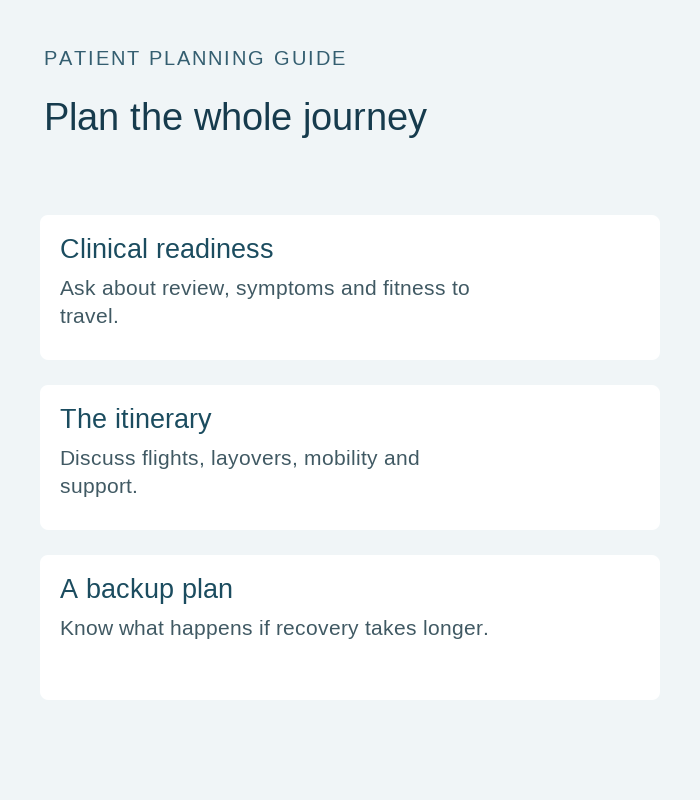
There is no universal safe flight date after V-line surgery. Your surgeon must assess your actual operation, recovery, medical history and itinerary before advising whether you can travel. Bone contouring may involve jaw-angle reshaping, a chin osteotomy, or a combination; another person's uncomplicated trip is not a clearance for yours. Reserve a flexible ticket, schedule the required reviews in Korea, and make a backup plan for a delayed return before you agree to an operation.
The CDC's medical-tourism advice notes that surgery and air travel each increase blood-clot risk. It cites a 7–10-day wait recommended for some cosmetic procedures to the face, eyelids or nose, but that general category is not a specific clearance interval for mandibular bone contouring. Do not book the earliest cited date as a guaranteed departure. Your surgeon may recommend a longer stay, particularly after combined procedures or if concerns arise. A letter prepared before surgery cannot replace a postoperative assessment.
Further reading: www.cdc.gov ↗
What your surgeon needs to assess
Ask who will perform your final in-person review, what it covers, and whether you receive a written decision. The team may need to assess breathing, swelling, bleeding, pain control, hydration, oral intake, wound condition and your ability to move around. Any new or worsening symptom deserves evaluation before departure, even if the ticket date has arrived. Your own team may identify additional needs based on your procedure and examination.
A useful question is not simply “Can I fly on Friday?” Describe the whole journey: transfer to the airport, hours at the terminal, each flight, layovers and transfer home. Explain whether you will travel alone, lift luggage, need a connecting flight or have difficulty communicating. A short first flight followed by a long connection still involves a long total journey. Ask what change in your condition means you should contact the team again before boarding.
Further reading: www.cdc.gov ↗
Build a recovery buffer before buying a ticket
Before paying a non-refundable deposit, ask for the expected dates of surgery, discharge and each necessary review. Record which appointments must be in person and which may be remote. Then ask what happens if the surgeon recommends staying longer: how to contact the clinic, whether another examination is available, and what additional accommodation, interpreter and consultation costs might arise. None of those answers makes a complication inevitable; they make an unexpected delay less disruptive.
Consider the availability of a companion for the entire potential extension, not only the first night. Look at changing fees and seat availability, as well as your employer's leave policy. Compare plans on the same basis: an attractive package price is incomplete if a required follow-up or delayed return would be difficult to fund. Keep your passport, travel insurance details and contact information accessible to someone you trust.
Further reading: www.nhs.uk ↗
Long flights and blood-clot risk
A deep vein thrombosis (DVT) is a clot in a deep vein, often in a leg. Part of a clot can travel to the lungs, causing a pulmonary embolism. Most long-distance travelers do not develop a clot, but recent surgery and long periods of limited movement can increase risk. The CDC describes long-distance journeys of more than four hours as a situation in which clot risk matters; a train, bus or car transfer can add prolonged sitting too.
Tell your care team about a previous clot, a family history or known clotting disorder, cancer, pregnancy or recent birth, limited mobility, and any estrogen-containing medicine. These are examples, not a complete risk checklist. Your team needs the complete medication list and relevant health history to make an individual plan. Never assume that being young or normally active removes the need for a risk discussion.
Further reading: www.cdc.gov ↗ · www.cdc.gov ↗
Ask for a personal prevention plan
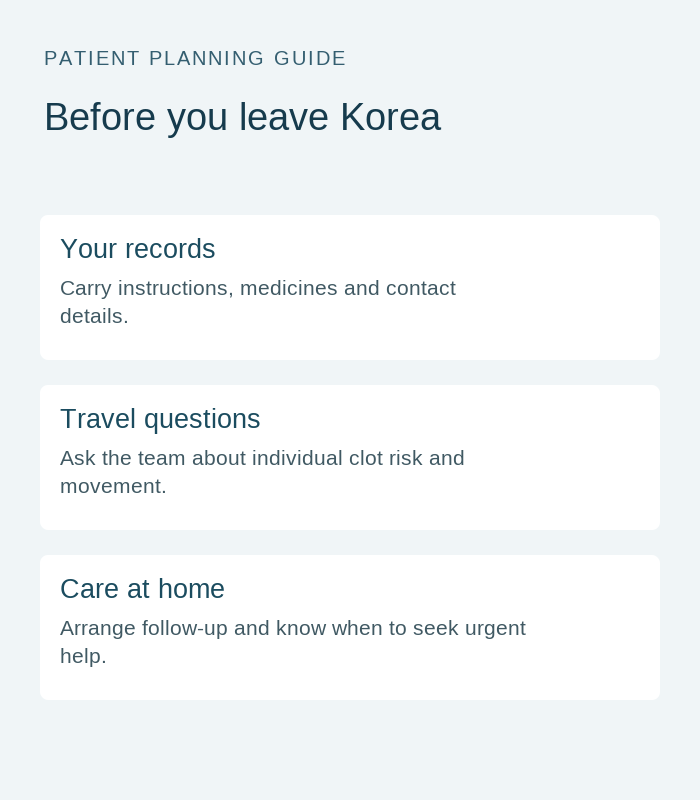
Ask the clinician whether walking or seated calf movements are appropriate for you and when you can do them safely. An aisle seat may make it easier to change position, but keep the seatbelt fastened when required and follow crew instructions. Ask whether compression stockings are appropriate and, if advised, how to obtain the correct type and fit. They are not a substitute for individual assessment or permission to travel.
Do not start aspirin, anticoagulants or another medicine solely because an article or another patient suggested it. These medicines can cause bleeding and their use depends on your individual risks. Likewise, do not stop a prescribed blood thinner without the prescriber’s direction. Bring a written plan covering both surgery and travel, and clarify which clinician to contact if instructions from different teams appear to conflict.
Further reading: www.cdc.gov ↗
Warning signs: do not board and seek urgent help
Sudden difficulty breathing, chest pain, coughing up blood, fainting, or a racing heartbeat can be signs of a serious problem such as a pulmonary embolism. Seek emergency medical help immediately rather than traveling to an appointment or waiting for a message reply. Tell emergency staff that you recently had surgery and describe your travel plans. If you develop these symptoms on the aircraft, alert the cabin crew immediately and follow their emergency instructions.
One-sided leg swelling, pain or tenderness, warmth, or discoloration can occur with a DVT and need prompt medical assessment. After facial surgery, difficulty breathing or swallowing, rapidly increasing facial or neck swelling, or severe uncontrolled bleeding requires immediate emergency care. Call local emergency services; in South Korea, call 119. For fever, worsening pain, or other concerning changes, contact your surgical team promptly for assessment, or seek urgent local care if they cannot be reached. These symptoms have several possible causes; a web page cannot tell you whether it is safe to fly.
Further reading: www.cdc.gov ↗
Eating, drinking and medicines during the journey
Before travel, confirm exactly what textures and fluids your surgeon permits, whether you can open your mouth enough to eat and drink, and how to manage mouth care away from your accommodation. Airport security, airline rules and availability of suitable food can complicate the plan. Ask the airline in advance about permitted food, liquids and assistance; carry what is permitted in hand luggage and have a backup for delays.
Take medicines in original labeled containers where practical, together with a medication list, dosing instructions and any required prescription or letter. Check the rules for Korea, transit countries, your destination and airline; drug names and permitted quantities differ. Keep scheduled doses accessible during the journey and ask the prescriber how to handle time-zone changes. Do not alter doses independently. Hydration is important for general recovery, but drinking water is not a replacement for a personalized blood-clot prevention plan.
Further reading: www.cdc.gov ↗
Swelling, comfort and practical assistance
Swelling and altered sensation can make a long day difficult even when your team considers you fit to travel. Ask what amount of swelling is expected for your own operation, which changes should prompt a call, and whether your planned face covering or support garment is appropriate. A photograph can help you describe a change, but it is not a diagnosis. Ensure you know how to reach the clinic from the airport and what to do if their usual office is closed.
Plan a route that minimizes rushing and heavy lifting. A companion can help with bags, food, transport and communicating if speaking is uncomfortable. If you require mobility assistance, contact the airline and airports before travel and ask exactly what they provide at the departure airport, connection and destination. Assistance is a practical arrangement, not proof that flying is medically safe. Avoid assuming that the airline can provide clinical monitoring or postoperative treatment.
Further reading: www.cdc.gov ↗
Follow-up after returning home
Ask for a written discharge summary in a language your home clinician can use, including the operation performed, operation date, relevant imaging or records, medication list, allergies, treatment already given and the contact details of the operating team. Ask how to report a concern, whether remote review is available, and who can coordinate urgent care near your home. Obtain permission and a secure method before sending photographs or medical records.
Arrange an initial discussion with a clinician at home before travel if possible. NHS guidance on cosmetic surgery abroad recommends considering what will happen if complications arise and how easily you could return for care. Remote advice can be useful, but it cannot replace an examination when a clinician recommends one. Check how appointments, imaging, emergency treatment and any revision would be funded, and ask the insurer about exclusions before relying on cover.
Further reading: www.nhs.uk ↗
Questions to ask at a facial-contouring consultation
Ask the same practical questions of each clinic you consider: What procedures are proposed for my jaw and chin? Which reviews are required before I leave Korea? What findings would postpone travel? Who assesses me if the operating surgeon is unavailable? How should I seek urgent care after hours? Can I have my operative record and a medicine list for the journey? Is an interpreter available for the discharge discussion, and are the written instructions in a language I understand?
Also ask about the planned journey itself: Should I discuss my personal clot risk with another clinician? What movement, medications or compression measures are appropriate for me? What happens if I have a fever, new leg symptoms or a sudden increase in facial swelling near departure? A useful answer explains both the clinical decision and the route for getting help. It does not guarantee an exact outcome or promise that every patient can fly on the same day.
Further reading: www.cdc.gov ↗ · www.cdc.gov ↗
A listed clinic to discuss your plan
Faceline Plastic Surgery describes jaw-angle and chin contouring, including V-line sculpting, on its international facial-bone-contouring page. The clinic advises overseas patients to discuss assessment, surgery and the expected in-country recovery period before finalizing travel. Its service is relevant if you wish to ask a team that lists this treatment about your proposed operation and follow-up arrangements; it is not a recommendation that surgery is suitable for you or a guarantee of a particular departure date.
Review the clinic’s official facial-bone-contouring information and the platform’s Faceline profile, then ask for an individual consultation and written follow-up plan. Compare its explanation with another qualified clinician where useful. This listing is selected for its stated facial-contouring service, not because the article can independently establish superior outcomes. Confirm current services, language support, fees and after-hours arrangements directly with the clinic before making arrangements.
Further reading: www.facelineplasticsurgery.com ↗
Frequently asked questions
Can I fly a week after V-line surgery? There is no reliable answer from the operation name alone. A general facial-procedure interval is not individual clearance for jawbone surgery. Ask the treating surgeon to assess you after the operation and before departure.
Does a short flight avoid clot risk? A shorter journey may involve less time seated, but risk depends on your health, the surgery and the entire trip. Discuss the complete route, including connections and ground travel, with your clinician.
What if my surgeon clears me but I develop a new symptom? A prior decision reflects your condition at that time. Seek fresh advice promptly, and seek emergency care immediately for difficulty breathing, chest pain, fainting or other urgent symptoms. Do not board simply because you have a letter.
Can I take a blood thinner just for the flight? Only follow a plan made by a clinician who knows your bleeding and clot risks. Do not start, stop or change aspirin or anticoagulants on your own.
Will a travel insurer pay for an extended stay? Policies differ. Ask the insurer in writing about elective surgery, complications, changes to flights, accommodation and treatment at home. Check the terms before paying for surgery or relying on coverage.
Further reading: www.cdc.gov ↗ · www.cdc.gov ↗ · www.nhs.uk ↗
Clinics and doctors to explore
These listed providers were selected because their published services and named care teams relate to the questions in this guide. Use their profiles to prepare a consultation and confirm the proposed operation and follow-up.
Faceline Plastic Surgery
Faceline lists jaw-angle, mandibular-body and chin contouring on its facial bone service page. These services make the clinic a relevant place to discuss the procedure and your own planning questions; the listing is not a comparative safety ranking.
Explore Dr. Lee Jin-soo’s profile ↗
Review the international website and ask about consultation ↗Sources & further reading
Plan the complete return journey to the United States
Give the treating team your full itinerary, including the flight from Korea, connections, airport waiting and the drive home. Ask which postoperative findings would delay travel. A general facial-surgery waiting interval cannot establish your fitness for this journey.
Arrange help for the arrival airport and home transfer, and allow for a changed itinerary if a review is needed. Confirm the date and time zone of each remote appointment in both locations. Daylight saving time and crossing the date line can make an informal “tomorrow” ambiguous.
U.S. planning sources: CDC Yellow Book: surgery and travel planning ·