What should an itemized V-line surgery quote include?
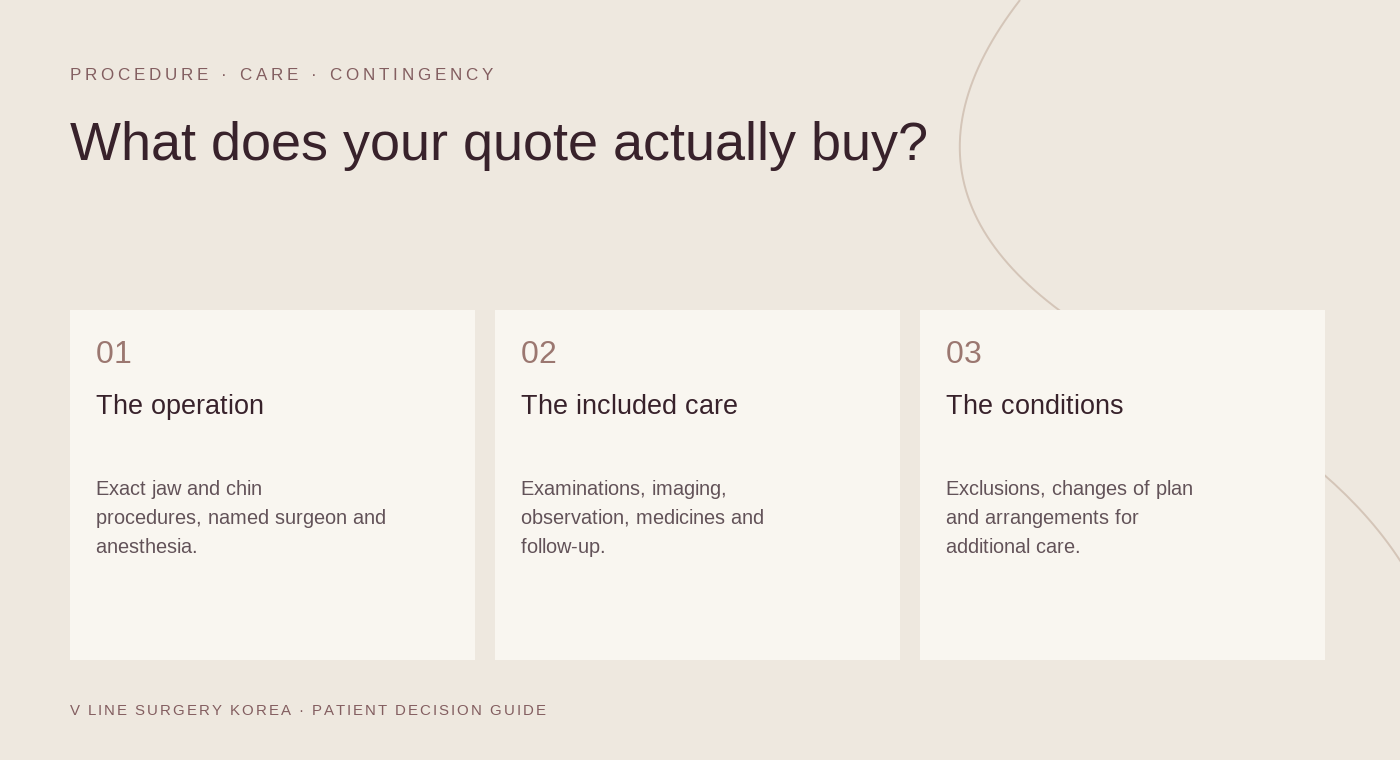
An itemized V-line surgery quote should connect the proposed operation to the people, facilities and follow-up you are paying for. Look for a named treatment provider, specific procedure components, anesthesia and facility arrangements, assessment costs, routine aftercare, exclusions, currency, validity date and payment stages. A package name and a final total are not enough to compare two offers meaningfully.
Start by asking what the surgeon proposes to change, then ask what each price covers. A lower estimate may describe a smaller operation; a higher one may include services you would otherwise buy separately. Neither observation establishes which plan is appropriate. This guide helps you read the clinic estimate itself. Keep flights, accommodation and time away from work in your separate full-trip budget so that the surgical comparison stays clear.
Translate the package into a procedure list
Ask the clinic to replace phrases such as full V-line or premium contouring with a plain description of the proposed areas and techniques. Does the plan address the jaw angle, the body of the lower jaw, the chin, or a combination? If cheekbone surgery appears on the estimate, ask why it is being discussed alongside your original lower-face concern. Faceline’s published service menu, for example, lists several different bone-contouring procedures; the names are not interchangeable.
Write your main goal above the procedure list. Then ask the surgeon to explain the contribution, limitations and added risks of each proposed component. You can request an estimate for the clinically reasonable alternatives, including a smaller scope where suitable. Choosing no treatment remains an option. A discount for adding procedures is not a clinical explanation for needing them.
Further reading: www.facelineplasticsurgery.com ↗
Separate a preliminary estimate from a confirmed plan
An online inquiry can help establish whether a consultation is worth arranging, but ask which assumptions underpin the price. Was it prepared from photographs, existing records or an examination? What remains to be assessed? Which findings might change the operation, and when will you receive the revised amount?
A useful preliminary document labels unresolved components instead of hiding them within a broad range. Ask the clinic to show the currently proposed scope and any separately priced options. This lets you see whether the upper figure means more extensive surgery, additional services or simply uncertainty.
Before accepting a different plan after arrival, request the new clinical explanation and estimate together. Compare them with your original goals. Travel arrangements and a previous payment should not substitute for understanding a changed operation. The surgeon, rather than an administrator alone, should answer questions about suitability and alternatives.
Further reading: www.nhs.uk ↗
Read the operating-day charges as one pathway
Break the operation into its financial components: the surgeon’s work, anesthesia, use of the operating facility and planned observation afterward. Ask whether the quoted amount includes all of these, even when the clinic prefers to bill them as a bundle. Itemization does not necessarily mean that every component can be purchased independently or removed.
For anesthesia, request an explanation of the planned service and who provides it. For the facility, confirm the actual location where your operation is proposed. For observation, clarify what is scheduled, what the quoted charge covers and how an additional stay would be billed if needed. A hotel room is a different service from monitored clinical care.
You are not trying to design the clinical pathway yourself. You are checking that the estimate matches the pathway the treating team has explained and that unfamiliar labels have a concrete meaning.
Clarify assessment, imaging and supplies
Make a separate line for the consultation and any tests or imaging the treating team considers necessary. Ask whether these are included in the quoted surgery price, charged before a decision, or credited only if you proceed. Find out what you would pay if assessment ends with a recommendation against surgery. The purpose is to understand the bill, not to request unnecessary testing or negotiate away clinically indicated assessment.
Ask the same questions about prescribed medicines, dressings and any supplies the clinic expects you to obtain. If a surgical technique uses fixation materials, ask whether the stated procedure fee includes them and whether the document distinguishes these from any future treatment. Do not assume that mentioning a device in a consultation establishes a lifelong service arrangement. Request written clarification of the proposed episode of care.
Make routine follow-up specific
Aftercare has both a clinical purpose and a financial scope. Ask for the planned review appointments and identify which are included in the quote. Clarify who conducts them, where they occur and how to arrange an additional assessment if the team recommends one. The NHS advises patients considering surgery abroad to establish where follow-up takes place and what further treatment could cost.
Separate medical reviews from optional comfort or cosmetic services. If a package advertises a large number of aftercare sessions, ask what each session actually involves and whether it is required for your treatment. A longer menu does not by itself tell you who assesses your recovery.
Ask how follow-up changes after you return home. Remote communication and an in-person examination are different services. Record any charge for sharing medical records or arranging a subsequent consultation rather than assuming every future interaction is included.
Further reading: www.nhs.uk ↗
Keep coordination services visible
An interpreter, airport transfer, hotel booking and companion support may make a trip easier, but they should each have an identifiable provider and scope. Ask whether interpretation is available for the surgeon consultation and consent discussion, rather than only for booking messages. If it is an additional service, request the price and booking arrangements.
Where a facilitator prepares the estimate, identify which charges belong to the clinic and which belong to the facilitator. Check who receives each payment and who can answer a billing question. If the documents describe different inclusions, ask both parties to reconcile them before you rely on the package.
For bundled transport or accommodation, understand what has actually been reserved. Keep optional upgrades separate. That preserves a useful comparison between medical plans even when one offer contains more travel conveniences than another.
Distinguish complications from a revision policy
Ask two separate questions: how would unexpected medical care be arranged and billed, and what are the written terms for a later aesthetic revision? These are different situations. A promise about revision should not be interpreted as insurance against every complication or every cost of returning to Korea.
Request the boundaries of any offered revision arrangement: which professional fees are covered, which facility or anesthesia costs remain, who assesses eligibility and whether travel is excluded. These are questions for the actual policy, not assumptions about a standard Korean rule.
For unexpected care, ask how the clinic coordinates assessment or transfer and which organization would invoice you. Smartraveller cautions that additional treatment can generate further costs and that ordinary travel insurance may not cover medical tourism. Disclose your planned procedure to your insurer and obtain an answer about your specific policy.
Further reading: www.smartraveller.gov.au ↗
Check currency and payment details without guessing tax rules
Keep the clinic’s billing currency beside every amount. If you convert it into US dollars, pounds or Australian dollars for planning, mark the conversion as an estimate with its date. Ask what currency the payment recipient actually receives and check your payment provider’s own exchange and transaction charges. A converted website figure and the amount charged to your account may differ.
Request a written statement of whether applicable taxes are already included. If someone proposes a refund, ask for the current official eligibility and process before treating it as money available for your care.
Record the quote’s expiry date, payment stages and legal recipient. For cancellation or deposit questions, read the separate booking terms alongside the estimate. Keep those contract decisions distinct from whether the proposed operation is appropriate.
Further reading: www.nhs.uk ↗
How can I compare two itemized quotes?
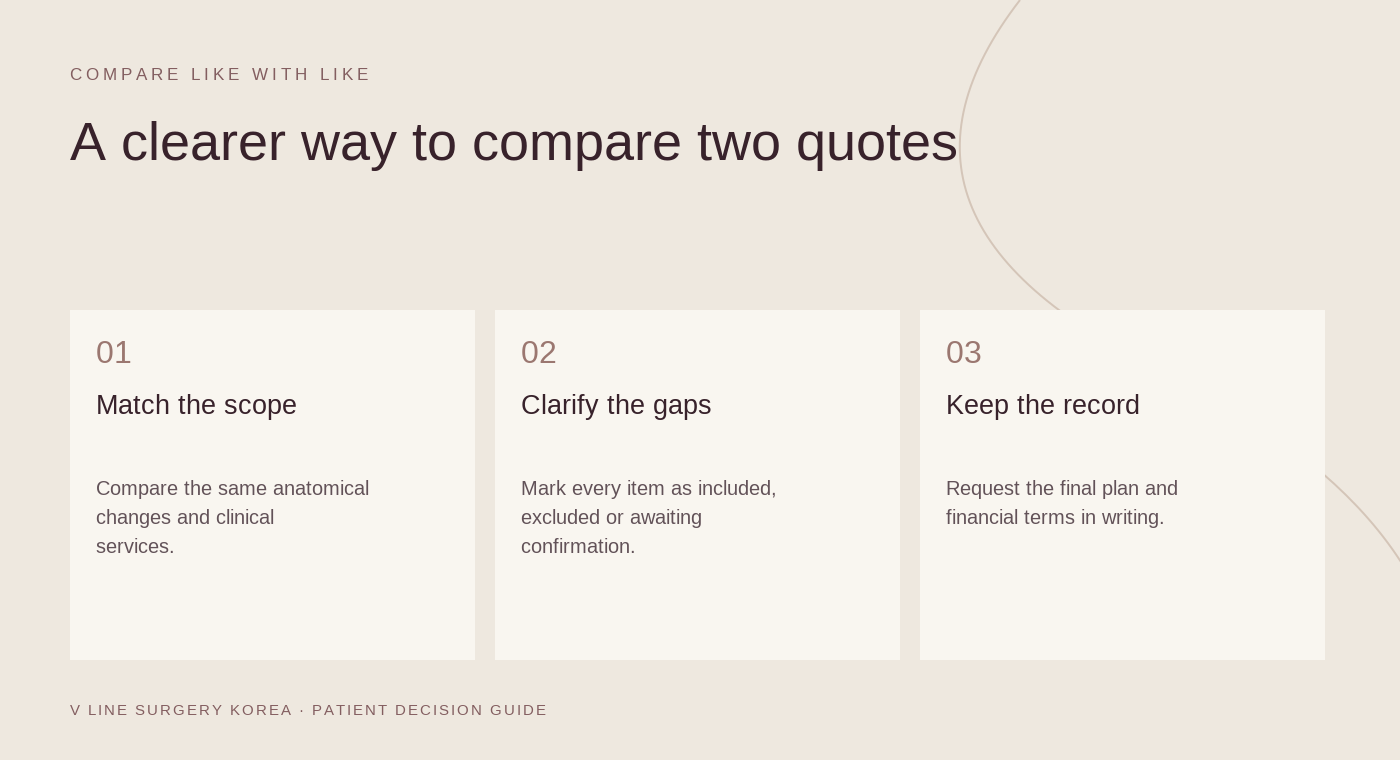
Imagine that one clinic quotes jaw-angle contouring with routine assessments included, while another quotes jaw and chin surgery with assessments billed separately. Comparing only the totals would combine two differences: surgical scope and financial inclusions. First ask each surgeon why their plan addresses your concern. Only then compare equivalent services within the plans you understand.
Create a row for each procedure and service, with columns for included, separately priced, not proposed and unresolved. Do not record unresolved as free. Add the date and version of each quote, because a later revision can invalidate a previous comparison.
This method does not require a national average or a guessed price range. It shows exactly what you still need to clarify. If plans remain materially different, another clinical opinion may be more useful than a further round of price negotiation.
Bring a focused question to a listed provider
Faceline Plastic Surgery and Dr. Lee Jin-soo are listed on V Line Surgery Korea. The clinic’s international website describes jaw-angle reduction, mandibular-body reduction and chin-contouring options. Its doctor profile identifies Dr. Lee as a plastic surgeon with a facial-contouring practice. Those stated services make the pair relevant for discussing how a proposed V-line operation should be defined in a quote..
Review their clinic and doctor profiles, then use Faceline’s international website if you want to request an individual consultation. A useful inquiry is: “Which components would you assess for my concern, and can you separate their proposed scope, included care and exclusions in writing?” Confirm the treating surgeon and obtain an individualized explanation before interpreting any estimate as a recommendation to proceed.
Further reading: www.facelineplasticsurgery.com ↗ · www.facelineplasticsurgery.com ↗ · www.facelineplasticsurgery.com ↗
Questions to resolve before accepting the estimate
Is an all-inclusive quote enough? Only if the document defines what is included and what remains outside it. Ask for the service list and the circumstances that could trigger additional charges.
Does a higher price prove safer care? Price alone cannot establish the quality of a surgeon or facility. Ask about the team, clinical arrangements and follow-up independently of the financial comparison.
What if the clinic cannot provide an exact final price yet? Ask what is unresolved, how it will be assessed and when a confirmed estimate becomes available. A clear explanation of uncertainty is more useful than an unsupported promise.
When is the paperwork ready? You should be able to match the clinical plan to a dated estimate, identify the payment recipient and understand the exclusions. Keep the final version and subsequent invoice together. If material questions remain unanswered, resolve them before making a financial commitment.
Clinics and doctors to explore
These listed providers were selected because their published services and named care teams relate to the questions in this guide. Use their profiles to prepare a consultation and confirm the proposed operation and follow-up.
Faceline Plastic Surgery
Faceline lists jaw-angle, mandibular-body and chin-contouring procedures, making a consultation with Dr. Lee Jin-soo relevant to clarifying the components of an individual quote.
Explore Dr. Lee Jin-soo’s profile ↗
Review the international website and ask about consultation ↗Sources & further reading
Questions for a U.S.-to-Korea quote comparison
Ask for the original currency and exact procedure names, rather than comparing a USD headline with a KRW surgical quote. Record the named operating surgeon, anesthesia, facility, required reviews and any separately billed tests. Mark exchange-rate assumptions outside the clinic’s confirmed total.
Ask what happens if you need review after reaching the United States: who assesses the concern, who receives the records, and which service is actually included in the written fee. A promise of remote contact is different from paying a local clinician or funding another trip.