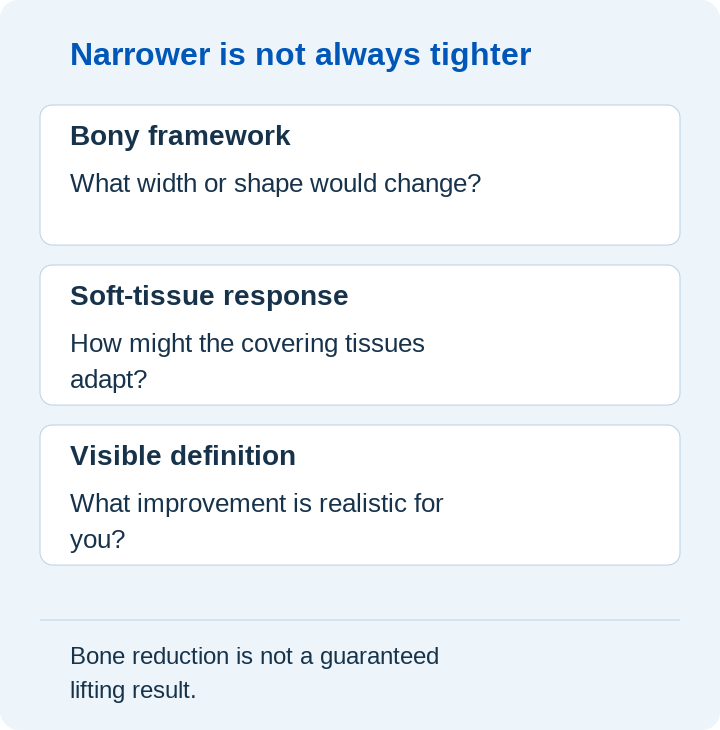
The short answer: a smaller framework is not a lifting result
Jaw or chin reduction changes the bony framework. The visible outline also depends on the soft tissues over it, so a smaller skeleton does not guarantee a sharp jawline or tighter skin. Before surgery, the important question is whether your concern is mainly bone width, soft-tissue laxity, fullness, chin position or a combination. After surgery, the question becomes what is causing the appearance you see and whether healing has progressed enough for a meaningful assessment.
If a narrower jaw and a smoother neckline are separate priorities
At the consultation, point to the widest part of the lower face, then separately to the fold or shadow under the jaw that catches your eye. Ask the surgeon which structures contribute to each finding. A plan for reducing a bony angle does not by itself explain what will happen to an existing skin fold. If the surgeon proposes an additional procedure, ask what visible concern that step targets and what you could reasonably expect if you leave it out. Decide which goal matters more before comparing plans.
Avoid deciding that you need another procedure from an early photograph. At the same time, do not dismiss worsening pain, sudden swelling, fever or drainage as merely a cosmetic concern. The guide below separates planning for an unwanted aesthetic trade-off from seeking care for a possible complication. It does not prescribe a lifting treatment or a fixed date when your result should be considered final.
Further reading: www.kokusen.go.jp ↗ · www.jscmfs.org ↗
The skin envelope does not behave like a drawing
The visible face includes skin, fat, muscle and connective tissues over the skeleton. When the supporting bone is altered, those tissues must adapt to a new shape. Their response varies with elasticity, thickness, age, previous procedures and the amount of change. A narrower bone outline therefore does not guarantee a tightly defined external jawline. Discuss this before surgery, particularly if your concern includes lower-face fullness or early jowling rather than only bony width.
Further reading: www.jscmfs.org ↗ · www.kokusen.go.jp ↗
Why reduction and definition are different goals
Reducing width can make a face smaller in one dimension while leaving the border soft. Definition depends on the relationship between the bone and its covering tissues, as well as neck and chin anatomy. If a surgeon promises both narrowing and a sharply sculpted edge, ask what supports each expectation. The two goals may require different reasoning. More bone removal is not necessarily the solution to a soft contour and may reduce support further.
Further reading: www.jscmfs.org ↗ · www.kokusen.go.jp ↗
Assessing your baseline
The consultation should examine skin quality, tissue thickness, existing laxity, chin projection and the distribution of fullness. Photographs can document the baseline, but touch and movement provide additional information. Ask whether the concern is present at rest or mainly with expression and posture. Previous liposuction, lifting, filler or bone surgery should be disclosed because they may affect tissues and expectations. A clear baseline also helps distinguish pre-existing features from changes that become noticeable later.
Further reading: www.jscmfs.org ↗ · www.kokusen.go.jp ↗
The role of conservative planning
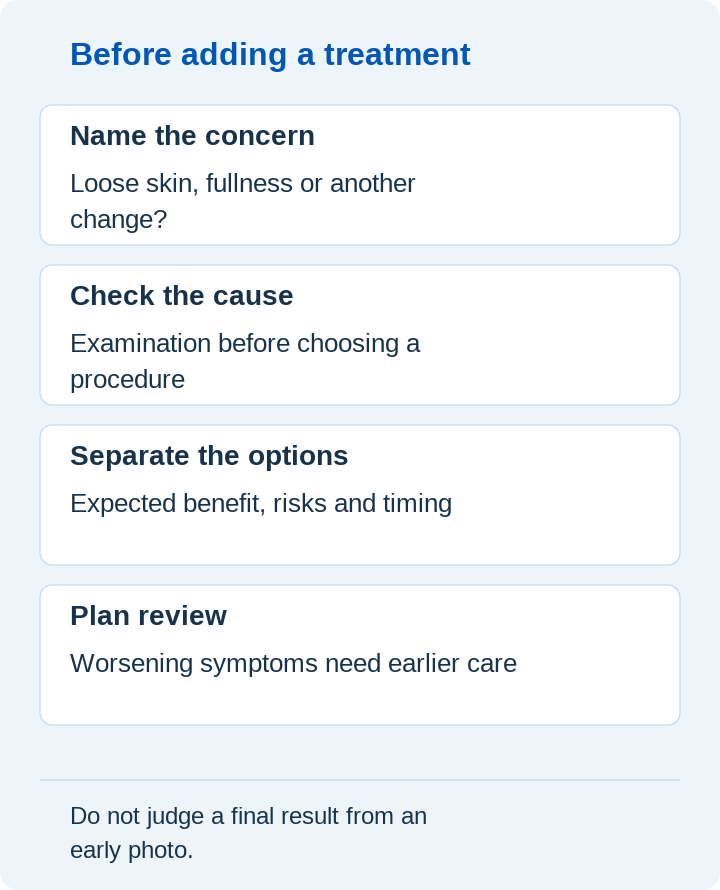
A proportionate reduction may preserve more of the underlying framework than an aggressive pursuit of narrowness. That does not guarantee avoidance of laxity, but it makes the support question part of the plan. Ask whether a smaller change would deliver the benefit you want with fewer aesthetic trade-offs. Discuss the jaw definition you wish to retain and how the chin and posterior angle work together. The best endpoint is not necessarily the smallest possible lower face.
Further reading: www.jscmfs.org ↗ · www.kokusen.go.jp ↗
Additional procedures need separate justification
Some patients may later discuss soft-tissue treatment, but a combined package should not be presented as automatically required. Each procedure has its own risks, timing and limitations. Ask what can be predicted before bone surgery and what may be better reassessed after healing. Early swelling can obscure the eventual contour, so premature conclusions may lead to unnecessary treatment. The surgeon should explain how and when a concern about laxity would be evaluated objectively.
Further reading: www.jscmfs.org ↗ · www.kokusen.go.jp ↗
Setting a realistic outcome standard
Before proceeding, identify the change you would consider worthwhile even if the jawline remains somewhat soft. Ask to review comparable cases with similar tissue characteristics rather than only dramatic examples. Understand that photographs are selective and cannot guarantee your response. Include residual fullness, contour softness and the possible need for further assessment in the discussion. This helps align the operation with a realistic goal instead of a digital image that ignores the behavior of living tissue.
Further reading: www.jscmfs.org ↗ · www.kokusen.go.jp ↗
Describe the concern before calling it sagging
People use “sagging” to describe several different appearances: a loose fold, fullness beneath the jaw, less visible jaw definition, an uneven lower-face outline or a change in the chin crease. These descriptions do not establish the cause. Explain where you see the change, when it appeared, whether it is changing, and whether there are symptoms such as pain or a problem opening the mouth.
For a preoperative consultation, bring photographs that show your usual appearance rather than only a flattering angle. For a postoperative assessment, use earlier clinic photographs when available. Ask the clinician to compare like-for-like views and explain what was already present. A change you notice after surgery may include both a pre-existing feature and an effect of treatment or healing. Recognizing that mixture helps make the next discussion more precise and avoids treating every visible difference as a new problem.
Further reading: www.plasticsurgery.org ↗ · www.kokusen.go.jp ↗
Discuss the reduction limit, not just the reduction amount
A useful planning conversation asks what should remain, as well as what could be removed. Ask how the proposed jaw and chin shape relates to the tissue covering it, the nerve position, the bite and your desired proportions. More removal is not a reliable shortcut to more definition. The clinician should be able to explain why the planned amount is proportionate and what compromises a larger change might introduce.
If a package emphasizes the smallest possible face, return to your own priority. Would a modest change still be worthwhile if it preserved a feature you like? Which residual fullness would you accept to avoid a more extensive intervention? These are preference questions, not measurements you need to calculate yourself. The goal is to make the proposed operation respond to your priorities while respecting anatomical limits, rather than treating maximal reduction as the default endpoint.
Further reading: www.kokusen.go.jp ↗ · www.jscmfs.org ↗
What a simulation and before-and-after photo cannot settle
Digital planning and photographs can support communication, but neither shows exactly how your skin and other tissues will behave. Ask whether the simulation represents bone changes, an estimated outer contour, or an edited illustration. A clean line on a screen is not evidence that a particular patient will achieve that line after healing.
When reviewing photographs, ask whether the patients had similar starting concerns and which procedures were performed. Lighting, head position, expression and the time since surgery can alter what you see. A result from combined bone surgery and a lift cannot demonstrate the effect of bone surgery alone. Look for a clear account of treatment and follow-up rather than choosing the most dramatic image. If the surgeon expects your jawline to remain somewhat soft, that limitation is more useful to understand now than after you have paid a deposit.
Further reading: www.plasticsurgery.org ↗
After surgery: assess the pattern and the symptoms
Healing can make appearance difficult to interpret. The clinical team should assess the course of swelling and the condition of the wound alongside your cosmetic concern. Ask when an in-person review is needed and what observations would change the plan. There is no single photograph or online calendar that can establish whether an individual contour difference is temporary swelling, persistent tissue laxity or another issue.
Contact the treating team promptly about increasing swelling after improvement, fever, discharge, increasing redness or worsening pain. Breathing or swallowing difficulty, rapidly worsening facial or neck swelling, or heavy bleeding requires emergency care. Do not wait for a routine aesthetic review. If you have already returned home, use an appropriate local service rather than delaying assessment until another trip. Keep a copy of your operative information available so the clinician can understand what was done.
Further reading: www.kokusen.go.jp ↗ · www.cdc.gov ↗
Do not add lifting, fat removal or devices automatically
A proposed additional treatment needs its own diagnosis, expected benefit and consent discussion. Ask whether it targets loose skin, fat, muscle or another structure, and why that target matches your concern. Removing more tissue is not automatically the right response to a less defined border. “Non-surgical” also does not mean free of risk or appropriate during recovery from a separate operation.
If a lift is suggested, ask about its scars, anesthesia, recovery, complication risks and the possibility of another procedure. If an energy-based treatment or injectable is suggested, request the exact treatment and its evidence, limitations and risks for your situation. Do not accept a general promise that an add-on will prevent every unwanted change. The timing should be justified by your assessment, not by a discount, a return-flight deadline or a bundle that assumes everyone needs the same combination.
Further reading: www.plasticsurgery.org ↗ · www.mhlw.go.jp ↗
Keep a practical review record
A useful review record is brief: operation date, procedures performed, symptoms, changes you have noticed and questions for the clinician. If the team asks for photographs, follow its instructions about views and frequency. Repeatedly checking different selfies can make it harder to recognize a real trend. Record function and symptoms as well as appearance, and do not use photographs to rule out a complication.
Before leaving Korea, ask who will review a persistent contour concern, how to send records securely and when a physical examination is required. Clarify whether a later visit is an assessment or an agreed treatment, and whether its costs are included. A future revision is not a promise that every unwanted feature can be corrected. If a second opinion is needed, bring the actual operative records and imaging rather than only marketing names for the first surgery.
Further reading: www.cdc.gov ↗ · www.plasticsurgery.org ↗
A decision checklist for the next consultation
Ask the clinician to distinguish the part of your concern attributable to bone from the part attributable to soft tissue. Ask what evidence supports that assessment and what remains uncertain. Ask what would happen if you waited, accepted a limited change, or chose no additional treatment. Ask which option could improve your main concern without creating a different problem.
Then compare the practical demands: the need for another examination, anesthesia, time away from work, help during recovery, access to follow-up and a written estimate of cost. A reasonable plan may be observation, a focused assessment or a separately justified intervention. It should not require you to treat every sign of normal facial variation. If the proposed benefit is difficult to explain or the plan depends on a guaranteed perfect outline, take time to clarify it or obtain another opinion before proceeding.
Further reading: www.mhlw.go.jp ↗ · www.plasticsurgery.org ↗
Common questions about loose skin and jaw reduction
Does every patient develop loose skin after bone surgery? A universal prediction is not supported. Individual tissues, starting anatomy and the specific operation matter. An assessment should discuss your risk and uncertainty without promising that a technique eliminates the possibility.
Does a narrow bone outline mean a defined jawline? No. The visible border depends on more than the bone alone. Discuss both width and surface definition before deciding what change is worthwhile.
Should a lift always be performed at the same time? No automatic rule applies. Ask why a combined or staged approach is proposed, which risks it adds and whether later reassessment could change the decision.
Can I wait if the concern is only appearance? The timing of a routine contour review should be agreed with your team. New or worsening symptoms require clinical triage and should not be postponed simply because the final aesthetic result is not yet settled.
Further reading: www.kokusen.go.jp ↗ · www.plasticsurgery.org ↗
Clinics and doctors to explore
These listed providers were selected because their published services and named care teams relate to the questions in this guide. Use their profiles to prepare a consultation and confirm the proposed operation and follow-up.
Faceline Plastic Surgery
Faceline Plastic Surgery publishes facial bone contouring information and also describes facelift and anti-aging services on its official international site. This makes it a relevant listed clinic for asking the team to distinguish a bone-width concern from a soft-tissue concern. Its descriptions are provider-published information, not evidence that a lift is necessary or that one technique prevents laxity. Ask which clinician would assess each part of your concern.
Explore Dr. Lee Jin-soo’s profile ↗
Review the international website and ask about consultation ↗