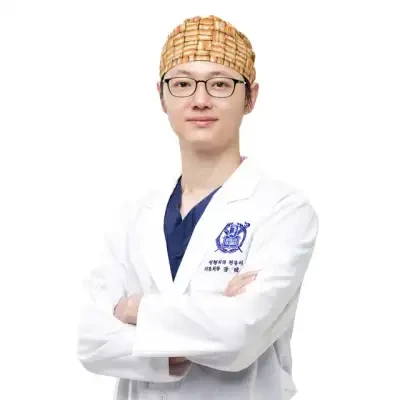
Care team at TJ Plastic Surgery ↗
Also listed as Dr. Tack Jin Chang
What does Dr. Tack-Jin Chang’s practice include?
Dr. Tack-Jin Chang is a plastic and reconstructive surgeon at TJ Plastic Surgery in Seoul. His published background includes medical and surgical training and craniomaxillofacial interests. The clinic lists V-line and other facial-contouring procedures. Ask which parts of the jaw or chin would change and whether each proposed addition is necessary for your goal.
Clinical role
Dr. Tack-Jin Chang’s professional page identifies him as a plastic surgery specialist practicing at TJ in Seoul. The clinic’s facial-contouring service includes V-line surgery. His broader aesthetic and reconstructive practice makes it useful to define the exact lower-face operation and the reason for each component during consultation.
A focused lower-face assessment
Explain whether your main concern is jaw width, a sharp angle, chin length, projection or asymmetry. Ask Dr. Chang how he would distinguish bone from muscle and soft tissue as the source of the appearance. Request an explanation of why the proposed technique addresses that cause and whether a smaller intervention would be sufficient.
Understanding a combined plan
If the proposal includes several facial procedures, ask for the V-line portion to be explained and priced separately. Discuss the additional recovery and anesthesia implications of combining operations. Ask which changes are essential for your stated goal and which are optional. You can choose to limit treatment even when several procedures are technically possible.
Preparation and review
Bring relevant dental history, previous facial-surgery records and a complete medication list. Ask how the final plan is confirmed after in-person examination and imaging. Request a written follow-up schedule, instructions for oral care and a contact route for concerns after returning home. Confirm who will assess healing before you leave Korea.
Education and international training
Dr. Chang’s biography lists Seoul National University College of Medicine, residency at Seoul National University Hospital and specialist training in plastic and reconstructive surgery at Seoul Asan Medical Center. It also records completion of an AOCMF craniomaxillofacial course and clinical training at Taichung Veterans General Hospital in Taiwan. The craniomaxillofacial element is particularly relevant to understanding his stated interest in facial skeletal surgery.
Aesthetic and reconstructive interests
His profile describes craniomaxillofacial and reconstructive interests alongside eyelid surgery, facelifts, neck and forehead lifting, thread lifting and fat grafting. This is a broader scope than V-line surgery alone. The distinction helps a patient understand why a consultation may discuss the skin, fat and skeletal framework separately. A proposed soft-tissue procedure should be explained as its own treatment rather than presented as another name for bone contouring.
Hospital leadership and professional societies
TJ lists Dr. Chang’s former leadership of plastic surgery at Gangneung Asan Hospital and previous director positions at The One and The Class Plastic Surgery. His professional biography also records full membership in the Korean Society of Plastic and Reconstructive Surgeons and the Korean Society for Aesthetic Plastic Surgery. These roles complement the training described above and distinguish hospital leadership, private-practice employment and society membership as separate parts of his background.
Facial-contouring services
TJ names Dr. Chang on its facial-contouring service page, which lists V-line surgery, square-jaw reduction, cheekbone reduction, protruding-chin surgery and chin augmentation. These are distinct operations with different purposes. Ask which, if any, addresses your own anatomy, which surgeon will perform it, and how your bite and nerve position affect the plan.
Sources & further reading
Planning a consultation from the United States
Confirm the role of the named care professional, the treatment you want assessed, and how the clinic handles records and follow-up after your return. The Korean qualifications and clinic location described here do not establish U.S. licensure, U.S. insurance participation, or care availability near your home.
Prepare your U.S. follow-up plan →