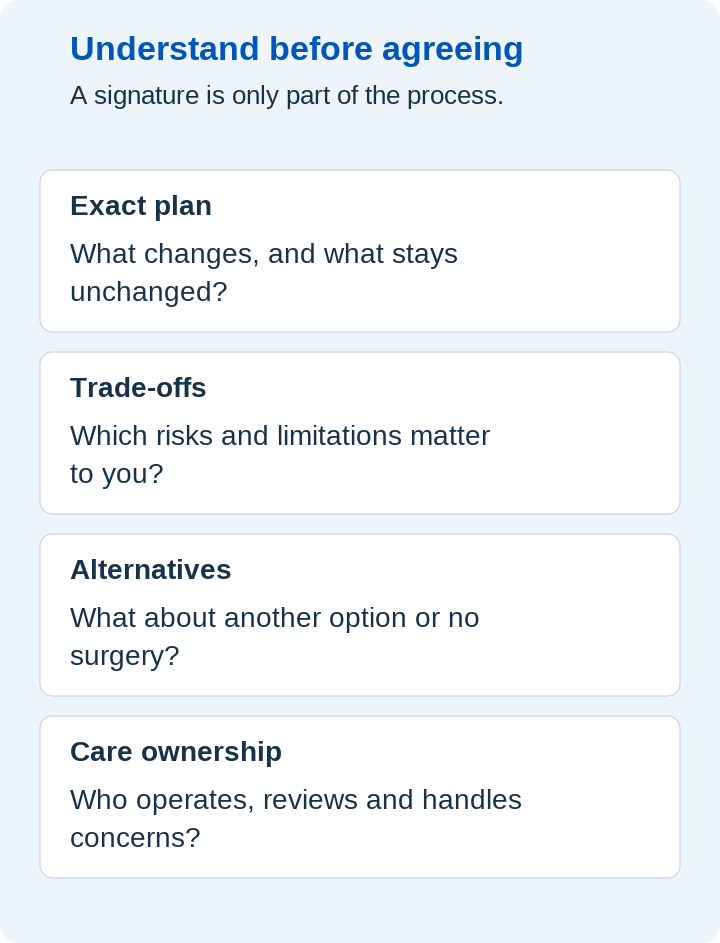
Consent begins with understanding, not a signature
Before agreeing to V-line surgery, you should be able to explain the actual operation, its intended benefits, meaningful limitations, important risks and reasonable alternatives. A signed form records part of that discussion; it cannot substitute for an explanation you understand. Ask for time to consider the information and for clarification whenever the plan remains vague.
When a procedure is added on consultation day
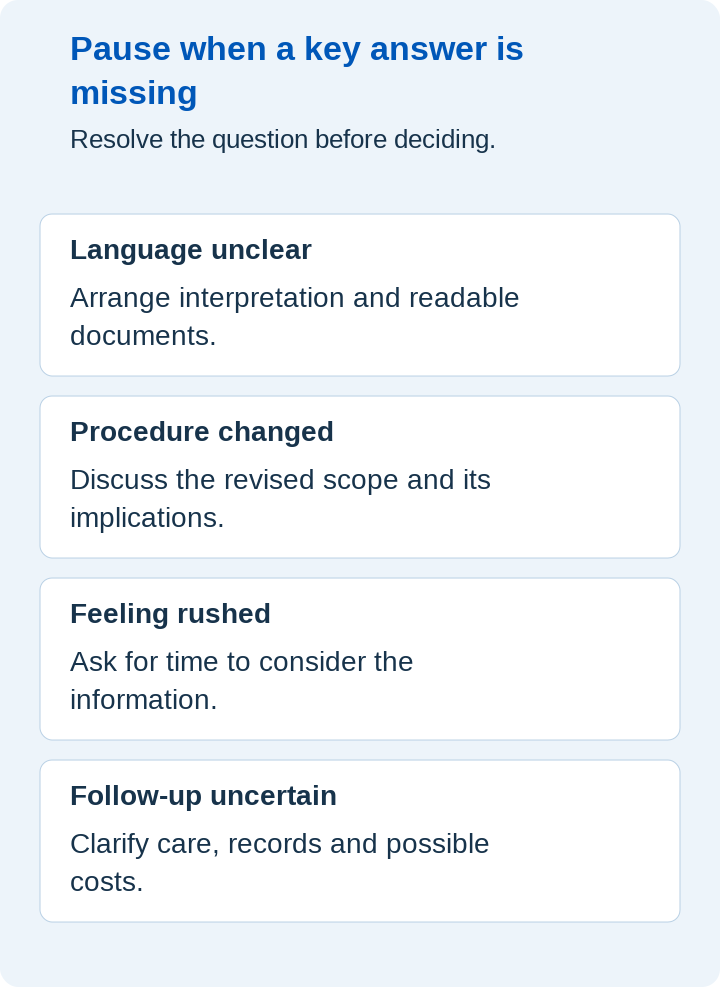
Ask the surgeon to write the additional procedure on the plan and explain which concern it is intended to address. Ask how it changes the risks, fees and follow-up, and what options remain if you decline it. If the new proposal affects your decision, take the revised plan away to consider. Ask for a copy in words you understand before agreeing to any change.
When the simulation looks closer to your goal than the surgeon expects
Ask the surgeon to point out one feature in the simulated image that they can plan on the bone and one soft-tissue change they cannot confidently predict. For instance, the virtual outline may look sharper under the chin even when the proposal addresses only the jaw angle. Explain whether you would still choose the operation if that particular detail stayed much as it is. Ask for the agreed procedure and its limits in words alongside the image, so that both of you are deciding about the same change.
Describe the change you would decline even if it were possible
Alongside the change you hope for, write down one change you would not accept. For example, someone may want a narrower jaw while wanting to preserve the projection of the chin in profile. Ask the surgeon to describe how each proposed step relates to those preferences, including what they cannot predict. Before signing, repeat the agreed scope in your own words and ask the team to correct any discrepancy between that account and the consent form.
This is a practical consultation guide, not a Korean legal opinion or a consent form. UK professional and patient resources offer useful decision-making principles, but their legal requirements and cooling-off arrangements should not be assumed to apply identically in Korea. Your consent discussion must concern your surgeon, procedure and circumstances. You can use the questions below to identify what still needs an answer before you make a decision.
Further reading: www.gmc-uk.org ↗ · www.nhs.uk ↗
Name each proposed procedure in plain language
V-line is a broad label, not a complete operative description. Ask which parts of the jaw or chin would be changed and what kind of change is intended. Clarify whether the recommendation concerns contour, position, width, height or projection, and whether the bite is expected to change. If several operations are offered together, ask why each is included rather than accepting the bundle as a single indivisible choice.
Keep a written summary in words you understand. A procedure name can be helpful, but it should sit alongside the explanation. If the surgeon's account differs from a coordinator's earlier message, ask for the discrepancy to be resolved. Do not treat a quotation heading, marketing name or simulated photograph as the final clinical plan. The scope you agree to should match the scope being explained.
Further reading: www.plasticsurgery.org ↗
Separate what you want from what the operation can deliver
Describe the concern in your own terms and explain what would make the change worthwhile to you. Ask the surgeon what the proposed operation is unlikely to improve and whether another issue needs assessment first. A front-view concern may not be addressed by a plan aimed chiefly at the side profile. A smaller jaw also does not automatically solve every concern about the skin, bite or facial balance.
Bring reference images only as a way to communicate preferences, not as an instruction to copy someone else's anatomy. Ask what the surgeon would decline to do and why. If the desired change is not realistically achievable, a useful consultation may lead to a different goal or no operation. Consent should reflect that discussion, not only agreement with the most appealing part of the proposal.
Further reading: www.plasticsurgery.org ↗ · www.nhs.uk ↗
Discuss the risks that matter to your decision
Ask about risks associated with your exact procedure, including bleeding, infection, changes in sensation, persistent pain, asymmetry, healing problems, dissatisfaction and the possible need for further surgery where relevant. Anesthesia requires its own assessment and explanation. Not every complication listed for chin surgery applies equally to every form of facial contouring, so ask the clinician to distinguish general risks from those specific to your plan.
Then explain which consequences would matter most to you. For someone whose work depends on speech or appearance, uncertainty about function or visible recovery may affect the choice differently than it does for another person. Ask how the team assesses your individual situation and what it cannot predict. A long list read quickly is less useful than a clear discussion of the trade-offs you actually need to weigh.
Further reading: www.plasticsurgery.org ↗
Ask for meaningful explanations of probability and uncertainty
If a clinician gives a complication percentage, ask what it describes: the same operation, a comparable patient group, and what kind of follow-up. Ask whether the figure reflects published evidence, the clinician's own records or an estimate. You do not need a perfect number for every possibility, but you should not be encouraged to treat an unsupported claim as a precise prediction.
Avoid the opposite trap of assuming that uncertainty makes discussion pointless. Ask what information could reduce it, what uncertainty remains even after assessment, and how the treatment plan accounts for that. A low-probability outcome may still matter greatly to you. Record the explanation rather than reducing the decision to a single success rate or a claim that complications never happen.
Further reading: www.gmc-uk.org ↗
Include alternatives and the option of no surgery
Ask what happens if you do nothing, postpone, seek another opinion or consider a less extensive intervention. Alternatives are not automatically equivalent: a nonsurgical option may address a different feature, have its own limitations or need repeat treatment. The question is whether it helps with your actual concern at a level of risk and commitment you find acceptable.
If the surgeon recommends against an option, ask for the clinical reason. If you are offered additional procedures, ask what problem each is intended to solve and whether the original plan still makes sense without them. A consultation fee, deposit or booked flight does not make an operation medically necessary. Keep the treatment decision separate from the disappointment or inconvenience of changing travel arrangements.
Further reading: www.nhs.uk ↗ · www.gmc-uk.org ↗
Check who will perform and supervise the care
Confirm the name and role of the operating clinician, who manages anesthesia, where the operation takes place and who provides the early reviews. Ask how you would be told if the team or facility changed. A provider directory can introduce people, but it does not establish who is assigned to your case or available on a particular date.
Use the consultation to ask the operating clinician questions directly. Administrative support is useful for logistics, but it should not be the only route for understanding a major surgical recommendation. If the surgeon cannot answer a question immediately, ask who can and how you will receive the response. Write down responsibilities in practical terms so that aftercare is not left as an assumed service shared by an unnamed team.
Further reading: www.nhs.uk ↗
Make interpretation part of the clinical discussion
If you and the clinician do not comfortably share a language, ask what qualified interpretation is available for the consultation and consent process. Clarify whether it covers medical discussion, documents and postoperative questions, not just reception or payment. Do not infer Japanese or Arabic support from an English-language website. Ask about availability, timing and any charge before arranging the visit.
Use short questions and ask to explain the answer back in your own words. An interpreter should help preserve the meaning of both your concern and the clinician's response, rather than replacing the conversation with a persuasive summary. Ask for unfamiliar procedure names and risk terms to be clarified. If you cannot understand a document, do not sign merely because you are told it is standard.
Further reading: www.nhs.uk ↗
Agree what happens if the plan changes
An examination or scan may change the recommendation before surgery. Ask to have the revised proposal explained, including why it changed and how the benefits, risks, recovery and cost differ. You should have an opportunity to consider a material change rather than discovering that an extra procedure has been added to the appointment schedule.
Also ask how the surgeon discusses the possible need for adjustments during an operation. The appropriate boundaries depend on the procedure and circumstances, and this article cannot define a legal rule for them. Your practical task is to understand the proposed scope and raise any limits or concerns before the day. Do not sign a broad description while assuming it excludes something that has not been discussed.
Further reading: www.gmc-uk.org ↗
Aftercare belongs in the decision before surgery
Ask when reviews are expected, who assesses urgent concerns and how care will continue after you return home. Clarify what information you will receive at discharge and how another clinician can obtain the operative details if needed. A messaging service is not the same as an arranged local examination, and a return visit to Korea may involve travel, accommodation and additional time away from work.
Ask how complications are assessed and which costs are included or excluded. Keep the clinical care plan separate from any financial promise about revision. An offer of reduced-cost or free revision does not establish that another operation will be appropriate or deliver the result you want. You need to understand both the practical follow-up pathway and its limits before making the initial decision.
Further reading: www.nhs.uk ↗ · www.cdc.gov ↗
Read financial and photography permissions separately
A treatment decision, payment terms and permission to use photographs can involve different questions. Read each document for its own purpose. Ask which photographs are required for clinical records and which permissions concern optional marketing or publication. Do not assume that agreement to an operation means you have agreed to every use of your image. Ask the clinic to explain the available choices and its policies.
Similarly, clarify deposits, cancellation conditions and additional charges without treating those terms as medical advice. This guide does not determine enforceability or promise a refund. If a contract term or a proposed use of personal information remains unclear, obtain the appropriate explanation before agreeing. Keep copies of the documents you actually accepted, including the version and date, rather than only an earlier promotional message.
Further reading: www.nhs.uk ↗
Give yourself a decision checkpoint
After the consultation, review the plan away from the pressure of the appointment. Can you describe the intended change, what will be left unchanged, the main risks you accept, the alternatives and the care arrangements? If you can recall the price and the target image but not those points, another conversation may be needed.
A useful checkpoint is a list of unanswered questions that could change your decision. Distinguish these from preferences that are already clear. You do not need to keep collecting opinions indefinitely, but you should not use a limited-time discount as the answer to a clinical uncertainty. Ask what time is available for reflection and what happens if you choose not to proceed. No universal Korean cooling-off duration is claimed here.
Further reading: www.nhs.uk ↗
Frequently asked questions about the consent appointment
Is signing a consent form enough? A signature does not show that an unexplained procedure has become clear. Use the discussion to understand the plan, then ask for an accurate record and copies of the documents.
Can I request another opinion? You can ask another qualified clinician to assess your concern and the proposed options. Share the same relevant history so that differences in recommendations can be discussed meaningfully.
What if I feel pressured after paying? Separate the clinical choice from the financial terms. Ask for the time and information you need, and clarify the consequences of postponing or declining without assuming an automatic refund.
Does a simulation become a promised result? It should be discussed as a planning or communication aid with limitations. Ask the clinician to explain those limits rather than assuming the picture guarantees the final appearance.
Further reading: www.gmc-uk.org ↗ · www.nhs.uk ↗
Use consent to make a decision, not to pass a test
You are not expected to master surgical anatomy or remember every technical term. The important outcome is a decision that matches a sufficiently clear understanding of the proposed care. Bring your questions, identify your priorities and tell the team when an explanation has not made sense. A companion can help remember the discussion, but your own preferences and understanding still matter.
If major uncertainties remain, ask what further consultation or assessment would resolve them. A considered decision may be yes, not yet or no. Each is more useful than a signature given because an itinerary feels difficult to change. Keep the agreed plan and follow-up details somewhere you can find them, and revisit the discussion if a material part of the proposal changes.
Clinics and doctors to explore
These listed providers were selected because their published services and named care teams relate to the questions in this guide. Use their profiles to prepare a consultation and confirm the proposed operation and follow-up.
Faceline Plastic Surgery
Faceline lists several facial bone-contouring approaches, making it relevant for discussing the exact scope, alternatives and limits of a proposed operation. Review its published service information and ask the assigned surgeon to explain the plan directly. Current availability and consultation arrangements must be confirmed with the clinic.
Explore Dr. Lee Jin-soo’s profile ↗
Review the international website and ask about consultation ↗Sinsa Oral & Maxillofacial Surgery
Sinsa lists both orthognathic and facial-contouring care, which is relevant when clarifying whether a recommendation concerns the bite, facial contour or both. Ask the operating clinician to distinguish the procedure choices and follow-up responsibilities. The website description is self-reported and is not an independent quality ranking.
Explore Dr. Ji-woong Jung’s profile ↗
Review the international website and ask about consultation ↗