The short answer: clearance should name the activity
There is no universal day when everyone can restart exercise after V-line surgery. The right plan depends on the operation, healing, symptoms and the activity's demands. Ask separately about everyday walking, cardiovascular exercise, resistance training, swimming and contact sport. Feeling energetic or looking less swollen does not by itself establish that the healing jaw is ready for loading or a blow.
Tell the surgeon how you get on and off the equipment
A gentle session on a stationary bike and cycling to work may feel equally easy on your legs, yet only one involves traffic, sudden braking and the chance of a fall. Describe the route or equipment, what touches your face and what you would do if you lost balance. Ask which part the restriction addresses: exertion, pressure on a healing area or a possible blow to the jaw. This gives you a practical answer about the activity you intend to do without treating approval for one setting as approval for another.
This guide helps you obtain a clear return plan, not a training prescription. It concerns cosmetic facial contouring; published instructions for corrective jaw surgery provide useful safety principles but cannot set your personal schedule. If exercise brings new bleeding, worsening facial pain or swelling, stop and contact the treating team. Chest pain, significant breathlessness, fainting or other severe symptoms need urgent medical assessment rather than a workout adjustment. The sources explain general medical principles, sometimes for related jaw operations. The questions, checklists and travel-planning suggestions here are original editorial aids, not protocols issued by those organizations.
Further reading: myoms.org ↗ · www.nhghealth.com.sg ↗ · www.nhs.uk ↗
Describe the activity precisely
Exercise is too broad a word for a useful postoperative instruction. Walking around the room, lifting weights, running, swimming and martial arts impose different demands. Tell the surgeon what you normally do, including intensity and any risk of a blow to the face. Ask which activities are permitted now, which require a review and which remain restricted longer. Do not assume that clearance for one category applies to all of them.
Further reading: myoms.org ↗
Avoid the all-or-nothing approach
A recovery period does not need to become a test of toughness or complete inactivity. Ask about appropriate gentle movement and how it fits with rest. If you usually train frequently, plan alternative ways to structure your day without replacing training with another demanding activity. Record instructions in ordinary terms you can follow. For example, a specific description of permitted walking is clearer than the vague phrase take it easy.
Further reading: myoms.org ↗
Do not use appearance as clearance
Reduced swelling does not prove that the operated tissues are ready for heavy exertion or impact. Equally, a visible contour change is not a reason to test jaw strength. Follow the surgeon’s criteria and review schedule. If your coach or trainer is involved, share the relevant restrictions rather than asking them to devise a medical progression. They can help adapt training only within the boundaries set by the clinical team.
Further reading: myoms.org ↗
Account for the environment
Gyms, pools, saunas and outdoor training introduce issues beyond exertion, including heat, crowds and the possibility of accidental contact. Ask about these settings separately. A tourist walking tour can also be physically demanding even when it is not described as exercise. Plan transport and rest options so that you are not forced into a long walk because it seemed manageable on a map.
Further reading: myoms.org ↗
Return with a review point
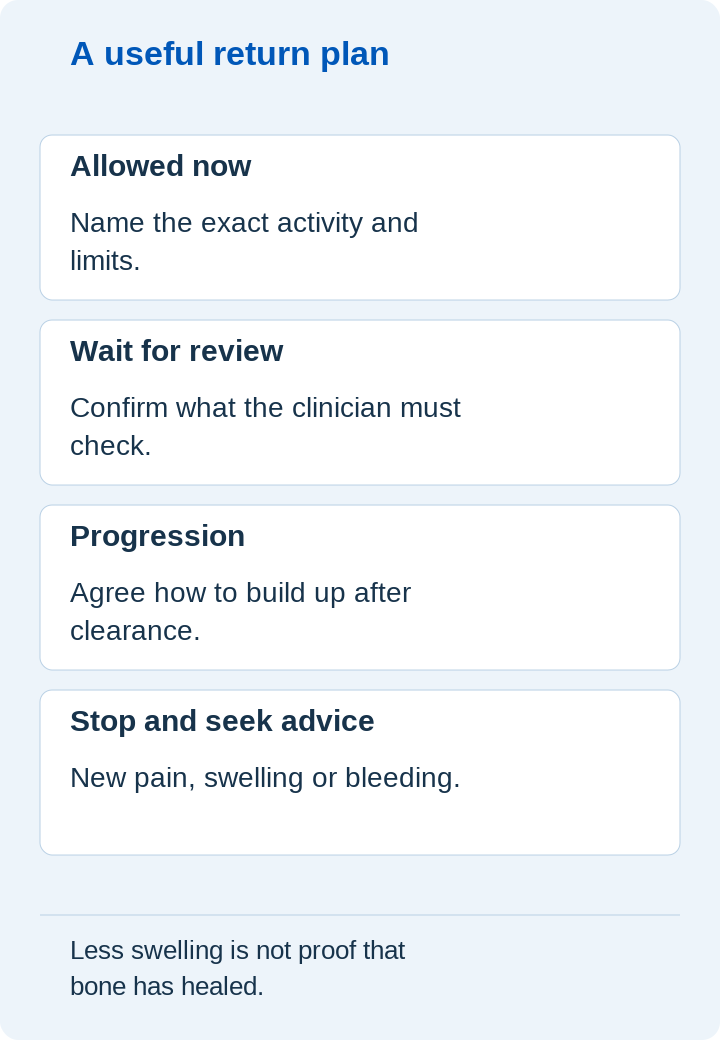
When activity is cleared, ask how to increase it and what symptoms mean you should stop and contact the team. Do not compensate for missed training with an intense first session. Keep contact sports and activities with fall risk on a separate decision pathway. The goal is a sustainable return to normal routines while respecting the operation performed, rather than reaching a fitness milestone before your next social event.
Further reading: myoms.org ↗
Bring a training example instead of a label
A statement such as I do light exercise may be interpreted differently by you and the surgeon. Describe a typical session: the movements, duration, resistance, pace and environment. Include yoga positions that place pressure on the face, cycling with fall risk and work-related exertion, even if you do not consider them sport. Ask the team to identify which parts must wait. If you receive permission to resume, share the limits with your trainer and arrange a review of the modified routine. Specific examples make it less likely that an apparently harmless activity falls outside the intended advice.
Further reading: myoms.org ↗
Find out which operation is setting the restriction
V-line is a description of a desired contour, not a single standardized operation. Your plan may involve the jaw angles, mandibular body, chin bone or several areas. Other procedures performed at the same time may add restrictions. Ask the surgeon to connect each limitation to what was actually done, including any osteotomy or fixation that is relevant to recovery.
A short explanation helps you avoid borrowing a schedule from someone who had a different operation. It also helps if a trainer asks why you can do one activity but not another. You do not need to interpret the scan yourself. You need a clear statement of permitted activity, what remains restricted, the next review point and who can update that advice. Keep this separate from a general marketing estimate of downtime.
Further reading: www.facelineplasticsurgery.com ↗ · www.mayoclinic.org ↗
Build a four-part activity list before the consultation
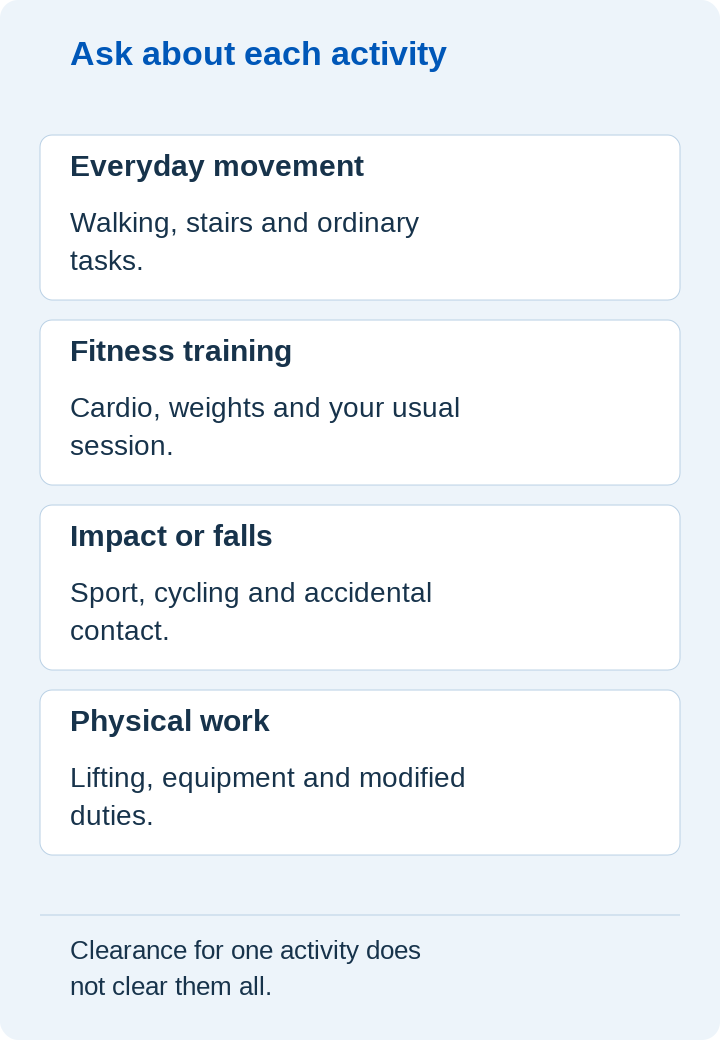
Make a list with four headings: ordinary daily movement, planned fitness sessions, activities with impact or fall risk, and physical work. Under each, describe what you actually do. An office worker who carries heavy camera equipment and a gym user who mostly stretches may need very different conversations, despite both describing themselves as moderately active.
Include movements that are easy to overlook: lifting a suitcase, carrying a child, bending during housework, cycling in traffic, inversions in yoga or dancing in a crowded venue. This list is a discussion aid, not a statement that every item is unsafe. Ask the clinician to sort the activities into permitted now, wait for review, and not yet. Write down any conditions rather than interpreting a vague answer such as light activity on your own.
Further reading: myoms.org ↗
Ask about daily mobility and clot prevention without self-prescribing
Surgery, reduced mobility and long journeys can increase the chance of a blood clot. Ask the clinical team for an individualized prevention plan and how appropriate movement fits with rest. This does not mean starting a vigorous walking target or taking aspirin or another blood-thinning medicine on your own. Prevention decisions must consider your operation and personal risk factors, including bleeding risk.
If you develop new one-sided leg pain or swelling, seek prompt medical assessment. Breathlessness or chest pain, particularly with leg symptoms, may indicate an emergency. Do not assume these symptoms are ordinary deconditioning. Tell the assessing clinician about the recent operation and travel. A return-to-exercise checklist cannot rule out a clot, and a fitness watch cannot replace evaluation of concerning symptoms.
Further reading: www.nhs.uk ↗
Do not confuse jaw rehabilitation with whole-body training
Some jaw operations require specific rehabilitation or guidance about opening the mouth. That does not authorize chewing exercises, forceful stretching or resistance work chosen from a video. Ask whether you need a particular rehabilitation plan and who will teach it. Cosmetic contouring and corrective jaw surgery may have different goals, and a program designed for another diagnosis may not apply.
If you notice stiffness, difficulty opening or a change in the bite, describe it to the surgical team instead of testing the jaw repeatedly. Ask what changes should prompt earlier review and how progress will be assessed. A trainer may help modify a general fitness routine after clinical clearance, but should not decide how to mobilize a healing jaw. Keep the instructions for facial movement and general exercise in separate parts of your recovery notes.
Further reading: myoms.org ↗ · www.mayoclinic.org ↗
Treat impact and falls as a separate decision
An activity can feel easy for your heart and lungs while still carrying a risk of a blow or fall. Ball sports, martial arts, climbing and outdoor cycling are examples to discuss specifically. A helmet or mouthguard does not automatically make an activity suitable during recovery, and protective equipment may itself contact the operated area. Ask whether equipment fit needs review.
Contact-sport advice in jaw-surgery leaflets can be much more restrictive than advice about gentle daily movement. That difference is a reason to ask for tailored clearance, not to select the shortest published waiting period. If an accidental blow occurs, contact the treating team or seek urgent assessment according to the symptoms. Report new pain, swelling, bleeding or a changed bite rather than waiting to see whether the next training session feels normal.
Further reading: www.nhghealth.com.sg ↗
Plan the first cleared session as a test of the plan, not fitness
When the surgeon permits an activity, ask what a sensible first session should look like and how progression will be decided. Clarify the allowed movements, effort and duration in terms you understand. If the advice is unclear, request an example based on your usual routine. Do not interpret one successful session as permission to return immediately to every previous exercise.
Choose an environment where you can stop easily and get help if needed. Tell your trainer the actual restrictions, not only the operation date. Avoid pressure to make up missed sessions or meet a competition deadline. A useful record notes the activity and any symptoms so the team can discuss the next step. It is not a challenge to increase a number every day regardless of how recovery is going.
Further reading: myoms.org ↗
Account for tourism, transport and work
A day of sightseeing may include stairs, heat, crowds and more walking than a planned gym session. A return journey can involve luggage, long queues and rushing through an airport. Ask about the total demand, not simply whether you are allowed to walk. Arrange transport, help with bags and places to rest so you can follow restrictions rather than being forced to abandon them.
Physical work may need a staged return even if social activities are manageable. Give the clinician concrete examples of lifting, bending, speaking, driving or work around moving equipment. Discuss modified duties with your employer using only the health information you choose to share. A flight date, paid booking or work deadline should not become the test of whether the tissues have healed enough for an activity.
Further reading: www.cdc.gov ↗
Questions to settle before returning to your usual routine
Ask whether clearance applies only to one activity or to an entire category. If the team says you can start exercising, ask specifically about weights, swimming, contact and fall risk. Confirm whether another examination is needed before progressing and who to contact after you return home. Keep the answer with the discharge record so it is not lost among travel messages.
Common questions include: Does reduced swelling mean I can lift weights? No; use the activity-specific clinical decision. Can I follow my friend's timetable? No; the operation and healing may differ. Should I train through new facial symptoms? Stop and obtain advice. Is there a fixed deadline for getting my fitness back? Recovery is not a competition. The aim is a durable return to valued activities while avoiding an unnecessary setback.
Further reading: myoms.org ↗ · www.nhghealth.com.sg ↗
Clinics and doctors to explore
These listed providers were selected because their published services and named care teams relate to the questions in this guide. Use their profiles to prepare a consultation and confirm the proposed operation and follow-up.
Faceline Plastic Surgery
Faceline lists facial bone contouring techniques affecting the jaw and chin. Use a consultation to connect the exact proposed procedure to your sport, work demands and activity-specific follow-up rather than accepting a generic downtime estimate. The service and doctor information are provider self-reports, not an independent quality ranking.
Explore Dr. Lee Jin-soo’s profile ↗
Review the international website and ask about consultation ↗