How long does V-line recovery take?
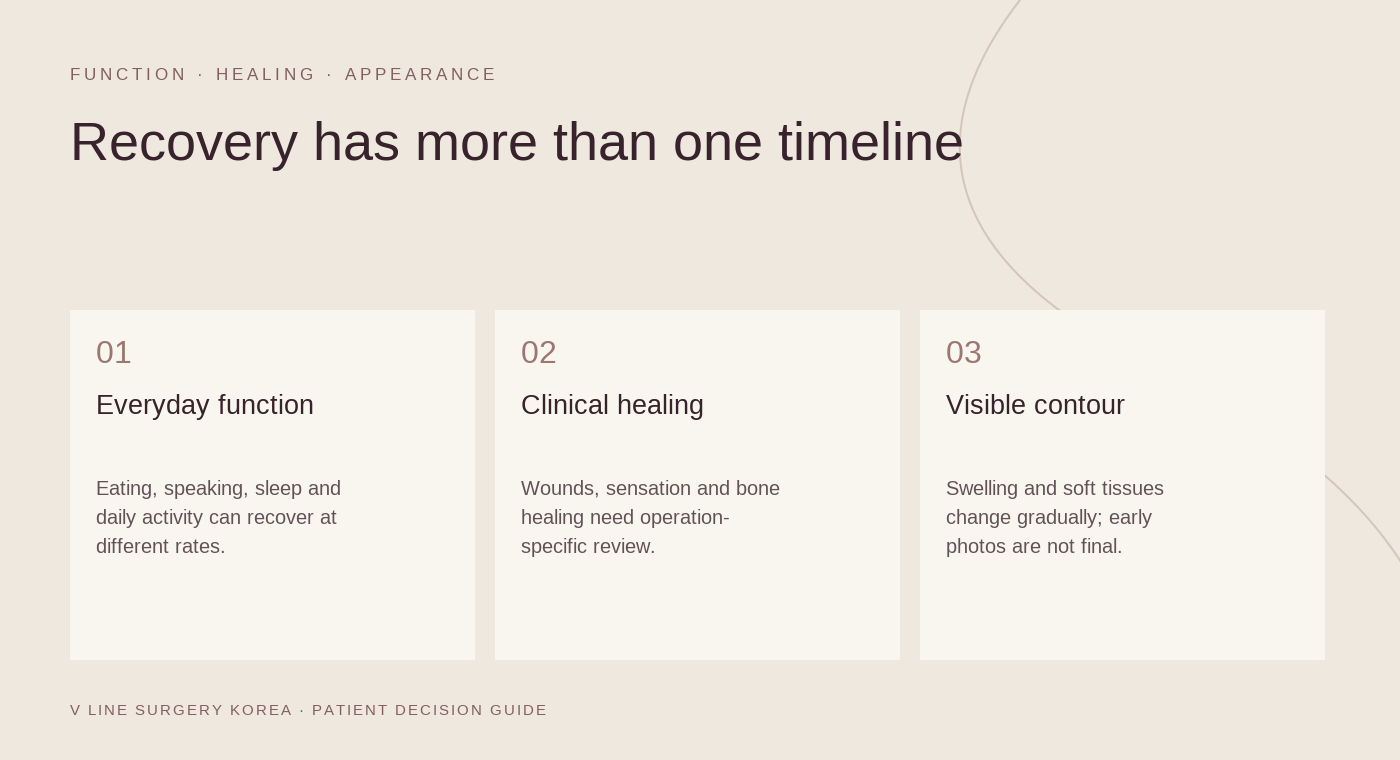
A useful V-line surgery recovery timeline has several finish lines: leaving supervised care, managing daily needs, returning to particular activities, traveling home and assessing the settled appearance. These do not happen together. Your operating surgeon must set the clinical milestones for your procedure and update them after examination. A hotel package or another patient's photographs cannot supply that assessment.
Use this guide to turn an estimate into a workable calendar. Its purpose is to help you ask precise questions and organize support, especially when traveling to Korea from the United States, United Kingdom or Australia. Keep the instructions issued by your own team alongside the calendar. Where they differ from a general article, ask the team to explain your specific plan before changing anything.
Start with the procedure actually planned
V-line describes an aesthetic goal and can involve different combinations of lower-jaw contouring and chin surgery. Ask the surgeon to name each proposed operation and explain what it changes. A chin reduction and a procedure that repositions the chin need not have identical instructions. If additional facial operations are proposed, ask how they affect observation, eating, appointments and your ability to manage independently.
Orthognathic surgery addresses jaw position and the bite; it is not interchangeable with cosmetic jaw contouring. Hospital information about jaw surgery can explain broad recovery issues, but its diet or activity timetable should not be copied onto a different operation. Put the exact procedure names at the top of your recovery document, and have the team correct them after surgery if the final operation differs from the plan.
Further reading: www.plymouthhospitals.nhs.uk ↗ · vgprsglobal.com ↗
Separate healing, daily function and appearance
Think of your calendar as three parallel tracks. The clinical track contains examinations and permissions. The function track records tasks such as preparing meals, concentrating on work and traveling to appointments. The appearance track contains your concerns about swelling and social confidence. Improvement in one track does not automatically clear the others.
Hospital jaw-surgery guidance describes variable discomfort, swelling and altered sensation, with some swelling persisting beyond the early recovery period. This helps explain why a single photograph is a poor measure of readiness. It does not predict your individual course after contouring. At a review, describe what you can do and what has changed rather than asking only whether you look normal. Ask which observations are expected, which need examination and when the next meaningful assessment should occur.
Further reading: www.plymouthhospitals.nhs.uk ↗
Before booking: make the itinerary conditional
Request the proposed appointment sequence before buying inflexible travel. For each visit, ask its purpose, who performs the assessment and whether your presence is essential. Distinguish an administrative booking from medical permission: an appointment can be scheduled on a date even though its outcome remains uncertain.
Create an expected itinerary and an extension plan. The extension plan should name an accommodation option, the person who can change flights, the effect on your companion and the work commitments that can move. Check cancellation terms while you are still comparing choices. Do not use every available day for appointments, airport transfers or sightseeing. Leave practical room for a changed plan. If your available leave cannot accommodate the surgeon's proposed follow-up, discuss postponing the operation before making financial commitments.
Further reading: www.nhs.uk ↗
The first milestone is an understood care plan
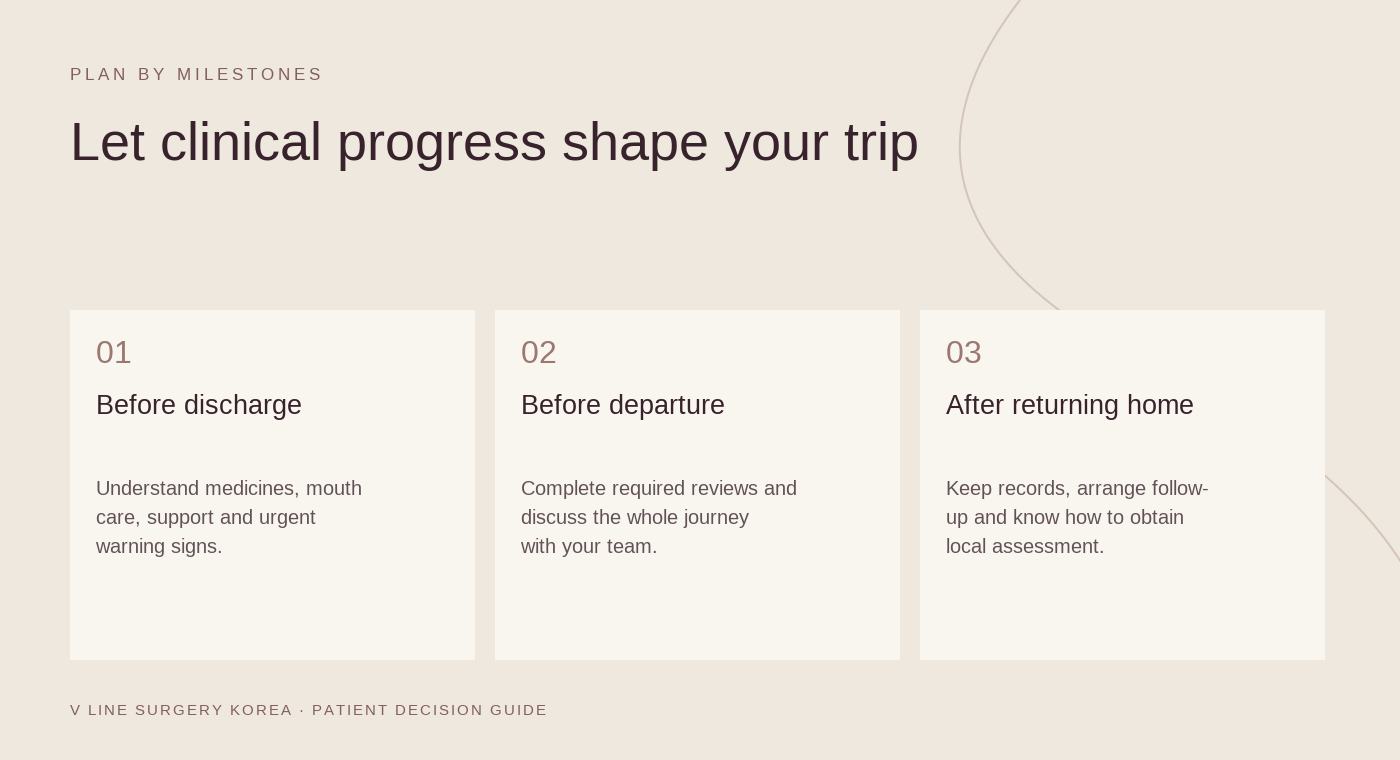
Before discharge, ask the team to confirm where you will recover and what support you require. Record the permitted food and drink, medication instructions, oral-care routine, activity restrictions and next review. Have the instructions available in a language you understand. With your permission, a companion can keep another copy and help you follow the arrangements.
The planning question is whether each essential task has an owner. Who collects prescriptions? Who obtains suitable meals? Who helps you reach the clinic if speaking is uncomfortable? Who responds outside office hours? Avoid leaving these decisions until you are tired after surgery. Our separate first-night guide covers the immediate handover in more detail; here, reserve that period in your calendar for care and support rather than discretionary commitments.
Further reading: www.rcseng.ac.uk ↗
Eating and self-care need their own review points
Ask for a procedure-specific description of the initial diet and the criteria for progression. Request examples of suitable textures rather than relying on words such as soft, which different people interpret differently. Plan how to obtain the foods your team permits before surgery, including a backup if a preferred delivery service is unavailable. Discuss allergies and dietary restrictions at the same time.
Do not treat less discomfort as permission to advance chewing. Ask when oral hygiene, mouth opening and any prescribed supportive items should be reviewed. Have the team demonstrate unfamiliar care steps and explain what to do if you cannot manage them. The calendar entry should say what needs confirming, not simply record a guessed day for eating normally. This keeps food planning connected to the operation rather than to social meals you hope to attend.
Further reading: www.plymouthhospitals.nhs.uk ↗
Write a milestone worksheet that supports decisions
Use five columns: activity, planned review, condition for permission, person confirming it and consequence of delay. Give eating progression, independent daily care, work, exercise and international travel separate rows. Fill in the clinical conditions with your surgeon rather than inventing your own tests. Keep a space for the date the advice was last updated.
For example, your practical consequence of a delayed review might be changing a hotel checkout or moving an important meeting. Recording that consequence helps you prepare without predicting a complication. At each appointment, ask the team to identify what remains restricted and when it will be reconsidered. An instruction that still applies should stay visible even when other rows have been cleared. The worksheet is a communication aid, not a substitute for an examination.
Budget for recovery as part of treatment
Ask for a written account of what postoperative appointments, medicines and additional assessments cost, and what happens financially if the stay becomes longer. Separate ordinary travel expenses from treatment charges so that you can see the effect of an extra night, a replacement flight or an additional companion. Clarify who pays for unexpected care rather than assuming a package includes it.
Insurance needs specific checking. Australian government guidance warns that standard travel policies commonly exclude elective treatment and related problems. Ask the insurer about your planned procedure, complications and evacuation, and retain the written answer. Patients traveling from any country should verify their own policy terms. A contingency budget cannot remove medical risk, but it can make a necessary change less dependent on finding money at short notice.
Further reading: www.rcseng.ac.uk ↗ · www.smartraveller.gov.au ↗
Plan a gradual return to responsibilities
List responsibilities by their demands. A workday may include lengthy conversations, commuting and concentration even when no lifting is involved. At home, childcare, shopping and carrying luggage can require more help than answering email. Ask about those actual tasks when discussing restrictions. Our return-to-work guide explores workplace planning separately.
Schedule only commitments you can change until the team has reviewed you. Agree in advance who covers urgent tasks if you need longer away. For a major event, distinguish being medically able to attend from feeling comfortable with your appearance; neither can be guaranteed by a booking date. Keep recovery updates private if you prefer, while giving employers or family the practical information they need. You can explain that a medical review determines the next step without sharing every detail of your procedure.
Departure is a handover, not the end of recovery
Before leaving Korea, request the operative information, discharge summary, medication list and follow-up instructions needed by clinicians at home. CDC guidance highlights the importance of obtaining medical records for continuity of care. Arrange the next clinical contact before departure and ask which concerns require a local examination rather than a remote message.
Your operating team should consider your actual journey when assessing readiness. Keep the flight decision separate from an accommodation deadline. Bring the full itinerary to the review and use our flying-after-V-line guide for travel-specific questions. For patients returning to the US, UK or Australia, agree who can provide local follow-up and how it will be paid for; do not assume an overseas package automatically creates a local care arrangement. Save contact details somewhere accessible if your usual messaging app fails.
Further reading: www.cdc.gov ↗
What if recovery does not match the estimate?
Ask for the reason behind a changed plan and the next decision point. A longer stay may be recommended for an assessment or continued observation; understand what the team needs to establish. Revise your support arrangements at the same time. A companion's original flight date does not determine whether you can safely manage alone.
Keep a short record of symptoms and their direction of change, together with questions for the next review. Follow the escalation instructions supplied at discharge. Do not wait for a scheduled appointment when the team has told you a symptom requires earlier assessment. If you cannot reach the clinic and feel acutely unwell, obtain local medical help. Online reassurance and comparison photographs cannot establish whether an unexpected change is harmless. Recovery planning should make it easier to obtain assessment, not require you to diagnose yourself.
Further reading: www.rcseng.ac.uk ↗
A relevant clinic and doctor to discuss your plan with
Verygood Plastic Surgery and Dr. Im Young-min are listed in V Line Surgery Korea. The clinic's international website identifies Dr. Im as its chief director and includes facial contouring among his areas of practice. These published service and affiliation details make them a relevant option for a consultation about a proposed jaw-and-chin procedure and its recovery requirements.
Review the clinic and doctor profiles, then use the international website to ask who would perform your operation and how the postoperative pathway would be tailored to it. Bring your milestone worksheet, travel constraints and questions about care after returning home. Selection here is based on the listed facial-contouring service and named surgeon affiliation, rather than a comparison of outcomes. A consultation should establish suitability and the necessary recovery arrangements before you decide whether to proceed.
Further reading: vgprsglobal.com ↗
Clinics and doctors to explore
These listed providers were selected because their published services and named care teams relate to the questions in this guide. Use their profiles to prepare a consultation and confirm the proposed operation and follow-up.
Verygood Plastic Surgery
The clinic lists facial contouring and identifies Dr. Im Young-min as chief director with facial contouring among his practice areas; a relevant consultation for a procedure-specific recovery plan.
Explore Dr. Im Young-min’s profile ↗
Review the international website and ask about consultation ↗