Breathing or swallowing difficulty, rapidly increasing facial or neck swelling, or severe uncontrolled bleeding: seek emergency care immediately. In South Korea call 119.
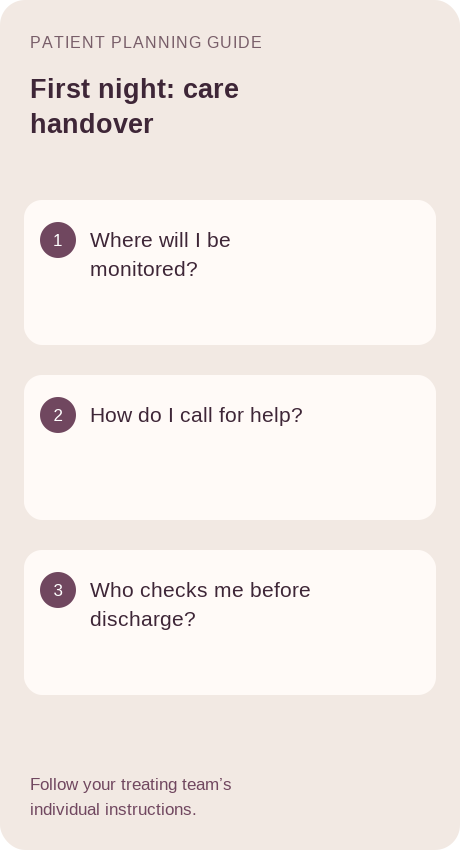
What happens on the first night after V-line surgery?
The first night is a period of recovery and observation, not a deadline to look or feel normal. Your team should tell you where you will recover, who is responsible for monitoring you, and how to summon help. The exact plan depends on the operation, your health and how you respond to anesthesia. You might have jaw-angle contouring, chin bone surgery, or another combination; do not assume that a stranger’s postoperative diary describes your care.
Oxford University Hospitals describes recovery-area monitoring after corrective jaw surgery, including pulse, blood pressure, temperature and pain, followed by transfer once stable. That is evidence about its own jaw-surgery pathway, not proof that every V-line clinic has the same staffing, facilities or length of stay. Ask for your own written plan before booking. If breathing or swallowing becomes difficult, seek emergency help immediately; do not wait for a routine clinic message.
Further reading: www.ouh.nhs.uk ↗ · www.cuh.nhs.uk ↗
Before the operation: establish who is watching over you
Ask whether you will remain in a clinical facility overnight, who will assess you, and how you alert staff if you cannot speak comfortably. Clarify the qualifications and availability of overnight staff, how often observations are made, and whether a clinician can examine you urgently. Ask who makes the decision to transfer you if a complication exceeds the facility’s resources. A hotel with a companion is not the same as a staffed clinical recovery area.
Ask for answers specific to your procedure rather than assuming that every patient is admitted for a fixed number of nights. If the proposed plan changes because of an unexpected finding, ask how you or your companion will be told. A responsible team may decide you need longer observation; a departure booking should not override that clinical decision. Before payment, understand whether additional clinical observation or a transfer could create extra charges, without letting a payment question delay emergency treatment.
Further reading: www.ouh.nhs.uk ↗ · www.cdc.gov ↗
Waking up and communicating discomfort
People can feel groggy, thirsty, nauseated or disoriented after anesthesia. You may have a sore throat, altered sensation around the mouth and difficulty opening widely. Staff need to know about symptoms rather than guessing from your appearance. Agree on a simple way to ask for help: a call bell, writing on a phone, a paper card or a companion who knows how to alert the team. If you need an interpreter, confirm availability for both routine discussion and unexpected overnight problems.
Report pain, nausea, dizziness, trouble swallowing or a change in breathing promptly. Do not try to walk unassisted while dizzy. Ask staff when you can safely sit up, stand or use the bathroom, and what assistance is available. The goal is not to tolerate worsening symptoms silently. Explain any allergies, previous anesthesia problems and medicines before surgery; check that the handover has reached the recovery team.
Further reading: www.ouh.nhs.uk ↗ · www.nhs.uk ↗
Swelling, tightness and symptoms that need immediate help
Some swelling and tightness are expected after jaw and chin operations, and their amount varies. A face that looks swollen is not by itself a diagnosis. Ask the treating team what they expect for your operation and what change needs an immediate examination. Do not rely on a photograph or a general recovery timeline to decide that progressive swelling is harmless.
Breathing difficulty, inability or increasing difficulty swallowing, rapidly increasing swelling of the face or neck, significant ongoing bleeding, collapse or fainting require immediate emergency assessment. If you are in a clinical facility, alert staff immediately; if you are elsewhere, call local emergency services rather than waiting for an online reply. In South Korea the emergency ambulance number is 119. Tell responders that you recently had facial bone surgery. If symptoms are severe, do not travel alone or drive yourself. Your discharge instructions should explain the route to care, but never postpone emergency care while looking for a telephone number.
Further reading: www.asph.nhs.uk ↗ · english.visitkorea.or.kr ↗
Drinking and food: get an individual instruction
Ask the team when it is safe to drink and what form of food is permitted. Oxford’s corrective jaw-surgery leaflet describes water after team review and a gradual return to liquidised or soft food, with variation between patients. V-line operations and discharge instructions differ, so those examples are not a universal diet or permission to drink before your own team says you can.
Tell the nurse if you cannot manage fluids, cough or choke when drinking, keep vomiting, or feel too nauseated to take prescribed medicine. Difficulty swallowing can be serious and needs immediate assessment, particularly if breathing is affected. Ask how to take medicines in the form prescribed, how to record intake if requested, and whom to contact if you cannot drink enough. Do not force a texture, a straw, a syringe or an oral rinse that your surgeon has not approved. A companion can help communicate what you have managed but should not substitute for clinical assessment.
Further reading: www.ouh.nhs.uk ↗ · www.cuh.nhs.uk ↗
Pain control and medicines
Before leaving the monitored area, ask for a written medicine list showing the name, strength, dose, timing, purpose and a contact for side effects. Check whether a brand name differs from the name used in your home country. Ask how to take the next dose if nausea occurs and what to do if pain is not controlled. Keep the instructions and packaging together and let a trusted companion know where they are.
Take only medicines as directed by your own clinicians. Do not add a painkiller, sleeping pill, supplement or alcohol simply because another patient used it; interactions and bleeding risks vary. Do not restart or stop a prescribed blood thinner without instructions from the appropriate prescriber. If you develop breathing problems, severe drowsiness, a widespread reaction or another alarming symptom, seek immediate emergency assessment rather than waiting to discuss the next dose.
Further reading: www.cuh.nhs.uk ↗ · www.nhs.uk ↗
Mouth care, bleeding and a practical handover
Incisions may be inside the mouth and the mouth may feel uncomfortable or numb. Ask exactly when and how your team wants you to clean your mouth and teeth, whether a rinse is prescribed, and what not to disturb. Oral-surgery instructions differ by operation. Do not infer that instructions for a tooth extraction apply unchanged to bone contouring. A small amount of blood-stained saliva can occur after some mouth operations; ask your team what is expected for you and report ongoing or increasing bleeding.
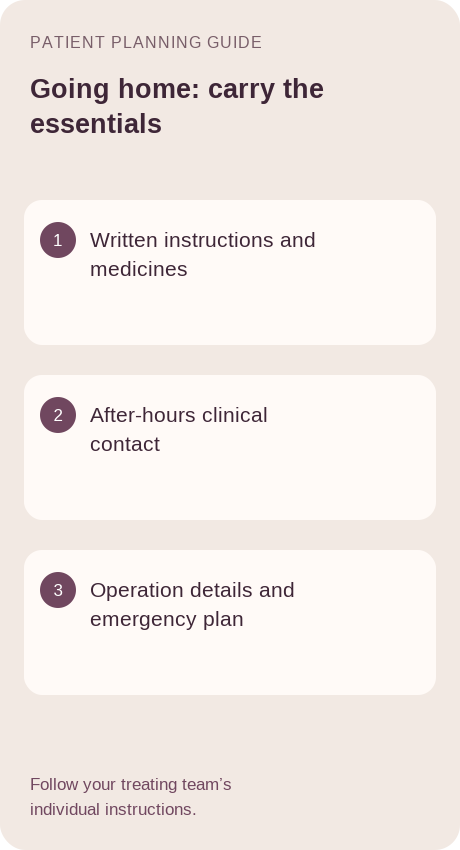
A collection of blood can also develop in tissue, so a lack of visible bleeding does not exclude a serious problem. Rapidly increasing swelling, trouble swallowing or breathing, or heavy or uncontrolled bleeding needs immediate emergency assessment. Follow the team’s procedure-specific instructions while arranging help; do not delay emergency assessment for a self-care experiment. Before discharge, demonstrate how you will contact the clinical team after hours and ask what to do if they do not answer.
Further reading: www.asph.nhs.uk ↗ · pmc.ncbi.nlm.nih.gov ↗
What should a companion do?
A companion can keep your phone charged, help retrieve your written instructions and relay changes to staff. They should know the operation date, clinic and surgeon name, allergies if you choose to share them, and the emergency plan. Agree on a way to communicate if speaking is uncomfortable. Ask whether they may stay with you in the clinical facility and whether interpretation is available if urgent decisions arise.
A companion is not a replacement for nursing care, a clinician’s examination or emergency transport. They should not judge that new breathing or swallowing difficulty is simply normal swelling, administer unprescribed medicine, or leave you waiting for an online response. Make a plan for the possibility that your companion’s availability changes or you need to remain in Korea longer than planned. Give them only the information needed for your care and respect your own privacy preferences.
Further reading: www.cdc.gov ↗
The discharge conversation and your first night outside the clinic
Ask who decides that discharge is appropriate and what needs to be checked. Discuss pain and nausea control, your ability to drink, mobility, the wound, medicines and the next review. Ask where you will stay, how to reach a suitable emergency department and how to communicate after hours. If anything is unclear, request an interpreter or written explanation before leaving. Do not assume that discharge guarantees there can be no complication later.
Keep your operation summary, medication list, allergy information, clinic contact and follow-up appointment details together. Ask for a copy in a language you and a future treating clinician can use. The CDC advises medical travelers to obtain copies of medical records and disclose procedures when seeking later care. Ask how to obtain the operative report and imaging, not merely a cosmetic photograph. The clinical team should decide whether you are ready for travel; the date on a ticket is not medical clearance.
Further reading: www.cdc.gov ↗ · www.ouh.nhs.uk ↗
Questions to take to your consultation
Before committing to surgery, ask: Where will I spend the first night and who is present? How will I summon help? What will you monitor, and who can assess me at night? Which symptoms require immediate emergency care? Where would I be transferred, and how would the transfer be arranged? Can my companion stay and will interpretation be available?
Also ask when you expect to review my drinking, pain, wound and discharge readiness; what happens if I need longer observation; and how I can obtain written instructions and records. Request an itemized explanation of care included in the quote. If an answer is vague, ask for a specific written pathway before deciding. It is reasonable to postpone or choose not to have an elective procedure if you cannot establish a plan that meets your needs.
Further reading: www.ouh.nhs.uk ↗ · www.cdc.gov ↗
Common questions
Will everyone stay overnight? No single length of stay applies to all procedures or patients. Ask your surgeon what is proposed and what might change that plan. Is swelling on the first night proof of a complication? Not necessarily, but a general article cannot assess the cause. Report a concerning change; rapidly increasing swelling or breathing or swallowing difficulty warrants emergency assessment.
Can I sleep alone after discharge? Ask the treating team based on your condition, medication and accommodation. Arrange the support they recommend and a reliable way to get help. Can I fly the next day if I feel well? A feeling of wellness is not clearance. Ask the surgeon about in-person reviews and the entire journey, and allow for a change in travel plans. This guide is educational and does not replace your own team’s instructions.
Further reading: www.ouh.nhs.uk ↗ · www.cdc.gov ↗
Clinics and doctors to explore
These listed providers were selected because their published services and named care teams relate to the questions in this guide. Use their profiles to prepare a consultation and confirm the proposed operation and follow-up.
TJ Plastic Surgery
TJ lists facial contouring including V-line surgery. Ask its team where you would be observed, who would be available overnight and how discharge is decided.
Explore Dr. Tack-Jin Chang’s profile ↗
Review the international website and ask about consultation ↗