What can I eat after V-line surgery?
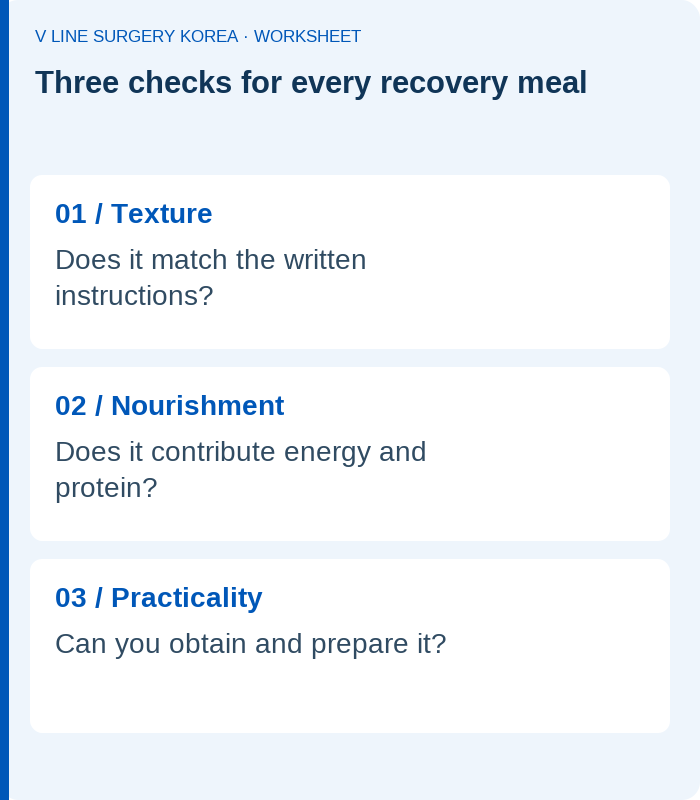
Follow your surgeon’s written texture and chewing restrictions; liquid, pureed, soft and no-chew diets mean different things. Choose tolerated meals that provide energy and protein, and ask when progression is permitted. Plan suitable food for travel too. Persistent difficulty meeting food or fluid needs warrants clinical advice.
Get the texture instructions in writing
Liquid, pureed, soft and no-chew diets are not interchangeable terms. Ask your surgeon to define the permitted texture, whether chewing is allowed and what must happen before you progress. A plan for jaw repositioning may be more restrictive than one for isolated contouring, but that does not mean you can choose your own schedule. Request examples of acceptable meals and ask about foods that commonly cause confusion, such as noodles, rice, eggs and blended soups.
Plan nourishment rather than a cleanse
Recovery meals should support nutrition rather than rapid weight loss. A drink that is easy to swallow may still provide very little energy or protein. Build a menu of foods you already tolerate and discuss dietary restrictions with the team. If you have diabetes, kidney disease, food allergies or another condition that affects your diet, obtain individualized advice. Commercial supplements are not automatically necessary, and a social-media recovery menu may not meet your needs.
Further reading: www.uhb.nhs.uk ↗
Solve the equipment problem in advance
Find out whether your accommodation has a refrigerator, kettle or blender and whether appliances are permitted. If you intend to buy prepared food, check ingredients and texture before the operation. Small portions may be easier to organize than large meals, especially when appetite is low. Ask which utensils or drinking methods are appropriate for you. Do not assume a straw or feeding syringe is suitable simply because it appears in another patient’s video.
Progress by permission, not impatience
Feeling hungry for ordinary food does not establish that the surgical area is ready for it. At reviews, ask specifically what can be added and what remains restricted. Keep a short record of foods you manage comfortably and any difficulties. If eating becomes more difficult rather than gradually easier, tell the clinic. Persistent inability to meet fluid or food needs deserves assessment; it should not be treated as a desirable part of slimming the face.
Prepare for the journey home
Check whether suitable meals will be available during airport transfers, waiting periods and the flight. Airline meals may not match your prescribed texture even when labeled soft or special. Clarify what you may carry through the relevant security process and arrange permitted alternatives. Keep the clinic’s dietary instructions available for your companion. Once home, continue the same plan until the treating team changes it rather than treating the end of the trip as the end of restrictions.
Take a sample menu to your review
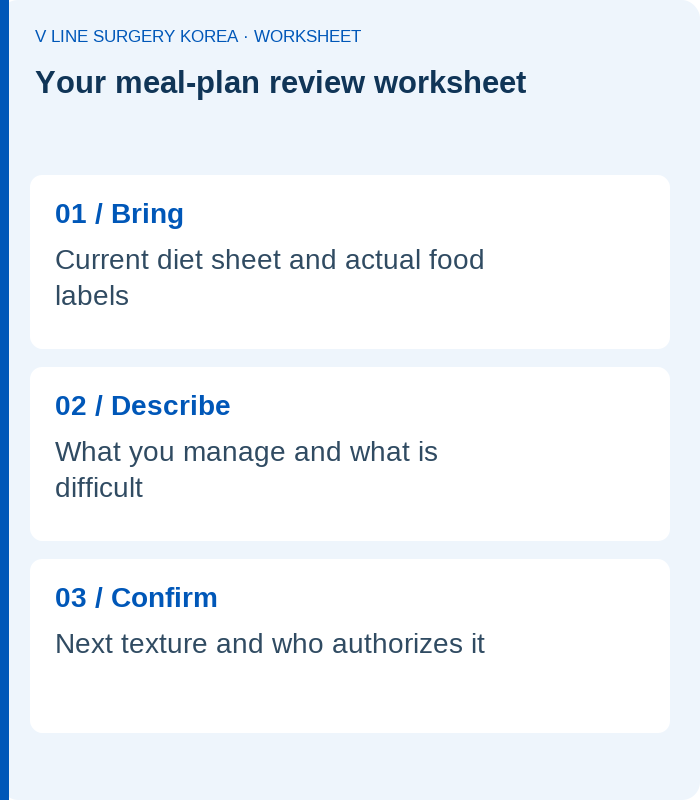
Write out a typical day of meals, including ingredients and texture, and ask the team to identify anything unsuitable. This is more concrete than asking whether you can eat normally. Include drinks, snacks and any nutritional products, because these may contribute much of your intake during a restricted diet. If your weight is changing unexpectedly or you are struggling to obtain enough nourishment, say so. Ask whether a dietitian should review the menu. The purpose is to make the prescribed plan achievable with foods you can actually obtain, not to create a universal meal plan for every facial contouring patient.
Why a universal week-by-week menu can mislead
V-line is a description of a desired contour, not a standardized operation. A plan involving jaw-angle reshaping may differ from one involving a chin osteotomy or additional jaw repositioning. Published hospital leaflets often address orthognathic surgery, where the purpose and bone movements differ from cosmetic contouring. Those leaflets are useful for understanding meal preparation, but their dates should not become your personal permission to chew. Get instructions that name your actual procedures.
Ask the team to write the starting texture, any restriction on chewing, the next review and the person who can authorize a change. If two staff members seem to give different advice, request clarification before choosing the less restrictive version. Keep a single current copy and mark when it was updated. Your companion can then use the same instructions when buying food. A timetable in a video may describe another operation, another recovery course or simply a patient's personal choice rather than clinical guidance.
Further reading: www.baoms.org.uk ↗
Separate food texture from nutritional value
Think of two questions for every meal: does it meet the prescribed texture, and does it contribute useful nourishment? A smooth drink can be low in energy and protein. Conversely, a nutritious food may still be unsuitable if it contains pieces that require chewing. Neither question cancels the other. Hospital jaw-surgery information emphasizes nourishment during recovery; it is not an invitation to replace every meal with juice or to use the restricted diet as a weight-loss program.
Build a short list of familiar foods and ask a dietitian or your team how they can fit the instructions. Depending on your individual restrictions, ingredients such as dairy foods, eggs, tofu or blended beans may be worth discussing as sources of protein. These are possibilities to review, not a prescribed menu. Food allergies, lactose intolerance, diabetes, kidney disease and other conditions may change what works. Bring the label of any meal-replacement drink you intend to use rather than assuming that the word protein means it is nutritionally complete.
Further reading: www.uhb.nhs.uk ↗
Turn the instructions into a one-day meal worksheet
Before surgery, write down breakfast, lunch, dinner and any smaller meals or snacks you normally prefer. Beside each, leave space for the allowed texture, ingredients, preparation method and a backup. Ask the team to review the uncertain entries. A specific question about a familiar food is easier to answer than asking whether all Korean food is allowed. Include drinks and supplements so the reviewer sees what you expect to consume across the whole day.
Use the worksheet to identify practical gaps. Perhaps every acceptable choice requires a blender you do not have, or all your planned protein sources contain an ingredient you avoid. Solve those issues while you feel well enough to shop and compare labels. Make a trial portion if useful, without presenting the result as automatically approved for after surgery. Check taste and preparation effort as well as texture. A plan that looks balanced on paper but is difficult to obtain or unpleasant to eat will need another option.
Familiar Korean dishes still need an ingredient check
Porridge and soup are broad menu descriptions. A bowl may include chewy meat, whole grains, vegetables, seeds or garnishes that do not match your instructions. Noodles and rice cakes can require more chewing than their appearance suggests. Ask about the actual contents and preparation rather than treating a dish name as a medical clearance. If the restaurant cannot answer, choose an alternative you can check more reliably instead of trying to make an uncertain meal fit.
Keep allergies separate from texture requests. Removing visible pieces is not a way to remove an allergen, and a request for a mild flavor does not communicate a no-chew restriction. Have your actual requirements translated accurately if needed. When using delivery, check whether customization requests will be read and whether the food can be stored safely after arrival. For detailed shopping and accommodation logistics, use the linked recovery-meals guide; the central decision here is whether the meal matches the clinical diet you were given.
Organize help around the barriers you actually have
A companion can collect approved food, prepare small portions and wash equipment, but should not decide when you are ready for a new texture. Agree which tasks would help you most. If you are alone, establish a backup for shopping or preparation before the operation. A hotel reception desk may help with delivery logistics, but it cannot decide whether a meal is suitable for your surgical plan. Keep clinical questions with the treating team.
If you struggle with a meal, describe the obstacle rather than simply reporting a poor appetite. The issue might be obtaining appropriate food, nausea, discomfort, difficulty opening the mouth or trouble swallowing. Those situations need different responses. Tell the clinic what you have managed and over what period. Do not force food through a concerning symptom to complete a checklist. Ask what signs mean you need an earlier review and how to reach the team if your usual coordinator is unavailable.
Use appointments to review progress, not just appearance
Take the current diet instructions and a few notes about eating to your review. Ask whether the permitted texture or chewing restrictions have changed and request examples of newly acceptable foods. If restrictions continue, ask what will be reassessed next. The visible reduction in swelling is not a substitute for the clinician's decision about the operated area. Equally, the end of a hotel booking is not a reason to advance the diet before the team advises it.
Mention unexpected weight change, continuing difficulty obtaining nourishment or a reliance on only one drink. Ask whether dietetic input would help make the plan more practical. Avoid comparing your intake competitively with another patient. Different medical histories and operations make those comparisons unreliable, and food preferences matter too. The useful question is whether your own plan meets your needs and remains achievable. If you receive new instructions, update the copy used by your companion so that old and new advice do not become mixed.
Keep mouth care and medicines connected to the meal plan
Request written mouth-care instructions and check how they fit around meals. Use the products and technique specified by your surgical team; do not assume that a rinse, toothbrush routine or home remedy recommended for a different operation is appropriate. Ask how to handle an area that feels numb or is difficult to reach. If food seems to be collecting near an incision, seek advice rather than probing the wound yourself to remove it.
Ask the prescriber or pharmacist about medicines that need to be taken with food and what to do if you cannot tolerate the planned meal. Do not crush tablets, open capsules or change doses simply because swallowing is awkward; whether that is acceptable depends on the product. Bring the medication packaging or a clear photograph of its label when asking for help. Practical coordination between meal instructions and medicine instructions is easier before discharge than during a late-night problem at your accommodation.
Further reading: www.plasticsurgery.org ↗
Common questions about the return to ordinary food
Can I eat normally if I feel hungry? Hunger does not determine the permitted texture or chewing load. Ask for clearance at review. Is every blended food acceptable? Blending does not answer questions about ingredients, allergies or nutritional adequacy, and the final texture still needs to match instructions. Must I buy a particular branded recovery drink? Ask whether a supplement is needed for your situation and what alternatives are acceptable; a package recommendation alone does not explain the nutritional goal.
What if I cannot drink enough or keep fluids down? Contact the treating team promptly for assessment and follow its escalation advice. Breathing or swallowing difficulty requires immediate emergency care. Call local emergency services; in South Korea, call 119. Do not wait for a meal-planning message to be answered if you are acutely unwell. What happens after I leave Korea? Continue the current written plan until it is changed by the appropriate clinician, and make sure food for the journey and first days at home is organized before departure.
Further reading: www.nhs.uk ↗ · www.nhs.uk ↗
Clinics and doctors to explore
These listed providers were selected because their published services and named care teams relate to the questions in this guide. Use their profiles to prepare a consultation and confirm the proposed operation and follow-up.
Sinsa Oral & Maxillofacial Surgery
Sinsa Oral & Maxillofacial Surgery lists facial contouring among chief director Dr. Ji-woong Jung’s specialties. It is a relevant clinic to ask how the actual proposed operation would affect chewing, food texture and follow-up. For treatment in Changwon, ask for written diet instructions and discuss any dietary conditions before booking.
Explore Dr. Ji-woong Jung’s profile ↗
Review the international website and ask about consultation ↗