The short answer: obtain a mouth-care plan for your operation
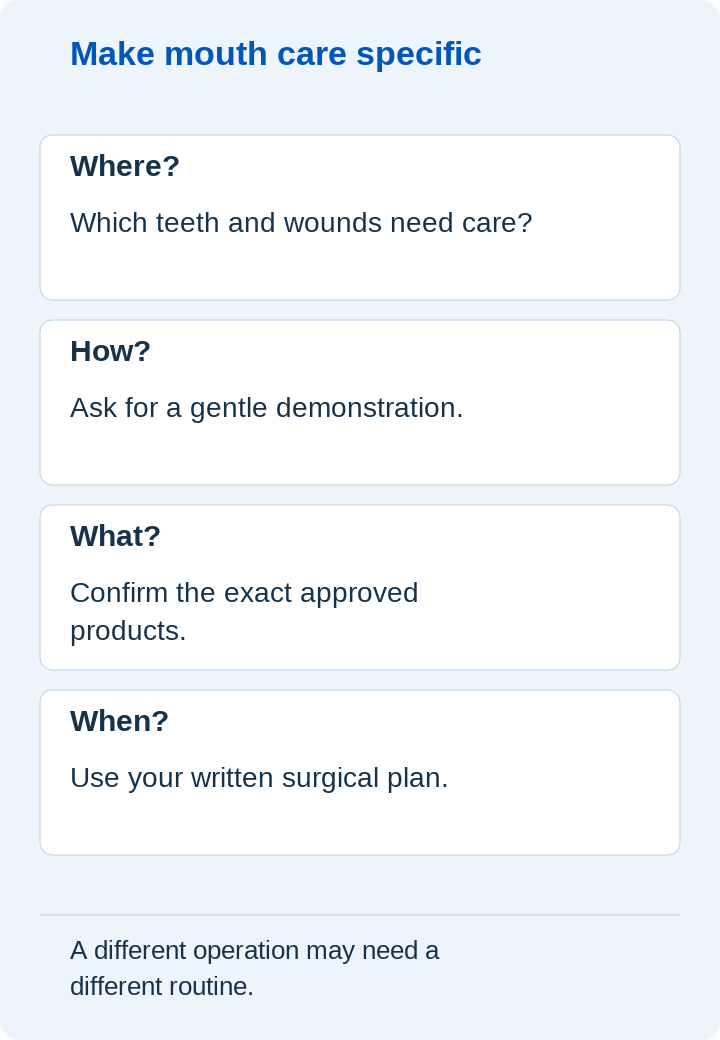
Mouth care after V-line surgery should protect the surgical wounds while keeping the teeth and mouth clean. Ask for a practical demonstration before discharge: which surfaces to brush, what to avoid, whether a rinse is prescribed, and when to start each step. Do not copy a tooth-extraction routine or another patient's timetable. Jaw-angle reduction, a chin osteotomy and combined jaw surgery can leave different wounds and require different instructions.
What if the rinse named on your instructions is unavailable at home?
Before leaving Korea, ask the team to record the product, active ingredient, strength and dates of use for any rinse they prescribe. If the label is in Korean, keep the bottle or a clear picture of both sides. Ask who should check a proposed replacement if your home pharmacy stocks a different product. A similar flavour, bottle colour or claim about gum health does not establish that two rinses are interchangeable. Also clarify where and when you can resume brushing, since a rinse and a toothbrush serve different purposes.
This guide helps you prepare questions and organize the routine. It does not prescribe a mouthwash, dilution or cleaning schedule. Difficulty breathing, new or worsening difficulty swallowing or managing saliva, rapidly increasing swelling, or heavy bleeding needs urgent assessment; severe symptoms require emergency care, rather than extra mouthwash. In Korea, call 119. Your surgeon's written instructions and direct assessment take priority over a general online guide. The sources explain general medical principles, sometimes for related jaw operations. The questions, checklists and travel-planning suggestions here are original editorial aids, not protocols issued by those organizations.
Further reading: www.cuh.nhs.uk ↗ · myoms.org ↗ · www.gov.uk ↗
Understand where the wounds are
Many facial contouring operations involve incisions inside the mouth, but the exact location and closure depend on the procedure. Ask the team to explain which areas need protection and which can be cleaned normally. Avoid pulling the lips or cheeks aside repeatedly to inspect the wound. Your surgeon’s instructions should define when to begin each part of mouth care. General dental extraction advice is not a complete substitute for instructions after facial bone surgery.
Further reading: www.cuh.nhs.uk ↗
Use the instructed technique
Ask for a demonstration of brushing around the operated areas and of any prescribed mouth rinse. Confirm the product, timing and duration rather than improvising with whichever rinse is available at a convenience store. Cleaning too aggressively can be unhelpful, while avoiding all cleaning because you are nervous can also create problems. If the technique hurts or you cannot reach an area, tell the team and ask for an adjustment.
Further reading: www.cuh.nhs.uk ↗
Keep a simple care station
Store the approved toothbrush, rinse and written schedule together. If several people share the bathroom, keep your items separate and easy to identify. A small reminder on your phone may be more useful than a complicated chart. Ask whether you need to clean after meals and what to do when you are outside the hotel. Do not introduce a water flosser, strong mouthwash or other device solely because it is part of your usual routine.
Further reading: www.cuh.nhs.uk ↗
Do not manage stitches yourself
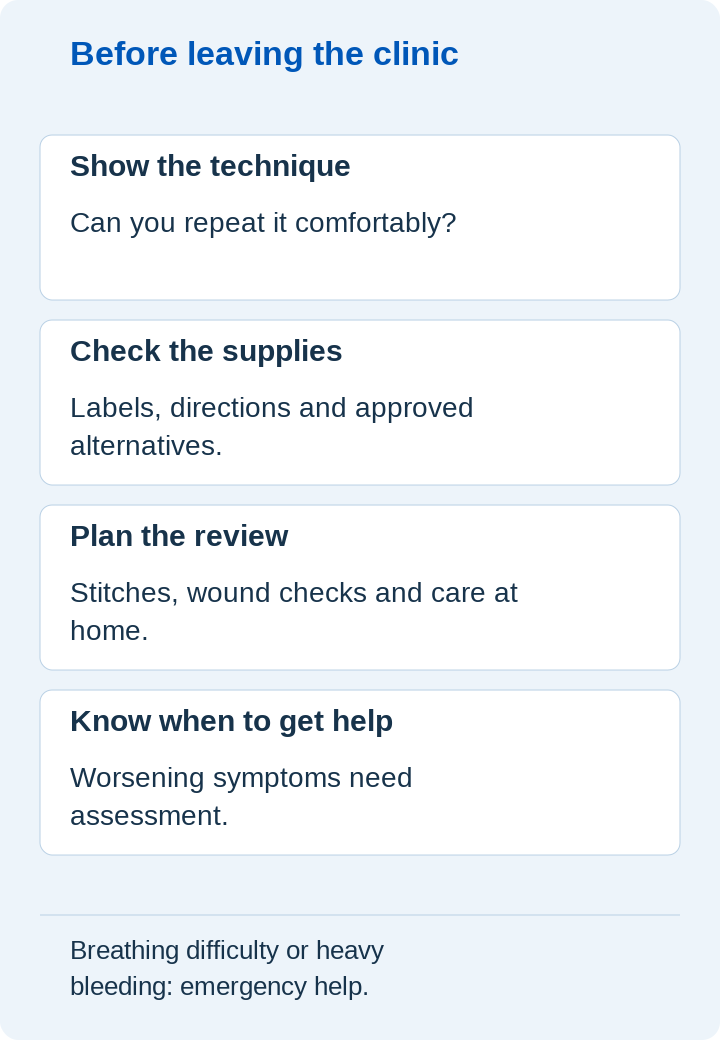
Some stitches dissolve and others require removal; confirm which applies to you. Do not pull, cut or pick at a loose-looking thread. If something catches, rubs or appears to open, contact the clinic and follow its advice. A photograph may help the team decide whether you need examination, but it cannot replace assessment in every case. Keep the scheduled wound review even if the mouth feels comfortable.
Further reading: www.cuh.nhs.uk ↗
Report changes clearly
Describe new bleeding, discharge, worsening pain, an unpleasant taste or any other concern along with when it began. Avoid masking a problem with repeated extra rinsing or leftover antibiotics. Persistent bleeding or severe symptoms need urgent assessment. At the next appointment, ask when your ordinary brushing and dental-care routine can resume and whether a planned dental visit should be postponed. Mouth care is part of the surgical plan, not an optional cosmetic aftercare extra.
Further reading: www.cuh.nhs.uk ↗
Plan for mouth care away from the hotel
If a review or transfer overlaps with your cleaning routine, ask what supplies you should carry and whether the clinic can provide a suitable place to use them. Keep products in their original containers where practical so instructions remain visible. Do not decant an unfamiliar rinse into an unlabelled drink bottle. If you miss a scheduled step, ask what to do rather than doubling the next application. Before returning home, check that you can obtain the required product or an approved equivalent, since a familiar brand name may differ between countries.
Further reading: www.cuh.nhs.uk ↗
Why two reputable instruction sheets can differ
A short oral-surgery leaflet may describe an extraction or another minor procedure. A jaw-surgery leaflet may assume orthodontic appliances, a splint or elastics. Neither automatically describes your cosmetic contouring operation. Even the timing of brushing near the incision or beginning a rinse can differ. The useful lesson is not to choose the most convenient schedule; it is to identify which instructions apply to the operation actually performed.
Ask the clinic to write the procedure name and the location of your wounds on the discharge plan. If two written instructions conflict, show both to the treating team and ask for one corrected plan. Do this before improvising. Retain the updated version so a companion or clinician at home can see the same instructions, rather than relying on separate fragments from several messages.
Further reading: www.hey.nhs.uk ↗ · myoms.org ↗
Turn the demonstration into a routine you can repeat
Before leaving, try explaining the steps back to the nurse or surgeon in your own words. Point out any part you cannot perform comfortably, including holding the brush, opening enough to reach a tooth, or seeing the label on a bottle. If a companion will help, ask whether they should watch the demonstration with your permission. A demonstration is especially useful when your usual toothbrush is too large or the incision is somewhere you cannot easily see.
Keep the plan short: approved tool, area to clean, start time, frequency, product instructions and contact details. Ask which movements are too forceful. Do not turn a cleaning routine into stretching exercises for the jaw; mouth-opening rehabilitation is a separate question. A photograph of supplies may help you remember the correct items without taking repeated close-up photographs of the wound.
Further reading: myoms.org ↗
A prescribed rinse is a medicine, not a stronger cleaning shortcut
If chlorhexidine or another medicated rinse is prescribed, confirm the exact formulation and directions with the clinic or pharmacist. Products for the skin are not substitutes for products intended for the mouth. Ask about the relationship to toothpaste, meals and other oral treatments because product instructions may affect timing. Do not increase the concentration or frequency because the mouth feels unpleasant, and do not swallow a mouthwash.
Keep the original label and write down the active ingredient if the packaging is in Korean. Ask how long to use it and what to do if you miss a step. The aim is a routine you understand, not a shelf full of antiseptics. If the prescribed product cannot be found at home, ask for an approved equivalent rather than selecting one by similar bottle color or advertising claims.
Further reading: www.nhs.uk ↗
Know when a product problem needs review
A mouth product can cause irritation or an altered taste. Some chlorhexidine dental products can also temporarily stain teeth or the tongue. These possibilities do not mean that every unpleasant taste after surgery comes from the rinse. Tell the team which product you used, when the change started and whether you have pain, discharge or swelling. If chlorhexidine makes the mouth sore or irritated, stop that product and seek advice from the prescribing clinician or pharmacist.
Sudden swelling of the tongue or throat, breathing difficulty, collapse or inability to wake normally needs emergency help. Do not wait for an ordinary clinic reply. If there is a possible reaction, keep the packaging available for the clinician, but do not delay emergency care to search for it. Ask for a revised mouth-care plan once the immediate problem has been assessed.
Further reading: www.nhs.uk ↗
Separate cleaning difficulty from a problem that needs examination
Limited opening, tenderness or numbness can make routine cleaning awkward, but they do not tell you what is happening inside the wound. If you cannot complete the instructed care, contact the team for practical help rather than stopping all cleaning indefinitely. Explain what you can reach and which action is difficult. Do not push a tool into a wound, scrape away material or probe a stitch to test whether it has healed.
New or worsening pain, swelling, discharge, fever or an opening in the wound should be reported promptly. A photograph may help communication, but it cannot reliably rule out a complication. Say when the change began and whether it is progressing. Severe bleeding, breathing difficulty or rapidly expanding swelling belongs on the urgent pathway, not in a routine photo diary.
Further reading: www.cuh.nhs.uk ↗ · myoms.org ↗
Plan dental appointments and devices separately
Ask when ordinary flossing, an electric brush, a water flosser, retainers or a night guard may resume. These are different tools with different contact points, so permission to brush the teeth does not settle all of them. If you already have orthodontic appliances, make sure the orthodontist's and surgeon's instructions agree. Do not remove or adjust a surgical splint or elastics on the basis of a generic online article.
Tell your regular dentist about the operation and provide the discharge summary before a planned visit. Ask the surgical team whether the timing or scope of that visit needs to change. Urgent dental pain or a suspected infection still needs assessment; postponing routine cleaning is not a reason to ignore a new problem. Record who will decide when your usual preventive care can restart.
Further reading: myoms.org ↗ · www.mayoclinic.org ↗
Practical questions before leaving Korea
Before the final planned review, ask the team to observe the cleaning technique again if you remain unsure. Check the supply of prescribed products, the next wound review, whether any stitches need removal and who will do it. Request instructions in a language you understand and an accessible copy of the operative and medication records. A translated product name alone is not enough if the directions remain unclear.
Plan how to contact care at home if symptoms develop during the journey or after arrival. The clinic should explain which concerns can begin with a message and which require local assessment. Carry relevant records rather than relying on access to one messaging app. The decision to fly and the mouth-care plan are related parts of recovery, but having enough mouthwash does not establish fitness to travel.
Further reading: www.cdc.gov ↗
Common questions about postoperative mouth care
Can I use my usual mouthwash? Not automatically. Ask whether its ingredients and method of use fit the wound-care plan. A familiar product may not be the prescribed product.
Should I clean harder if food seems trapped? Do not dig into or scrub a surgical wound. Ask the clinic how to handle the specific area and arrange review if you cannot keep it clean with the approved technique.
Does a loose stitch mean the wound has opened? Not necessarily, but do not cut or pull it. Send a clear description to the team and follow its advice about examination.
Can a clean-looking mouth rule out infection? No. Appearance alone cannot establish normal healing. Report worsening symptoms and keep the planned reviews. Good daily care supports recovery but is not a guarantee against complications.
Further reading: www.cuh.nhs.uk ↗ · myoms.org ↗
Clinics and doctors to explore
These listed providers were selected because their published services and named care teams relate to the questions in this guide. Use their profiles to prepare a consultation and confirm the proposed operation and follow-up.
Faceline Plastic Surgery
Faceline lists V-line sculpting, jaw reduction and chin osteotomy services. It is a relevant listed clinic to ask which intraoral wounds your proposed operation involves, who demonstrates the cleaning routine and how wound reviews continue after travel. The service and doctor information are provider self-reports, not an independent quality ranking.
Explore Dr. Lee Jin-soo’s profile ↗
Review the international website and ask about consultation ↗Sources & further reading
- Cambridge University Hospitals: mouth and jaw surgery advice ↗
- Hull University Teaching Hospitals: oral-surgery mouth care ↗
- AAOMS: recovery after corrective jaw surgery ↗
- NHS: using chlorhexidine ↗
- NHS: chlorhexidine side effects ↗
- CDC: medical tourism ↗
- Mayo Clinic: jaw surgery ↗
- Faceline: published facial bone contouring services ↗
- Faceline: Dr. Lee Jin-soo ↗
- UK Government: emergency services in South Korea ↗