The short answer: identify the cause before choosing a correction
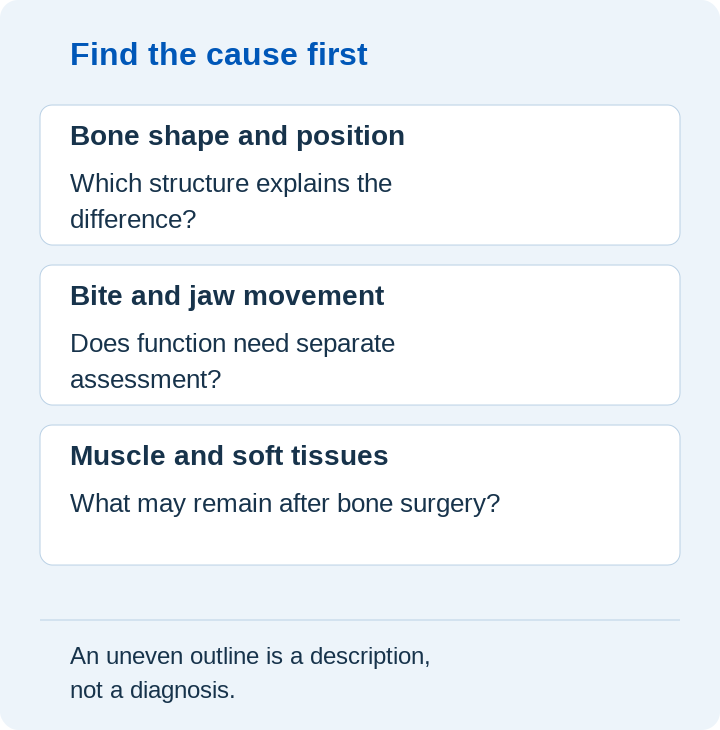
Facial asymmetry describes a difference between the sides; it does not identify the treatment. An uneven jaw outline may involve bone shape, jaw position, tooth contact, soft tissues, movement or several factors together. Cosmetic contouring can change an outline, but it cannot be assumed to resolve every cause of an off-center chin or uneven smile. Begin with an examination that explains the pattern and the limits of each option.
Describe what happens when your teeth come together
If you notice your chin points slightly to one side, tell the clinician whether this is visible at rest or mainly when you close your teeth. Describe a change in chewing, a past injury or an orthodontic adjustment if it coincided with the change you noticed. Let the clinician watch your usual jaw movement without deliberately shifting it to look straighter. The observed movement, bite and examination can help distinguish a functional shift from a difference in bone shape that a single still image cannot explain.
This guide concerns assessment of an established appearance concern. Sudden facial drooping, new arm weakness or speech difficulty can be signs of a stroke and require emergency help immediately, even if they improve. Do not send a cosmetic inquiry and wait for a reply. A new swelling, progressive change or pain also deserves medical assessment rather than self-diagnosis from photographs. The right next step depends on the timing and symptoms, not only the degree of visible difference.
Further reading: www.jsoms.or.jp ↗ · www.nhs.uk ↗
Asymmetry is a description, not a diagnosis
Most faces have some difference between the two sides. A chin that appears off-center may reflect skeletal position, tooth alignment, a tilted bite plane, muscle differences, posture or soft-tissue volume. These possibilities lead to different treatment plans. Begin by describing when the asymmetry is most visible: at rest, smiling, biting or opening the mouth. A surgeon should examine the pattern rather than assume that removing more bone on one side is the appropriate answer.
Further reading: www.jscmfs.org ↗ · www.jsoms.or.jp ↗
The bite and jaw relationship
If the chin position changes as you bring your teeth together, the bite may influence the apparent asymmetry. Dental midlines, jaw relationships and the way the teeth contact are relevant. Cosmetic contouring can change an outline but does not necessarily correct a skeletal or dental cause. Ask whether an orthodontic or oral and maxillofacial assessment is needed. The goal is to avoid treating a surface feature while overlooking the mechanism that produces it.
Further reading: www.jscmfs.org ↗ · www.jsoms.or.jp ↗
Comparing the two sides accurately
Standardized photographs and appropriate imaging help distinguish true differences from camera distortion. Head rotation can make one jaw angle look larger and one cheek more prominent. Selfies taken close to the face may exaggerate those effects. Clinical assessment should compare consistent views and relate them to examination findings. Ask which asymmetries are measurable, which are mainly soft tissue and which are unlikely to change. A claim of perfect symmetry should be treated as an unrealistic endpoint.
Further reading: www.jscmfs.org ↗ · www.jsoms.or.jp ↗
How a tailored surgical plan may differ
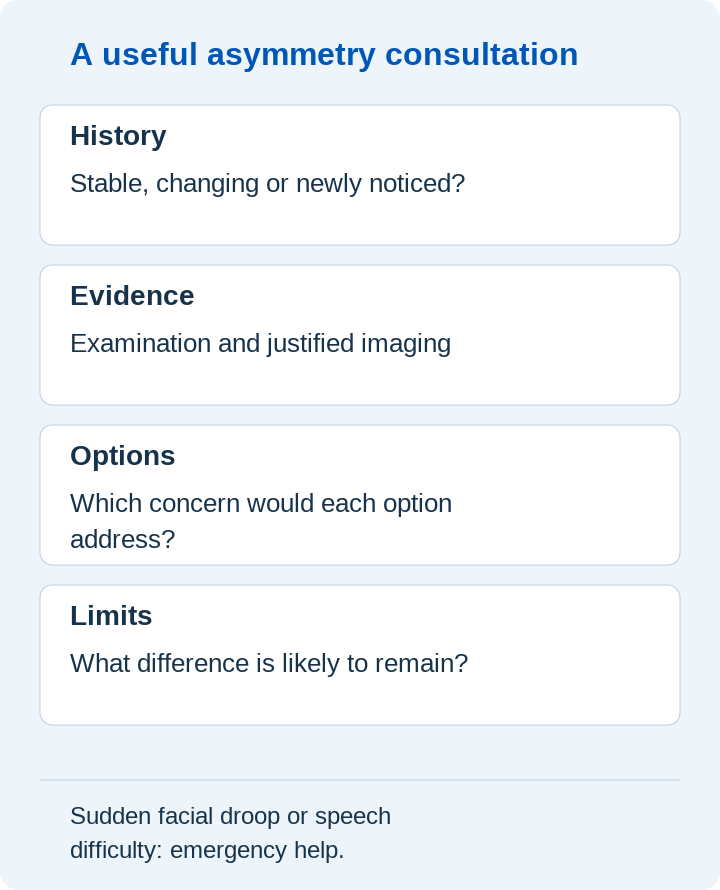
An individualized plan may involve different contouring on each side or a separate adjustment of the chin. The amount of bone available and the course of the nerve can also differ. Symmetric cuts do not necessarily create a symmetric result, but asymmetric cuts require a clear rationale. Ask how the surgeon will account for those differences and how the proposed change relates to your bite. The written plan should explain the intended balance, not merely promise correction of asymmetry.
Further reading: www.jscmfs.org ↗ · www.jsoms.or.jp ↗
Limits of soft-tissue prediction
Muscles, fat and skin may remain different even after a skeletal adjustment. Swelling can also obscure symmetry during healing, so early photographs are not a reliable final assessment. Discuss which residual differences are expected and how they will be evaluated over time. If an operation could improve one view while leaving another less changed, that trade-off belongs in the decision. Understanding these limits helps prevent repeated procedures aimed at an unattainable level of exact matching.
Further reading: www.jscmfs.org ↗ · www.jsoms.or.jp ↗
Preparing for a useful second opinion
Bring the same photographs, scans and treatment history to each consultation where possible. Ask each clinician to identify the cause before discussing a technique. If recommendations differ, compare their reasoning rather than only the promised amount of change. A useful second opinion may confirm that contouring is appropriate, suggest a bite-focused assessment or recommend no surgery. The important outcome is a diagnosis you understand and a proportionate plan.
Further reading: www.jscmfs.org ↗ · www.jsoms.or.jp ↗
Give the clinician a history, not only a preferred photograph
Write down when you first noticed the difference and whether it has been stable or has changed. Mention injury, previous facial surgery, orthodontics, dental treatment, implants, fillers and any difficulties with chewing or mouth opening. If you have older photographs or records, ask whether they would help establish the baseline. You do not need to decide what caused the asymmetry before the appointment.
Describe the situations in which it bothers you most: a resting front view, smiling, speaking or bringing the teeth together. State whether appearance, function or both are your main concern. A clear description prevents the conversation from defaulting to a standard V-line package when the actual question might concern a dental relationship, a particular soft-tissue difference or a new health problem. Avoid repeatedly forcing your jaw into a position for comparison; clinical examination should assess movement safely.
Further reading: www.jsoms.or.jp ↗ · www.nidcr.nih.gov ↗
Understand what the assessment is trying to separate
The clinician may need to distinguish the shape of the bony border from the position of the jaws and the relationship between the teeth. The visible skin and soft-tissue outline may not match the skeleton exactly. A treatment plan should explain which finding is responsible for the feature you want to change and how the proposed operation addresses it.
Ask whether an orthodontic or oral and maxillofacial opinion would change the recommendation. This is especially relevant when appearance concerns coexist with problems biting or a changing bite. It does not mean that every person with asymmetry needs two-jaw surgery. It means that the cosmetic decision should follow an appropriate diagnosis. If two clinicians describe different causes, ask them to explain the evidence for each interpretation before comparing the suggested operations or prices.
Further reading: www.jscmfs.org ↗ · www.jsoms.or.jp ↗ · www.mayoclinic.org ↗
Imaging should answer a clinical question
An examination may be supported by standardized photographs, dental records or imaging chosen for a specific purpose. Ask what the proposed test is intended to show and how its result could affect the plan. Do not request repeat scans solely because a different clinic uses a different package. Bring existing images and reports so the receiving clinician can judge whether they are adequate.
A three-dimensional image can help explain anatomy but does not remove uncertainty about the final appearance. Ask the surgeon to identify the relevant finding on your own records in ordinary language. If a plan relies on a number, clarify what it measures and why it matters to your goal. The most useful explanation connects the examination, the image and the proposed change, rather than treating technology or a rendered face as proof that a particular operation is necessary.
Further reading: www.jscmfs.org ↗ · www.mayoclinic.org ↗
Jaw pain and clicking need their own reasoning
Tell the clinician about painful clicking, locking, stiffness or changes in how the teeth meet. These symptoms may require assessment for a temporomandibular disorder or another cause of facial pain. A visible asymmetry does not by itself establish the source of pain, and an aesthetic procedure should not be promised as a general cure for jaw-joint symptoms.
NIDCR emphasizes caution with irreversible interventions for TMD because symptoms and causes vary and evidence for many treatments is limited. Ask which diagnosis is being treated and whether a less invasive approach is appropriate. Painless clicking alone does not automatically mean that treatment is required. If the reason for surgery changes during the consultation from appearance to pain relief, ask for a clear explanation of the new indication and consider an independent assessment before making an irreversible decision.
Further reading: www.nidcr.nih.gov ↗
Compare treatment pathways rather than bigger promises
Depending on the findings, the discussion may involve observation, a focused cosmetic procedure, dental or orthodontic care, jaw-position surgery, or a separate approach to soft tissues. These are not interchangeable packages. Ask which of your priorities each pathway could address and which it would leave unchanged. If several procedures are proposed together, request the contribution and additional burden of each one.
A more extensive operation is not automatically a better response to an appearance concern. Equally, a small cosmetic adjustment may not address an underlying bite problem. Ask what would make the clinician recommend against the procedure you initially requested. A useful consultation allows room for no treatment and for a smaller, realistic goal. Consider whether you would still value the expected improvement if some difference between the sides remained.
Further reading: www.jscmfs.org ↗ · www.mayoclinic.org ↗
Plan how improvement would be evaluated
Agree before treatment on the views, symptoms and functions that matter most. If the goal is a more balanced jaw border, ask how that will be assessed separately from smile symmetry or tooth alignment. Do not use perfect matching as the only acceptable endpoint. The surgeon should identify changes that are plausible, differences expected to remain and uncertainty that cannot be removed before surgery.
After an operation, swelling can complicate early comparisons, but worsening symptoms should still be assessed. Ask for a review schedule and the signs that require earlier contact. A later review should compare consistent records and your original goals rather than a new ideal image. If dissatisfaction persists, an independent opinion can help distinguish a problem requiring treatment from a limitation that was inherent in the original plan.
Further reading: www.plasticsurgery.org ↗ · www.kokusen.go.jp ↗
Prepare for consultation in Korea and care at home
For an international consultation, request the medical explanation in a language you understand. An interpreter should help you discuss the cause, proposed technique, alternatives and risks, not only booking details. Ask whether any dental assessment or additional opinion should happen before travel. Leave room in your plans for an examination that changes or postpones the procedure.
Before paying, clarify the named clinical team, anesthesia and facility arrangements, planned reviews and the route for urgent concerns. Ask for records that a clinician at home could use if necessary. Travel plans should follow the actual operation and recovery rather than a generic V-line itinerary. If appearance and bite treatment involve different clinicians, make sure responsibility for follow-up is clear. A remote message can support communication but does not replace every in-person assessment.
Further reading: www.cdc.gov ↗ · www.mhlw.go.jp ↗
Common questions about asymmetry and V-line surgery
Will removing more bone on the larger-looking side fix the problem? Not necessarily. The apparent difference may have causes that bone reduction will not correct. Ask the clinician to explain the diagnosis and why a particular change is appropriate.
Does an uneven chin mean I need double-jaw surgery? No. That decision requires assessment of jaw position, the bite, function and treatment goals. A chin procedure and jaw-position surgery are different interventions.
Should I be able to see the diagnosis in a selfie? No. Camera angle, distance, head position and expression can influence the image. Clinical photographs and examination provide a more useful basis for discussion.
What if different surgeons propose different plans? Compare their explanation of the cause, expected benefit, residual differences and risks. Seek clarification or another opinion if the proposals answer different questions. You do not need to choose simply because a travel date or promotional offer is approaching.
Further reading: www.jscmfs.org ↗ · www.jsoms.or.jp ↗ · www.plasticsurgery.org ↗
Clinics and doctors to explore
These listed providers were selected because their published services and named care teams relate to the questions in this guide. Use their profiles to prepare a consultation and confirm the proposed operation and follow-up.
Faceline Plastic Surgery
Faceline Plastic Surgery lists both facial bone contouring and a separate jaw-position surgery service. That distinction is relevant when an asymmetry concern includes the bite as well as the visible border. Its official team page identifies Dr. Lee Jin-soo with contouring and double-jaw care. The practice separately lists orthodontic care. Ask the clinic which clinician would evaluate your specific findings and whether orthodontic assessment is needed. The listing is not a guarantee of suitability or symmetry.
Explore Dr. Lee Jin-soo’s profile ↗
Review the international website and ask about consultation ↗