Start with your V-line goal, then ask what needs assessment
If you began by researching a narrower jawline or a different chin shape, use this guide to prepare a contouring consultation. Write down the feature you want to change and any bite or chewing concern separately. These notes are questions for your clinicians, not a way to diagnose yourself or select surgery from photographs.
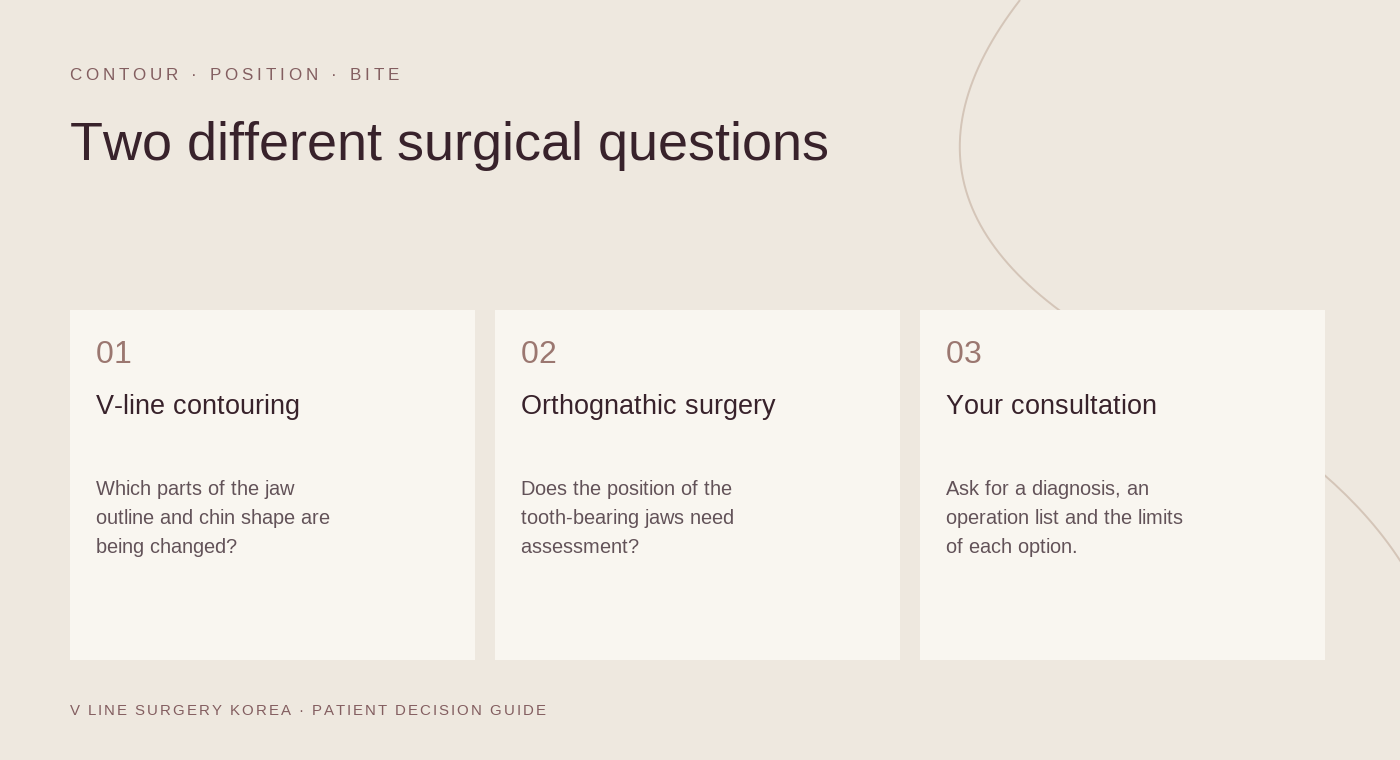
V-line contouring primarily reshapes the lower facial outline. Double-jaw surgery repositions both the upper and lower jaws, including their tooth-bearing portions. They can both change appearance, but they solve different anatomical problems. A narrower jawline does not necessarily mean a better bite, and correcting a bite does not necessarily create a narrow chin.
For someone considering surgery in Korea, the first useful question is therefore not which operation produces the most dramatic photographs. It is whether the concern comes from the jaw's outer contour, the position of one or both jaws, the chin, or a combination. A written diagnosis should make that distinction understandable before you compare clinics, travel dates or prices.
Further reading: www.facelineplasticsurgery.com ↗ · bos.org.uk ↗
What a V-line operation may actually include
V-line is a description of an aesthetic goal rather than one universally identical operation. A proposed plan may include jaw-angle reduction, reshaping along the lower border of the mandible, and a chin procedure. Two clinics can use the same label while recommending different bone cuts.
Request an itemized procedure list. Ask which areas will be reduced, whether a chin segment will be moved, and which structures will remain in their original position. Discuss front, three-quarter and profile views separately: a change that looks useful from one angle may not answer your concern from another. The consultation should also explain what the operation cannot change. Do not assume that the word V-line includes correction of dental alignment or a skeletal underbite.
Further reading: www.facelineplasticsurgery.com ↗
What double-jaw surgery changes
Double-jaw surgery, also called bimaxillary orthognathic surgery, changes the relationship of the upper and lower jaws. Orthognathic treatment can instead involve only one jaw when that is appropriate. The British Orthodontic Society distinguishes these operations from genioplasty, which addresses the chin.
A useful surgical explanation names each planned movement and its purpose. Ask whether the upper jaw moves forward, upward or in another direction, what happens to the lower jaw, and how the final bite is established. Two patients offered double-jaw surgery may need quite different movements. The term alone does not tell you the expected appearance, the airway implications or the complete risk profile. Ask for an explanation tied to your records rather than a standard promotional animation.
Further reading: bos.org.uk ↗
Start with the bite, even when your concern is appearance
Corrective jaw surgery is used for skeletal and dental discrepancies that can affect functions such as chewing and speaking. Appearance may improve too. A specialist assessment separates the position of the teeth from the position of the supporting jaws; an attractive-looking smile is not a complete assessment of either.
Before consultation, describe what you experience in ordinary life. Do front teeth meet when you bite food? Do you avoid chewing on one side? Has your dentist identified an underbite, open bite or other discrepancy? These observations are conversation starters, not a self-diagnosis. If function feels comfortable and your concern is purely cosmetic, say that clearly. Ask the clinician to explain why a jaw-repositioning operation would be appropriate for your specific goals.
Further reading: myoms.org ↗
A recessed chin does not automatically mean a recessed jaw
Chin surgery can change the chin's shape or prominence. However, a side photograph cannot establish whether the concern is confined to the chin or involves a broader skeletal relationship. Moving the chin does not, by itself, reposition the tooth-bearing part of the lower jaw.
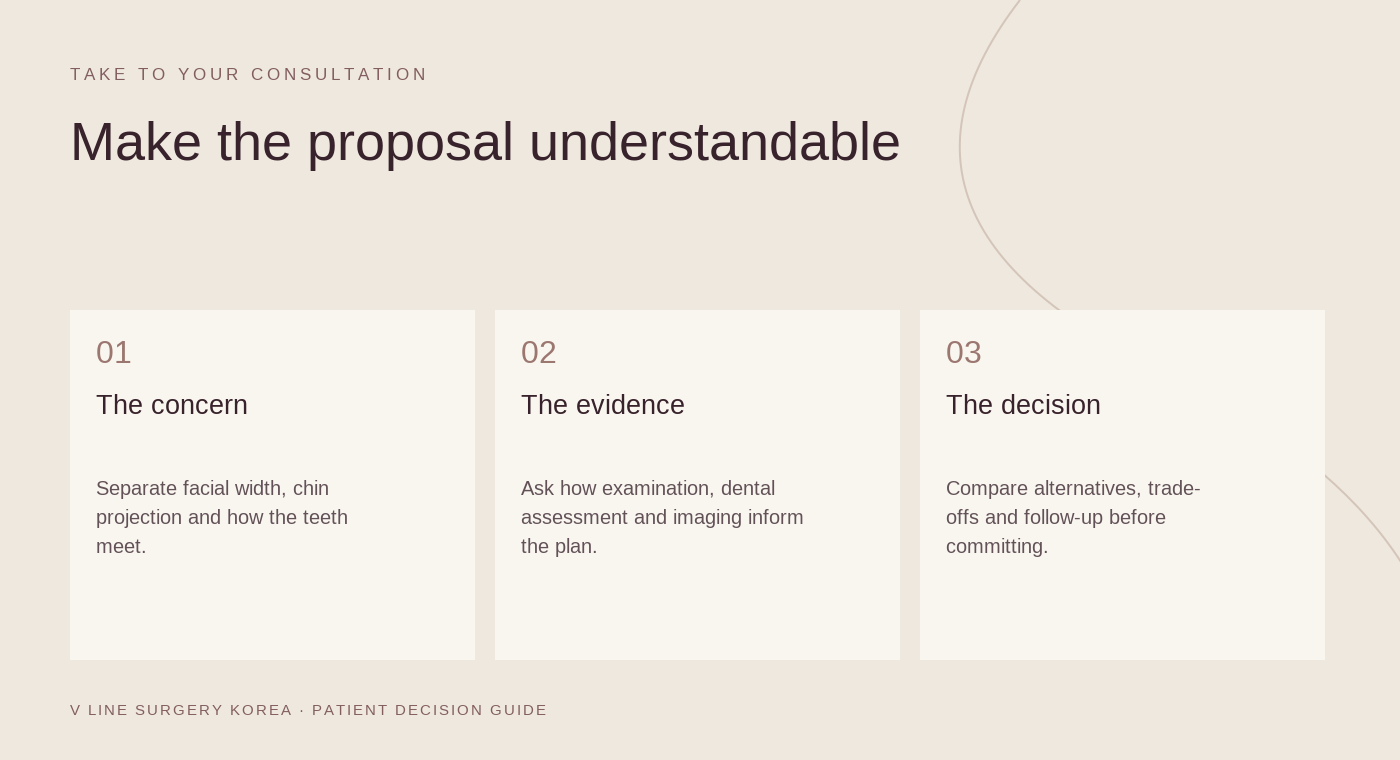
Ask the specialist to show the difference between a chin-only plan and a whole-jaw plan using your examination and imaging. Which part of the profile would change with each? What would remain unchanged? Would the proposed treatment address the concern that brought you to consultation? This discussion is especially useful if you have received very different recommendations from different clinics. A comparison of diagnoses is more informative than comparing two attractive simulations without knowing what each assumes.
Further reading: www.plasticsurgery.org ↗ · bos.org.uk ↗
Orthodontics can make this a treatment course, not a single trip
Orthognathic care commonly combines surgical and orthodontic treatment. The teeth and jaws need a coordinated plan; moving the jaw is only one stage of achieving a stable dental relationship. Ask whether preparation is needed before surgery and what orthodontic treatment follows afterward.
If you live in the United States, United Kingdom or Australia, establish who will provide each stage before booking travel. A Korean surgeon and an orthodontist at home should agree on responsibilities rather than leaving you to pass informal messages between them. Request a written sequence, the records that must be shared, and the criteria for proceeding. If a clinic proposes surgery before orthodontics, ask why that sequence suits your case and who will manage the subsequent adjustments.
Further reading: orthodonticsaustralia.org.au ↗
Compare risks for the exact procedures, not the marketing labels
Both choices involve surgery and can have complications. Chin surgery risks include bleeding, infection, altered sensation, asymmetry and an unsatisfactory result. The consent discussion should identify which risks apply to your actual procedure and which could require additional treatment.
Lower-jaw repositioning also requires discussion of bite stability, changes in jaw position during healing, fixation problems and sensory changes. Backward movement of the lower jaw can have breathing implications. These are reasons to examine the proposed movements carefully, not reasons to assume every double-jaw operation has the same outcome.
Ask how risks are measured: temporary and persistent changes are different outcomes. A percentage from another operation, another patient group or a short follow-up period may not answer the question you are asking.
Further reading: www.plasticsurgery.org ↗ · www.cuh.nhs.uk ↗
Jaw pain and sleep concerns need their own assessment
Jaw-joint pain is not a simple signal that cosmetic bone reduction or double-jaw surgery is necessary. Temporomandibular disorders encompass several joint and muscle conditions. NIDCR advises caution about treatments that permanently change the bite or jaws for TMD; symptoms require a diagnosis and consideration of appropriate alternatives.
Tell the team about locking, painful chewing, previous joint treatment, snoring or diagnosed sleep apnea. Ask which symptoms the proposed operation is expected to address and which need separate care. An aesthetic consultation should not turn a symptom into an assumed surgical indication. If a breathing benefit is promised, request the diagnostic basis, the relevant specialist involvement and the plan for assessing the result. A slimmer-looking face is not a measurement of breathing function.
Further reading: www.nidcr.nih.gov ↗ · www.cuh.nhs.uk ↗
When contouring and jaw repositioning are discussed together
A patient can have both a jaw-position concern and an independent contour preference. A clinic may therefore discuss a combined or staged approach. Faceline's international service pages describe both facial bone contouring and jaw-repositioning treatments, illustrating why the operation names must be separated during consultation.
Ask the team to write two lists: changes needed to address the diagnosed jaw relationship, and optional changes requested for appearance. Then ask whether the second list should be reconsidered after the first treatment. This makes the decision easier to review and prevents a package name from deciding the scope for you. Discuss the additional recovery obligations and cost of each optional component. You should understand the purpose of every procedure even if several are performed during one anesthetic.
Further reading: www.facelineplasticsurgery.com ↗
How to read before-and-after photographs intelligently
Use photographs to discuss preferences, while keeping your diagnosis central. Ask whether a displayed patient had contouring alone, jaw repositioning, orthodontics, chin surgery or additional facial procedures. An image labeled only jaw surgery leaves too much unanswered for a useful comparison.
Request consistent angles, lighting and facial expression, plus the time elapsed after treatment. Ask what features of that example resemble your starting anatomy and which do not. A photograph can help communicate a preferred degree of change, but it cannot establish your bite, reveal every complication or predict your individual result. If a simulation is provided, ask the clinician to explain its uncertain elements. Keep a copy of the agreed goals in ordinary language, alongside any images used during the consultation.
Further reading: www.plasticsurgery.org ↗
Choose consultation options by relevance to the decision
For a Seoul consultation, consider Faceline Plastic Surgery and its listed plastic surgeon Dr. Lee Jin-soo. His current international profile describes a focus on facial contouring and double-jaw surgery. This makes the clinic relevant to discussing why one approach, a combination, or no operation would fit your anatomy. Ask who will assess the bite and coordinate any required orthodontics.
For an oral and maxillofacial perspective, consider Sinsa Oral & Maxillofacial Surgery and Dr. Ji-woong Jung. His international profile lists double-jaw surgery and facial contouring. The clinic is in Changwon, so account for that location when comparing travel plans. These are consultation recommendations based on listed services and professional roles; your examination must determine suitability. Use each clinic's international website to request current arrangements.
Further reading: www.facelineplasticsurgery.com ↗ · www.sinsafacialsurgery.com ↗
Questions to bring to a second opinion
If recommendations conflict, bring the same records and describe the same priorities to each clinician. Ask each to state the diagnosis before naming an operation. Is the disagreement about skeletal position, the bite, the source of facial width, or the degree of aesthetic change you prefer?
Request an explanation of what would remain untreated with the smaller plan and what additional benefit would require the larger plan. Ask whether there is a reasonable nonsurgical route or whether waiting is acceptable. Finally, ask each clinician to identify the limits of the proposed result. A useful second opinion need not produce an identical operation list; it should help you understand the reasoning well enough to make a considered decision without feeling rushed.
Further reading: myoms.org ↗
Plan continuity before paying for surgery in Korea
Compare complete care plans rather than operation prices alone. Your questions should cover preoperative appointments, orthodontics when relevant, postoperative reviews, accommodation needs, interpretation and access to the treating team after returning home. Ask which clinician handles a new bite concern and what records they will receive.
Obtain an individualized travel plan; readiness to leave Korea and completion of recovery are different milestones. Cambridge University Hospitals describes follow-up with both surgeon and orthodontist after lower-jaw osteotomy, underscoring the importance of coordinated care. Ask for emergency contact arrangements and a written explanation of additional fees if an extended stay or further treatment is required. The practical goal is a plan that still works after the initial operation and after your flight home.
Further reading: www.cuh.nhs.uk ↗
Common questions before choosing a pathway
Can V-line contouring correct an underbite? Contouring the outer jaw does not reposition the tooth-bearing jaws. An underbite needs dental and skeletal assessment before deciding on treatment.
Does double-jaw surgery always include V-line contouring? No. Ask for the individual procedure names; reshaping the jaw outline is a separate planning question.
Can I choose based on recovery time? Recovery matters, but the operation first needs to match the diagnosed problem. A shorter recovery does not make an unsuitable procedure appropriate.
Is doing nothing a valid option? Yes. Ask what choosing no operation would mean for your particular function and appearance. For an elective aesthetic concern, understanding that option is part of making an informed choice. Proceed when the purpose, limits and continuing care are clear to you.
Further reading: www.facelineplasticsurgery.com ↗ · www.plasticsurgery.org ↗
Clinics and doctors to explore
These listed providers were selected because their published services and named care teams relate to the questions in this guide. Use their profiles to prepare a consultation and confirm the proposed operation and follow-up.
Faceline Plastic Surgery
Consider for a consultation comparing facial contouring and double-jaw surgery; the current official international profile lists both areas of practice.
Explore Dr. Lee Jin-soo’s profile ↗
Review the international website and ask about consultation ↗Sinsa Oral & Maxillofacial Surgery
Consider for an oral and maxillofacial consultation about the distinction between jaw repositioning and contouring; the listed clinic is in Changwon.
Explore Dr. Ji-woong Jung’s profile ↗
Review the international website and ask about consultation ↗Sources & further reading
- British Orthodontic Society: Your Surgery Explained ↗
- AAOMS: Corrective Jaw Surgery ↗
- Cambridge University Hospitals: Mandibular osteotomy ↗
- Faceline: Facial Bone Contouring ↗
- Faceline: Two-Jaw Surgery ↗
- ASPS: Chin Surgery ↗
- ASPS: Chin Surgery Risks and Safety ↗
- NIDCR: Temporomandibular Disorders ↗
- Faceline: Dr. Lee Jin-soo ↗
- Sinsa: Dr. Ji-woong Jung ↗
- Orthodontics Australia: Jaw surgery and braces ↗