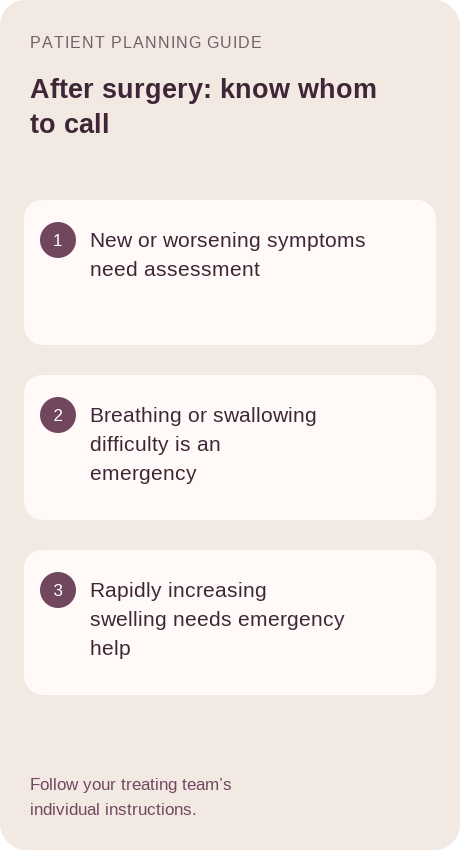
Breathing or swallowing difficulty, rapidly increasing facial or neck swelling, or severe uncontrolled bleeding: seek emergency care immediately. In South Korea call 119.
When to get emergency help
Call an ambulance or go immediately to the nearest emergency department if you have difficulty breathing or swallowing, or rapidly increasing or substantial swelling of the mouth, face or neck after jaw or facial surgery. Do not wait for a reply from your clinic, a scheduled review, or a flight home. In South Korea, call 119 for an ambulance. If you need language support, say “English please” or “Interpreter please” and give your location. Tell the dispatcher that you recently had jaw or facial contouring surgery.
Also seek emergency help for severe illness, particularly new confusion, shortness of breath, or extreme pain after surgery. These can be signs of a serious complication, including sepsis, and require urgent assessment. An infection does not need to have been confirmed before you seek help. If possible, take your discharge summary and medicine list, but do not delay care to find them.
For other concerning changes, including fever, worsening pain or swelling, pus, a bad smell from the wound, or increasing redness and warmth, contact your surgical team immediately for prompt assessment. If you cannot reach them promptly, seek urgent local medical care instead. You do not need to decide for yourself whether an infection is present.
Further reading: english.visitkorea.or.kr ↗ · www.cdc.gov ↗ · www.cdc.gov ↗ · medlineplus.gov ↗ · www.nhs.uk ↗
What infection can mean after V-line surgery
V-line facial contouring can involve reshaping the lower jaw, chin, or both. The exact operation differs from person to person, as do the incision sites and whether plates or screws are used. Ask your surgeon to explain what was done in your case. A surgical-site infection is an infection involving the area of an operation; it may be superficial or involve deeper tissues, and it can develop after you leave the hospital.
This guide uses general surgical infection and jaw-surgery advice to help patients recognize concerns. It does not provide an infection rate for V-line surgery or replace the individual instructions of the team that examined you. Some corrective jaw operations use plates and screws; occasionally infection can involve this material. That does not mean every V-line patient has hardware or that pain means a plate is infected. If hardware was used, tell any clinician evaluating you.
Infections may be treatable, but the correct treatment depends on the findings. Early medical assessment matters because symptoms alone cannot establish the cause, location, or severity. Do not press on or probe a sore area in an attempt to check it yourself.
Further reading: www.cdc.gov ↗ · www.cuh.nhs.uk ↗
Swelling and pain: look for a change, not a perfect schedule
Some swelling, discomfort, bruising and difficulty opening the mouth can occur after surgery to the mouth or jaws. These symptoms do not by themselves prove an infection. Recovery varies with the operation and the person, so ask your surgical team what pattern they expect for you rather than using someone else’s photographs or a fixed online timeline as a test. General oral-surgery guidance describes swelling and discomfort that then begin to improve, but that guidance does not predict an individual V-line recovery.
A change in direction is useful information: tell the team if pain or swelling is increasing, particularly if it is markedly worse, returns after it had begun to improve, or is accompanied by fever, redness, warmth, drainage, or feeling unwell. A sudden change deserves attention even if it occurs before a commonly quoted recovery milestone. Equally, an infection cannot be ruled out simply because you do not have every listed symptom.
Do not wait until your face looks a particular way. Contact the team if you are uncertain whether the change is expected. They can compare your current condition with your operation and examination, and tell you whether they need to see you urgently. Difficulty breathing or swallowing is an emergency, whatever the appearance of the swelling.
Further reading: www.cuh.nhs.uk ↗ · medlineplus.gov ↗
Signs to tell your surgeon about
Contact your surgical team immediately if you notice any of the following, even if you are not sure they are connected:
- New or increasing pain, tenderness or swelling around the jaw, chin, cheek, or surgical area.
- Redness or heat around an incision, especially if it is spreading or worsening.
- Cloudy fluid or pus, a bad smell from a wound, or an unpleasant discharge or taste in the mouth.
- Fever, chills, or feeling increasingly unwell.
- An incision or area inside the mouth that seems to be opening, or a new area of concern near a surgical site.
These are reasons to ask for assessment, not a checklist that can diagnose infection. There may be other causes, and some changes are difficult to see when incisions are inside the mouth. The CDC lists redness and pain, cloudy wound drainage and fever as possible signs of a surgical-site infection. MedlinePlus also lists warmth, bad smell and chills.
If your team gave you a temperature threshold, follow it. Do not delay contacting them while trying to obtain a thermometer or waiting for a particular number if you feel significantly unwell or have other concerning symptoms. When you call, describe when the change started and whether it is getting worse. If breathing or swallowing is difficult, call emergency services instead of waiting for the clinic.
Further reading: www.cdc.gov ↗ · medlineplus.gov ↗ · www.cuh.nhs.uk ↗
Make a simple recovery record
A brief record can help a clinician judge a change over time. At roughly the same time each day, note your symptoms in your own words: where you feel pain or swelling, whether it is improving or worsening, and any new warmth, drainage, unpleasant taste, fever or chills. If you take your temperature, record the number, time and how you measured it. Write down the medicines you took, including the name and time, and any reactions. This record supports a discussion; it is not a way to rule out infection.
If your clinic requests photographs, use consistent lighting and send them through its approved channel. Ask what views are useful, and do not pull on stitches, put objects inside the mouth, or cause pain to produce a clearer image. A photo cannot assess everything a clinician can examine in person, so do not let taking or sending one delay a needed assessment.
When calling, have your operation date, surgeon and facility name, current location and callback number ready. Mention whether you are having increasing pain, swelling or fever and how quickly the change occurred. Ask directly: “Do I need to be examined today, and where should I go if you cannot see me?” If symptoms are worsening while you wait, seek urgent care rather than relying on an unanswered message.
Further reading: www.cdc.gov ↗
Mouth and wound care without disturbing healing
Follow the written instructions from the team that performed your operation. Ask them when to begin brushing and rinsing, what solution to use, how gently to clean near stitches, and how to care for any external incision or dressing. Recommendations for different oral operations and individuals can differ; do not assume a technique or schedule recommended to someone else is right for your procedure. If the instructions are unclear or you cannot carry them out because of pain, stiffness or another problem, call the clinic for specific guidance.
Good mouth hygiene supports healing, but vigorous rinsing, scrubbing, picking at stitches, or attempting to clean deep inside an incision can disturb the area. Use only the products and method your team recommends. Wash your hands before and after wound or dressing care, and ask anyone assisting you to do the same. Do not let visitors touch wounds or dressings.
Tell your surgeon if you smoke or use nicotine and ask for help stopping. Smoking impairs wound healing and is associated with infection. If you have diabetes or a condition or medicine that affects your immune system, discuss your personal recovery plan with the team; do not stop prescribed medicines on your own. These factors can affect surgical infection risk, but they do not mean an infection will occur.
Further reading: www.cuh.nhs.uk ↗ · www.cdc.gov ↗ · medlineplus.gov ↗
Antibiotics and other medicines
If you are prescribed an antibiotic, take it exactly as directed and ask what to do if you miss a dose or cannot take it. The purpose and duration of treatment should come from your surgical team. Do not start leftover antibiotics, borrow someone else’s medicine, change the dose, or add an antibiotic on your own. Antibiotics are useful against certain bacterial infections, but they can cause side effects and their use can contribute to resistance. A clinician needs to decide whether an antibiotic is needed and which one is appropriate.
Tell the team promptly about a suspected medicine reaction. Difficulty breathing or swallowing, or another severe reaction, needs emergency care. If you experience troubling or unexpected effects, contact the prescribing clinician or another healthcare professional for instructions; do not simply ignore them. Share your allergies and a full list of prescription drugs, non-prescription medicines and supplements with anyone treating you.
Pain medicine can make you more comfortable, but improvement in pain alone does not establish that a wound is healing normally. If symptoms are worsening, report the change even if you have taken medication. If you are seen at a different facility, show them the medicine packaging or a written list with the generic names, doses and times you have taken them.
Further reading: medlineplus.gov ↗ · www.cuh.nhs.uk ↗ · wwwnc.cdc.gov ↗
What an assessment and treatment may involve
A clinician will ask about your operation and symptoms and examine the affected area. Depending on what they find, they may consider blood tests, imaging, or a sample of fluid for laboratory testing. Not everyone needs every test. A sample can help identify an organism and guide antibiotic choice, particularly when the course is unusual or the initial treatment is not working.
Treatment depends on the cause and depth of the problem. A surgical-site infection may be treated with antibiotics, and some patients need additional procedures or surgery. If an abscess or deeper infection is suspected, a clinician will decide whether drainage or hospital care is needed. If plates or screws were used, their presence is one part of the assessment; removal is not automatically required, although infected hardware sometimes needs a further operation. Do not try to drain an area or remove stitches yourself.
Before leaving an appointment, ask what diagnosis is being considered, what changes should bring you back immediately, who will review any results, and when the next assessment should occur. Confirm how to get help outside office hours. If you are not improving as the treating clinician expected, or you become worse, contact them again or seek urgent care as advised. Emergency symptoms require emergency care regardless of a previous reassuring assessment.
Further reading: medlineplus.gov ↗ · www.cdc.gov ↗ · www.cuh.nhs.uk ↗
Plan follow-up while you are in Korea
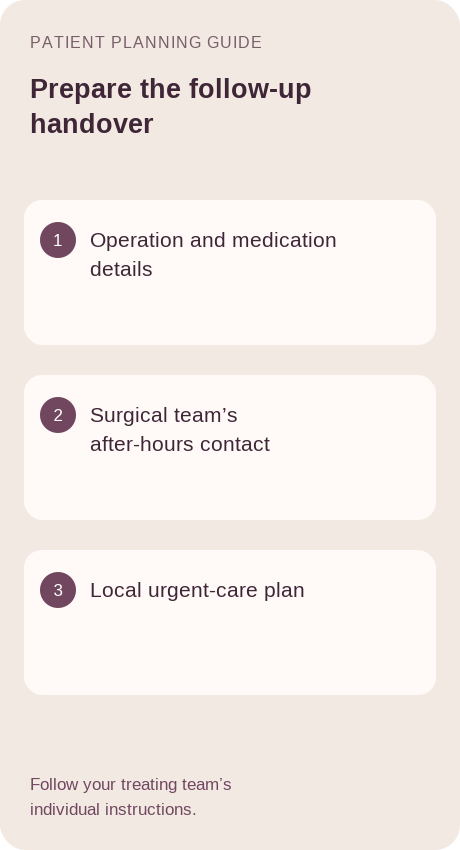
Before your procedure or discharge, request the name and direct contact details of the surgeon or clinical team, an out-of-hours number, and the location of an emergency department able to assess postoperative jaw problems. Confirm the language in which you can communicate, how quickly messages are monitored, and whether a qualified interpreter is available. Do not assume a coordinator’s messaging service is staffed overnight or can assess an emergency.
Book the reviews your surgeon recommends and clarify who will examine you and what each visit is intended to check. Ask how the plan changes if you develop fever or worsening swelling before an appointment. Keep your accommodation address in Korean and in a form you can show emergency personnel. Save the clinic contact details and 119 on your phone, and let a trusted companion know where they are. If you need an ambulance in Korea, 119 can connect callers to an interpreter; say “Interpreter please.”
Make a practical contingency plan for a longer stay if the clinical team needs to reassess you. Review your insurance and payment arrangements for complications, as follow-up and emergency treatment may not be covered. Cost or travel plans should not delay emergency care. If the original clinic is closed or unavailable, seek assessment through an urgent service or emergency department appropriate to your symptoms.
Further reading: wwwnc.cdc.gov ↗ · english.visitkorea.or.kr ↗
Before flying home and after returning
Ask your surgeon when you can safely travel based on your operation, recovery, symptoms and any treatment underway. Do not treat a general cosmetic-surgery travel interval as clearance for your own jaw operation. If you develop signs of infection before departure, contact the surgical team immediately and obtain medical assessment rather than boarding while waiting for a message. Flying after surgery also adds risks unrelated to infection, including blood clots; your clinician can advise on your individual situation.
Before you leave, request copies of the operative and discharge reports, the procedure date and facility details, medicine and allergy lists, any relevant images or test results, and details of implants or hardware if used. Ask for a translation when needed and keep a copy accessible during travel. Arrange a clinician at home for follow-up and agree on how information will be transferred.
If symptoms arise during travel or after you return, do not wait for a remote reply from Korea. Seek local medical care promptly, and emergency care for breathing or swallowing difficulty or severe illness. Tell the treating clinician where and when you had surgery, what procedure you received, and what medicines you have taken. Infections and other complications can emerge after discharge; follow-up should continue for as long as your treating clinician recommends.
Further reading: wwwnc.cdc.gov ↗ · www.cdc.gov ↗
Questions to bring to your next appointment
A written list can make a short appointment more useful, especially if an interpreter is helping. Consider asking:
- What was done to my jaw or chin, where are my incisions, and were plates or screws used?
- What swelling and pain pattern do you expect for my operation? Which changes mean I should call immediately?
- Who assesses concerns at night or on weekends, and where should I go if I cannot reach you?
- When and how should I brush, rinse, care for stitches, and clean any external wound?
- Which medicines should I take, for how long, and whom should I contact about side effects or missed doses?
- If you suspect infection, do I need to be seen in person, and how will test results and follow-up be arranged?
- What records should I take home, and who will coordinate care with my local clinician?
- Is my planned flight appropriate for my current condition, and what should I do if symptoms change before departure?
Write down the answers or ask for them in a language you understand. Repeat back the urgent contact plan so you can check that you understood it. Share the plan with a companion if you wish. Keep the emergency rule separate: breathing or swallowing difficulty warrants immediate emergency help, even if you have an appointment scheduled later.
Further reading: www.cdc.gov ↗ · wwwnc.cdc.gov ↗
Clinics and doctors to explore
These listed providers were selected because their published services and named care teams relate to the questions in this guide. Use their profiles to prepare a consultation and confirm the proposed operation and follow-up.
Face Plus Plastic Surgery
Face Plus lists V-line facial contouring. Use a consultation to ask how suspected infection is assessed and how to access after-hours care, rather than assuming a routine message is emergency care.
Explore Dr. Jung Keun Park’s profile ↗
Review the international website and ask about consultation ↗Sources & further reading
- CDC: Surgical Site Infection Basics ↗
- MedlinePlus: Surgical wound infection treatment ↗
- Cambridge University Hospitals: Surgery to the mouth and jaws ↗
- Cambridge University Hospitals: Jaw or chin corrective surgery ↗
- CDC: Medical Tourism ↗
- CDC Yellow Book: Medical Tourism ↗
- Korea Tourism Organization: Emergency services for visitors ↗
- CDC: Sepsis after illness, surgery, or hospital care ↗
- NHS Gloucestershire: Surgery in the mouth ↗
- MedlinePlus: Antibiotics ↗
- Cambridge University Hospitals: Surgical extraction of teeth ↗