Start with a complete list, not a stop list
Before V-line surgery, give the surgical and anesthesia teams a current record of every medicine and supplement you use. Ask them to agree any changes with the clinician who prescribes your ongoing treatment. Do not stop, restart, substitute or change doses on the strength of a general website, another patient's instructions or an informal message that does not identify your medicines.
When a product has more than one name
Show the anesthesia team a photograph of the front and ingredient panel of any combination medicine, herbal product or supplement you use. If the label is in another language, bring the original alongside your translated list. Note the date and time of your most recent dose and describe occasional use too. Ask the team to reconcile the list with your prescriber before you change a prescribed medicine.
Show the team what you take on a bad day
A list copied from your repeat prescriptions may miss the products you reach for during a migraine, a cold or a flare of back pain. Tell the preoperative team the last time you used each one, including any combination product. Bring a photograph of the ingredients as well as the brand name, particularly if you might buy another product after arriving in Korea. Ask which person should confirm your plan if symptoms recur before surgery. Do not stop a prescribed medicine or take a substitute on the strength of a general online list.
If a prescription changes after the anaesthesia review
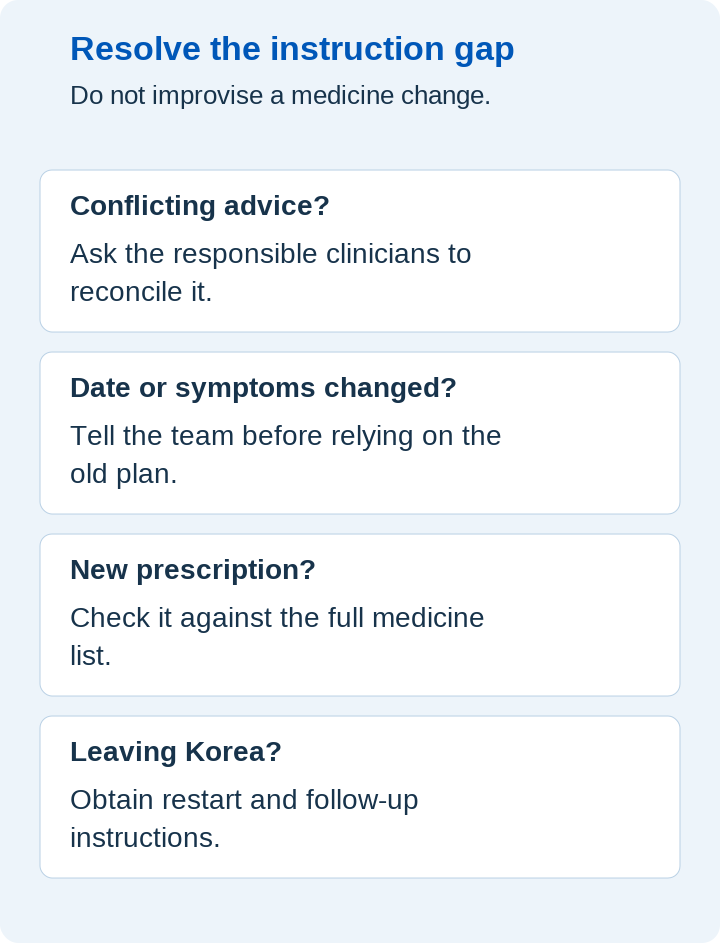
A medication list can be correct on the day you send it and out of date by the time you reach Seoul. If a clinician starts, stops or changes a medicine, record the date, the new prescription and the reason given. Tell the preoperative team and ask whether their earlier instructions still apply. Keep the updated answer with the list you bring on the day of surgery. A change in travel dates is also a reason to reconfirm any date-specific instructions.
The useful output is a dated, individualized plan. It should distinguish medicines to continue, medicines the team wants adjusted, and questions still needing a decision. This guide explains how to obtain that plan. It does not supply a stopping timetable, fasting prescription or clearance for surgery. General anesthesia resources apply across many operations; they do not determine the right instructions for your particular facial procedure or medical history.
Further reading: www.plasticsurgery.org ↗ · rcoa.ac.uk ↗
What belongs in the record?
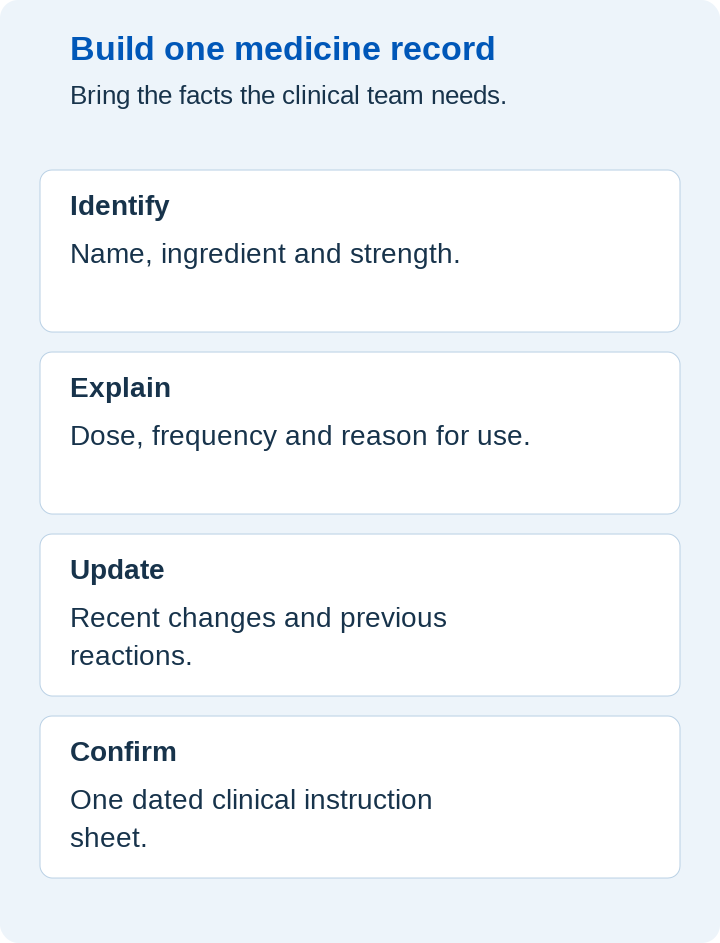
Include prescribed tablets, injections, patches, inhalers, eye drops and medicines you use only occasionally. Add products bought without a prescription, herbal preparations, vitamins, traditional remedies, sports supplements and weight-management treatments. A medicine prescribed privately or online belongs on the list just as much as one prescribed by your usual doctor.
For each item, record its generic name if known, brand, strength, actual dose, frequency, reason for use and the clinician or service prescribing it. Keep the original label or a clear photograph beside the entry. If you cannot identify an ingredient, say so. A pharmacist can help check the record. Do not guess from a tablet's color or translate a brand name into a different medicine with a similar name.
Further reading: www.plasticsurgery.org ↗
Show what you actually take
A prescription describes what was intended; the team also needs to know what you are currently using. Note occasional doses, missed doses, recently completed courses and medicines you started after the first inquiry. If a product contains several ingredients, show the complete packaging rather than writing only pain relief or sleep aid. Explain any difference between the label and your usual routine without embarrassment.
A practical record has a date at the top and one owner who updates it, usually you. Before each appointment, compare it with the products at home. After a new prescription, change that same record rather than creating another competing version. Bring uncertainties to the consultation instead of deleting them to make the form look simpler. Accurate information is more useful than an apparently uncomplicated history.
Further reading: www.plasticsurgery.org ↗
Ask who owns each medication decision
The surgeon, anesthetist and usual prescriber may each hold different pieces of your history. Ask which clinician will review the list and communicate the final instructions. A booking coordinator can arrange the conversation but should not be your only source for a complex medication change. If two clinical messages conflict, send both back to the responsible team and request one reconciled plan.
For example, a form saying stop blood thinners does not tell an individual reader what to do with a particular prescription or why it was prescribed. Ask for an instruction that names the medicine, identifies the decision-maker and explains the relevant timing. If an answer is still pending, mark it as unresolved. Do not interpret silence, a checked booking box or a deposit receipt as medical approval.
Further reading: rcoa.ac.uk ↗
Blood-thinning medicines need a specific discussion
Tell the team about anticoagulants, antiplatelet medicines and any history relevant to bleeding or clotting. The reason for treatment matters to the assessment. A medicine may be protecting against a serious problem, so stopping it is not automatically safer than continuing it. Your clinicians need to balance the risks in the context of the proposed operation.
Your preparation questions can be practical: who will speak to the prescriber, whether additional information is needed, and when you will receive a final decision. Ask who will provide restart instructions after surgery and what to do if the procedure date changes. Do not borrow a friend's schedule or assume a low dose is unimportant. This article cannot tell you whether a particular tablet should be withheld or for how long.
Further reading: rcoa.ac.uk ↗
GLP-1 and weight-management medicines: avoid outdated blanket rules
GLP-1 medicines used for diabetes or weight management can slow stomach emptying, which matters during anesthesia. Current ASA patient information describes an individualized approach: many patients can continue treatment, while some need additional precautions or a delay. Recent dose increases, digestive symptoms and other medical factors can change the assessment. A universal instruction to stop every weekly injection is not an adequate personal plan.
Tell the team the exact product, dosing pattern, date of the last dose, recent dose changes and any nausea, vomiting, bloating or other digestive symptoms. Ask the prescriber and anesthesia team to agree what applies to you. Do not adopt a liquid diet, extend fasting or interrupt diabetes treatment on your own. Ask what to do if symptoms appear or the operation moves to another date.
Further reading: madeforthismoment.asahq.org ↗
Supplements are part of anesthesia preparation
Natural does not mean irrelevant to surgery. Some supplements can affect bleeding, blood pressure or the action of anesthetic medicines. The effects depend on the product and circumstances, and a long list of internet interactions cannot replace review of the actual ingredients you take. Include concentrated herbal products and combinations marketed for energy, sleep, skin or recovery.
Bring the label and ask whether the team needs further ingredient information. Avoid adding a new supplement to prepare for surgery without checking it first. If you have already taken a product the team later asks you to avoid, report the name, amount and timing honestly. Do not try to compensate by changing other medicines, taking extra fluids or extending fasting. The clinical team decides whether the plan needs to change.
Further reading: www.asahq.org ↗
Describe allergies and previous reactions clearly
An allergy label is more informative when it includes what happened. Record the suspected medicine, symptoms, approximate timing, treatment required and whether a clinician confirmed the cause. If records of a severe reaction or previous anesthetic problem exist, ask how to provide them. It is also useful to distinguish a known allergy from an unpleasant side effect when that distinction has been assessed.
Do not remove an allergy from your history because you are unsure of its meaning. Write uncertain and explain what you remember. Ask whether the anesthesia team needs old hospital notes or a separate assessment before travel. Previous surgery without a problem does not make the current medication review optional, particularly when your health or prescriptions have changed since then.
Further reading: www.plasticsurgery.org ↗
Get a usable written instruction sheet
Ask for a single dated sheet linked to the planned operation and arrival time. It should name the medicines, spell out any clinician-directed change, and state who to contact if a dose is taken differently from the plan. Fasting instructions should come from the clinical team and should be separate from your general medication inventory. A heading such as follow usual precautions is not specific enough when you have an unanswered question.
Check the language as carefully as the dose. Ask an interpreter to clarify unfamiliar medical words, units and times rather than relying on automatic translation alone. Repeat the key points in your own words. If the document is updated, mark the old copy as superseded so that a companion does not accidentally follow it on the morning of surgery.
Further reading: rcoa.ac.uk ↗
Plan for travel without turning this into customs advice
For care across countries, keep the medication record available both to the Korean team and to your clinician at home. Ask the clinic which documents it needs before travel and which originals or packaging to bring. Use the provider's verified channel for health information, and keep a private copy you can reach during the trip. Avoid sending your full medical record to an unverified social-media account.
Clinical permission to take a medicine is not permission to import it. Check the current official entry requirements for your exact products and destinations separately, especially where controlled medicines are involved. This guide does not establish legal quantities or permit rules. Build time for questions into the trip, rather than discovering an unresolved medication issue after arriving for a same-day operation.
Further reading: www.cdc.gov ↗
The plan must include after surgery
Before discharge, ask which regular medicines to resume, which instructions have changed, and who will answer questions after you leave Korea. Keep the new postoperative prescription alongside the preoperative list so a pharmacist or clinician can check the complete picture. Ask before combining a clinic prescription with a product you brought from home; two different brands can contain the same ingredient.
If swallowing or nausea makes the prescribed plan difficult, contact the treating team instead of crushing, opening or substituting medicines without advice. Ask what information a local clinician should receive if you need care after returning home. The point is continuity: a plan that ends at the operating-room door leaves an important part of the medication decision unfinished.
Further reading: www.cdc.gov ↗
Common questions before the consultation
Should I stop all supplements now? No general article can make that decision for your products and health history. Send the complete list early and obtain individualized directions. If the appointment is close, contact the team promptly rather than creating your own stopping schedule.
What if the clinic's message differs from my prescriber's advice? Ask the clinicians to reconcile the difference and provide a clear final instruction. Do not choose the instruction that best fits your travel plans.
Does mentioning a weight-loss injection automatically cancel surgery? No. It prompts an assessment of the medicine and your situation. Be accurate about symptoms and dose changes, and leave the decision to the clinical team.
Is a photograph of the bottles enough? It is useful supporting information, but also explain how you take each product and why. A label alone may not show your current routine or a recent change.
Further reading: madeforthismoment.asahq.org ↗ · www.asahq.org ↗
Leave the appointment with answers you can use
Before considering the medication review finished, check that the team has the latest list, knows about allergies and prior reactions, and has identified any unresolved decisions. Keep the responsible contact and a dated copy of the instructions with your travel documents. If something changes, send an update rather than assuming the old plan still applies.
You can use a simple final question: if I needed to explain tomorrow's plan to another clinician, would I know which document to show and who approved it? If not, request clarification. Taking time to resolve a medication question is a preparation step, not a failure to be ready. Elective facial surgery should fit around a safe medical plan, rather than the medical plan being improvised around a fixed itinerary.
Clinics and doctors to explore
These listed providers were selected because their published services and named care teams relate to the questions in this guide. Use their profiles to prepare a consultation and confirm the proposed operation and follow-up.
Faceline Plastic Surgery
Faceline publishes facial bone-contouring services and identifies an anesthesia team on its international service information. It is relevant for asking how a proposed contouring operation is coordinated with a medication review. These are provider-published service descriptions, not independent safety certification. Confirm who will review your medicines and issue your personal instructions.
Explore Dr. Lee Jin-soo’s profile ↗
Review the international website and ask about consultation ↗