What anesthesia means for V-line surgery
Anesthesia is not just a medicine that makes an operation comfortable. It is a plan for breathing, circulation, monitoring, pain control and safe recovery, tailored to the operation and the individual. V-line is a broad description of lower-face contouring: the planned bone work, length of surgery and any combined procedures can differ. Ask your surgeon and anesthesia clinician to describe the proposed anesthetic for your exact operation and where you will recover. General anesthesia means being unconscious during surgery; sedation is different and has different levels of effect. Do not assume that a website’s general description substitutes for your assessment.
If you travel to Korea for care, arrange the anesthesia discussion before you commit to non-refundable flights. Allow time for records to be translated and for additional evaluation if needed. A reassuring consultation should explain both ordinary side effects and uncommon but serious complications, and leave space for your questions. The care team may recommend delaying elective surgery if an issue needs assessment first. Choosing to wait is a valid decision, not a failure of preparation.
Further reading: www.nhs.uk ↗ · www.rcoa.ac.uk ↗
Who assesses you and what should you ask?
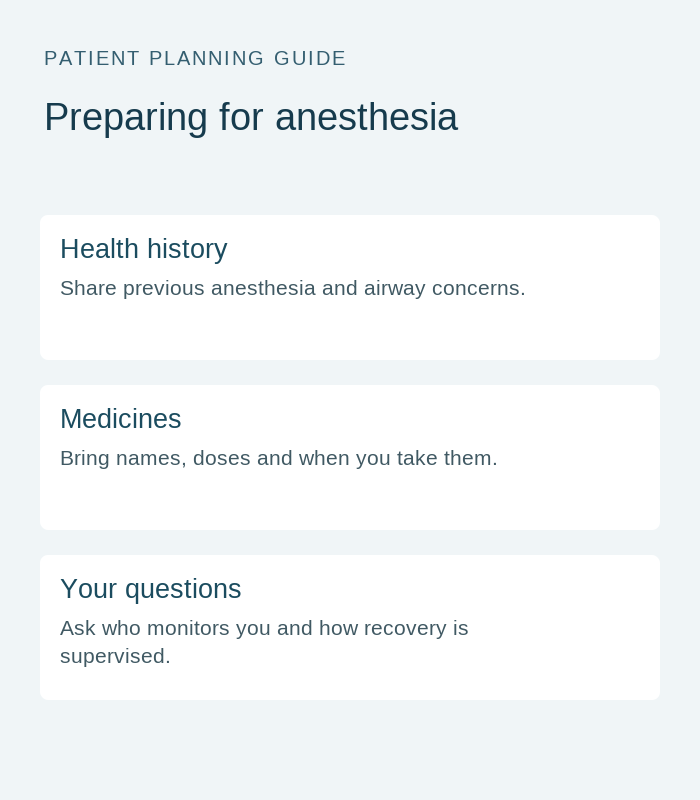
Ask who will lead the anesthesia care, their role and qualifications, whether you can speak with them before the day of surgery, and who will monitor you continuously during the operation and early recovery. Ask where the procedure is performed, what monitoring and emergency resources are available, and how transfer to higher-level care would be arranged if needed. These questions are not a way to guarantee a complication-free operation; they help you understand the actual care pathway.
Provide a written list of conditions, previous operations, allergies and medication reactions. Mention any prior difficult intubation, severe sickness after anesthesia, awareness during anesthesia, or unexpected family reaction to anesthetic medicines. If you have received a special anesthesia alert card, bring it. Ask what information the team has received from your online questionnaire and have the interpreter repeat back important details. A marketing description, an empty field on a form or a social-media safety claim cannot replace an individual assessment.
Further reading: www.rcoa.ac.uk ↗ · www.nhs.uk ↗
Breathing, airway and jaw-specific planning
Facial operations take place close to the mouth and airway. The anesthesia clinician and surgeon need a plan for breathing support and for the transition to recovery; the choice of airway technique depends on your anatomy, procedure and clinical assessment. Ask how the plan accounts for limited mouth opening, a previous difficult airway, dental work, nasal obstruction or previous facial surgery. Do not try to select a tube route or technique for yourself from a photograph or another patient’s account.
Tell the team about obstructive sleep apnoea, loud snoring, witnessed pauses in breathing, daytime sleepiness or use of CPAP. A diagnosis is not the only reason to raise concern: symptoms that have never been assessed matter too. The team can decide whether further evaluation, changes to medication or monitoring, a planned overnight stay or other precautions are appropriate. Bring your CPAP details and ask whether and when your own equipment can be used after facial surgery; pressure against the surgical area may require a specific plan. Never discontinue or improvise a treatment without your clinician.
Further reading: madeforthismoment.asahq.org ↗ · www.nhs.uk ↗
Medicines, supplements and substances
Make a single list with each product’s name, dose, usual timing, reason for use and the name of the prescriber. Include prescription and non-prescription medicines, diabetes treatments, anticoagulants or antiplatelet drugs, pain medicines, inhalers, vitamins, herbal products and weight-management medicines. Note injections and when you last took them. Include alcohol, nicotine, vaping, cannabis and other recreational substances honestly: the purpose is to plan safe care, not to judge you. Translated packaging or a photograph of the label can help if the brand name differs in Korea.
Ask the anesthesia team for an individual written plan that says what to continue, hold or adjust and precisely when to restart. Some medicines have risks if stopped abruptly; others can affect bleeding, blood glucose, stomach emptying or the anesthetic. Do not stop blood thinners, insulin, psychiatric medicines or any regular treatment just because an online checklist says to do so. If another doctor manages a medicine, ask who will coordinate that decision. Record changes made after you arrive and keep an up-to-date copy for your companion and home clinician.
Further reading: www.nhs.uk ↗ · www.rcoa.ac.uk ↗
Fasting instructions: follow your own team
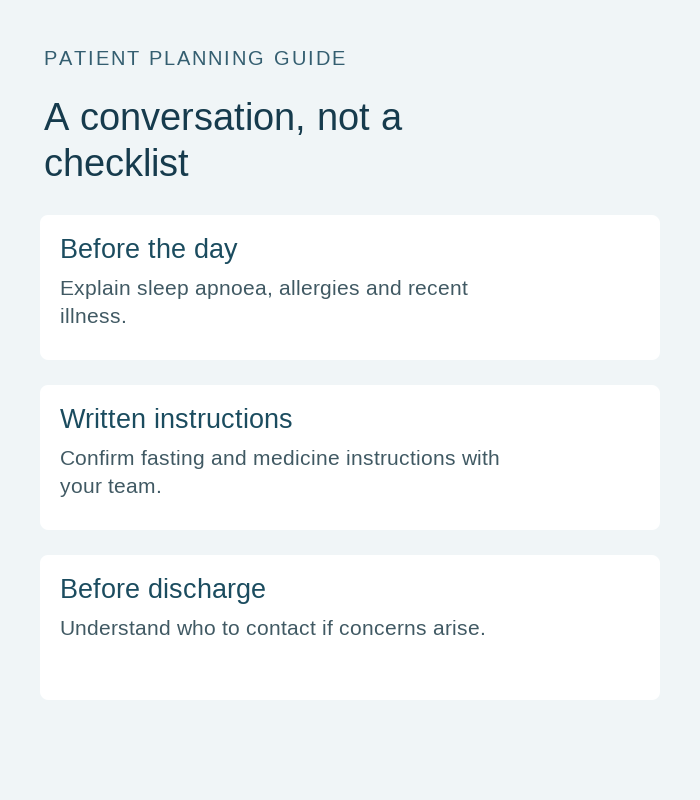
Fasting is used to reduce the chance that stomach contents enter the lungs while protective reflexes are affected by anesthesia. The exact instructions can differ by hospital, medicine, health condition and timing of surgery. Ask for the cut-off for solid food and for each type of drink, including milk, coffee, juice, water, gum and sweets. Ask whether your morning medicines may be taken and with what amount of water. Do not copy a universal time from a travel forum or fast longer than directed in the belief that longer is always safer.
If you accidentally eat, drink or chew something outside your instructions, tell the team exactly what and when. The team can reassess; hiding it creates risk. Likewise, if your operation is delayed, ask whether the fasting plan has changed rather than making a new plan yourself. People with diabetes or treatments that affect glucose may need an individual plan. Obtain the instructions in a language you understand and confirm whether the stated time is admission time or expected anesthetic time.
Further reading: www.nhs.uk ↗
Illness and decisions to postpone
Contact the clinic before traveling to the facility if you develop a fever, cough, respiratory infection, vomiting or another new health problem, or if a regular condition has become less stable. Tell them if you have started a new medicine or had an emergency visit since the assessment. Even seemingly minor changes can affect an anesthetic plan, but not every symptom means an operation must be cancelled: that judgement belongs to the treating team.
Have a practical postponement plan before leaving home. Ask whether assessment or surgery fees are refundable, how a change affects accommodation and flights, and how the team will communicate an updated date. Confirm whether your travel insurance covers complications or changes related to elective care. These are separate questions from medical suitability. Never feel pressured to conceal illness because you are worried about losing a booking.
Further reading: www.rcoa.ac.uk ↗
From admission to the recovery area
On arrival you may be asked to confirm your identity, the planned operation, allergies and fasting history several times. A clinician will review your health information and discuss the proposed anesthetic. A cannula and monitoring devices may be used. During general anesthesia, the anesthesia professional monitors and adjusts care while the surgical team operates. Ask in advance how you can communicate if you are worried and how an interpreter or companion will be involved.
Afterwards, you are monitored while waking and the team assesses breathing, comfort, nausea and other recovery needs. A sore throat, hoarseness, thirst, shivering, nausea or temporary drowsiness can occur; tell staff about symptoms instead of assuming you must tolerate them. The team will decide when you meet the criteria for discharge or transfer to your room. The fact that you are awake does not mean you are ready to travel independently or make important decisions.
Further reading: www.nhs.uk ↗
Side effects, complications and uncertainty
Ask the anesthesia clinician to explain the risks that matter most for your health and procedure and what is done if a problem occurs. Common temporary effects include nausea, sore throat, drowsiness, shivering and discomfort at an injection site. The NHS also describes uncommon complications including serious allergic reactions, breathing difficulty, chest infection, dental or mouth injury, and longer-lasting confusion. Serious complications can occur despite careful preparation; personal risk cannot be inferred from another clinic’s published percentage or a promise of a perfect safety record.
Explain loose teeth, crowns, dental appliances and past dental injury so the team can assess them. Discuss prior postoperative nausea or motion sickness; preventive and treatment options may be available. Ask whether discomfort comes from the operation, the anesthetic or another cause and whom to contact if it is not improving. A list of possible effects helps you ask informed questions; it is not a prediction of which effects you will experience.
Further reading: www.nhs.uk ↗
A clear plan for the first day and overnight
Before the operation, establish where you will spend the first night and who will be with you. Ask what observations are planned, what must happen before discharge, and who will evaluate you if symptoms change. If same-day discharge is proposed, confirm the name and telephone number of the responsible service and how a companion should obtain help. General anesthetic medicines can affect alertness and judgement after you leave hospital; follow your own team’s instructions about driving, alcohol, important decisions and supervision.
Facial swelling, pain, mouth care and eating restrictions are also surgical issues, so ask the surgeon and anesthesia team for a single coherent plan. Clarify how pain and nausea medicines are taken, what to do if you cannot keep fluids or medicines down, and whether an interpreter can help outside normal hours. Write down the address of your accommodation in Korean and English and the location of the nearest emergency service. An aftercare package is not a substitute for a route back to a qualified clinician.
Further reading: www.nhs.uk ↗ · www.rcoa.ac.uk ↗
When to seek urgent help
If breathing is difficult, you collapse, have severe chest pain, or experience rapidly worsening swelling affecting breathing or swallowing, seek emergency help immediately rather than waiting for a routine appointment or sending a message. In South Korea the emergency ambulance number is 119. Ask your team before discharge which other symptoms should trigger an immediate call and which service answers at night. Increasing bleeding, inability to drink, repeated vomiting, unusual confusion or symptoms that are worsening rather than improving need prompt assessment; follow the emergency instructions specific to you.
A phone photo can help describe swelling but cannot assess an airway or replace an examination. If you are abroad, have your companion carry the operation and medication record and know how to explain your location. For symptoms after returning home, tell the receiving team that you recently had surgery and anesthesia, provide your discharge summary and contact the operating clinic as advised. Do not wait for an overseas clinic to reply when emergency care is needed locally.
Further reading: www.nhs.uk ↗
Questions to take to a consultation
A short written list can make a remote appointment more useful. What exact operation and anesthetic are proposed for me? Who is responsible for anesthesia before, during and after surgery? How will my airway and dental work be assessed? Do my sleep symptoms or prior reactions change the observation plan? What fasting and medication instructions apply to my situation? What will happen if I become unwell before surgery? Where will I recover and what must happen before I leave?
Also ask how the team manages complications, where urgent care is available overnight, whether interpretation is available, and when the surgeon expects to reassess fitness for travel. Ask for the answers and the quote in writing, including anesthesia, facility and any overnight observation charges. Review them away from the sales conversation. If you cannot obtain a clear answer or understand who would manage an emergency, it is reasonable to seek another opinion before consenting.
Further reading: www.rcoa.ac.uk ↗
A listed clinic for a facial contouring consultation
Faceline Plastic Surgery describes V-line sculpting among its facial bone contouring services. Its English-language service information reports an in-house anaesthesiologist for its procedures. These are clinic statements, not an independent safety rating or a guarantee about your own care. A useful first step is to review the service and ask the clinic who will provide anesthesia for your proposed operation, what assessment is required, and what monitoring and emergency arrangements apply to you.
Use the official facial-contouring service link in the clinic section below, and compare the proposed plan with other appropriate providers. This clinic is included because it lists the relevant service and an international information page, not because its suitability for you has been established. A consultation does not commit you to surgery; discuss alternatives and the option of no operation.
Further reading: www.facelineplasticsurgery.com ↗
Common questions
Can I choose sedation instead of general anesthesia? The appropriate technique depends on your proposed operation and health. Ask your anesthesia professional why a technique is recommended and what alternatives, if any, are suitable. A choice based on avoiding one feared side effect may overlook airway or procedural requirements.
Does a normal blood test mean anesthesia is risk free? No single test establishes that. The team considers your history, examination, proposed surgery and any investigations together. Ask what each test is intended to answer and whether outstanding results could change the plan.
Can I fly immediately after discharge? Discharge and fitness for a long international flight are different decisions. Ask your surgeon and anesthesia team to assess your recovery and travel risks, arrange the required postoperative review, and build flexibility into the booking. A written discharge summary and a follow-up contact at home are useful. Seek immediate emergency care for difficulty breathing or severe chest pain rather than boarding a flight; call local emergency services. In South Korea, call 119.
What if I cannot understand the consent discussion? Request a qualified interpreter or another arrangement that allows you to understand alternatives, risks and follow-up. Ask the team to explain unfamiliar terms and repeat important instructions. You can take time to consider the decision and decline or postpone an elective procedure.
Further reading: www.nhs.uk ↗ · www.nhs.uk ↗
Clinics and doctors to explore
These listed providers were selected because their published services and named care teams relate to the questions in this guide. Use their profiles to prepare a consultation and confirm the proposed operation and follow-up.
Faceline Plastic Surgery
Faceline lists jaw-angle, mandibular-body and chin contouring on its facial bone service page. These services make the clinic a relevant place to discuss the procedure and your own planning questions; the listing is not a comparative safety ranking.
Explore Dr. Lee Jin-soo’s profile ↗
Review the international website and ask about consultation ↗Sources & further reading
- https://www.nhs.uk/tests-and-treatments/general-anaesthesia/ ↗
- https://www.nhs.uk/tests-and-treatments/having-surgery/preparation/ ↗
- https://www.rcoa.ac.uk/patients/patient-information-resources/preparing-for-surgery ↗
- https://madeforthismoment.asahq.org/preparing-for-surgery/risks/sleep-apnea/ ↗
- https://www.facelineplasticsurgery.com/specialties/facial-bone-contouring ↗