Why smoking belongs in a V-line assessment
Smoking is not a cosmetic detail in a jaw-contouring consultation. Tobacco smoking is associated with higher rates of breathing and heart complications around an operation, wound infection and delayed healing. V-line surgery can involve shaping the jaw angle, the chin or both, so your surgeon needs to assess the planned operation as well as your individual health. The name “V-line” does not tell you which tissues will be involved or what recovery plan you need.
Tell both the surgeon and anesthesia clinician what you currently use, even if you are trying to quit or use only occasionally. They need a realistic account to assess the airway, explain risk and help plan support. This is a conversation about reducing risk, not a test of willpower. A photograph, a normal-looking face or a favorable online quote cannot replace this assessment. If you have already booked a flight, share that date, but do not let travel arrangements prevent a clinically appropriate reassessment.
Stopping tobacco as early as possible is helpful. The World Health Organization reports that stopping approximately four weeks or more before surgery is associated with fewer complications; some surgical services recommend longer. This is general surgical evidence, not a promise that four weeks eliminates risk or is the required interval for your procedure. Ask your own team for its requirements before paying a nonrefundable deposit.
How smoking can affect anesthesia and breathing
Anesthesia clinicians need to know about smoking because the lungs and airway may respond differently during anesthesia and recovery. Tobacco smoke irritates the airways and can affect oxygen delivery. People who smoke are more likely to experience postoperative breathing problems and chest infections. Your clinician will consider the frequency and duration of use along with your overall health; the effect on one individual cannot be calculated from this article.
Mention a persistent cough, wheeze, shortness of breath, asthma, sleep apnea, recent respiratory infection or previous difficulty during anesthesia. Also bring information about prescribed inhalers and any oxygen treatment. A recent cold or worsening cough can change the assessment even after the initial online consultation. Contact the team promptly if something changes instead of waiting until you arrive at the facility.
Ask who will provide anesthesia, when you will meet them, how your airway will be assessed and what monitoring is planned during and immediately after surgery. Jaw contouring and double-jaw surgery are not interchangeable descriptions; explain every proposed procedure rather than relying on a package name. If you need an interpreter, request one who can communicate medical details in both directions and clarify who to call later if you develop symptoms.
Healing, infection and bone: what the evidence means
Healing depends on circulation, oxygen, nutrition, the operation and many individual factors. WHO describes higher risks of infection and delayed or impaired wound healing among tobacco smokers. NHS surgical information also identifies slower bone and wound healing as a concern. These observations do not predict that any particular patient will develop an infection or a bone-healing problem, and the size of the risk for a specific V-line technique cannot be inferred from general surgery advice.
A surgical incision may be inside the mouth or elsewhere depending on the operation. Ask where your incisions will be, which bones will be shaped or repositioned, and whether hardware is planned. The answer helps you understand why a tailored healing and follow-up plan matters. Ask how the clinic will distinguish expected changes from a concerning trend, and obtain written instructions for mouth care, medicines, eating and review appointments.
Do not use a normal-looking outer scar as the only sign of internal healing. Contact the operating team about increasing pain, swelling, a fever or discharge, particularly when symptoms worsen rather than improve. Severe difficulty breathing, significant uncontrolled bleeding, fainting or another rapidly worsening emergency needs immediate emergency care rather than a delayed message to the clinic.
Cigarettes, heated tobacco, vaping and nicotine are not identical
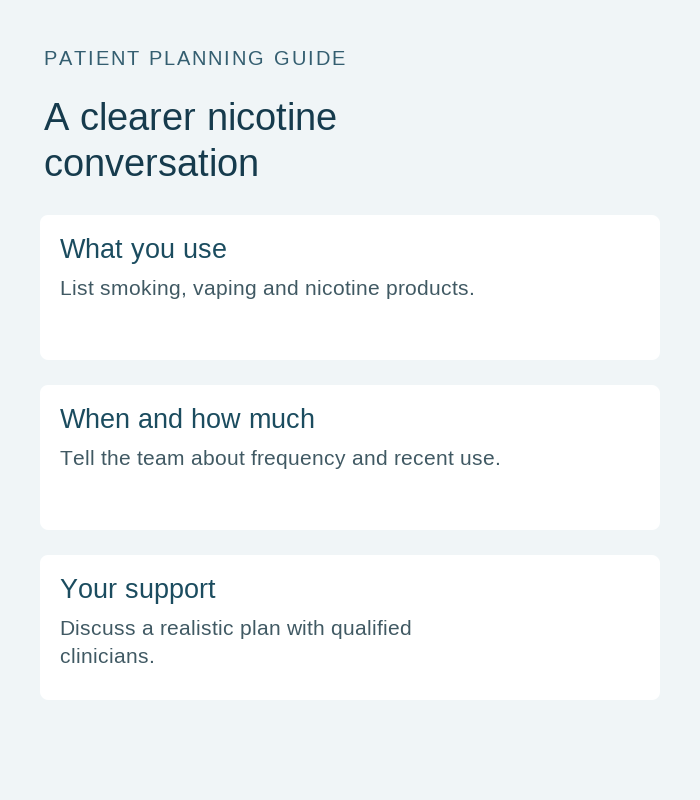
Give the team the name and form of every product: cigarettes, cigars, heated tobacco, waterpipe, electronic cigarettes, nicotine pouches, patches, gum or other products. Note whether a vape contains nicotine, how often you use it and when it was last used. If you do not know its contents, say so and bring the packaging or a photograph. Products and strengths differ, and “only a vape” does not convey enough detail for an anesthetic assessment.
Cigarette-smoke exposure and medicinal nicotine replacement are not the same exposure. Nicotine itself can affect blood vessels, while smoke also contains carbon monoxide and other substances. The evidence and instructions for e-cigarettes around facial bone surgery are less specific than the evidence on tobacco smoking. NHS sources recommend disclosing vaping and reducing or stopping it before surgery, but recommendations vary by procedure and service. Do not assume vaping is risk-free or that its risk is numerically identical to cigarettes.
Some stop-smoking services use nicotine replacement to help people quit; some operations have nicotine-free requirements. Ask your surgeon and anesthetist whether a patch, gum, lozenge or other aid is suitable for your operation and what to do on the day. A home-country cessation clinician can help coordinate, but the operating team must know the complete plan. Do not start, stop or substitute a prescribed medicine solely because an online clinic's instructions differ from your own prescription.
How much time should I leave before surgery?
Begin the discussion as soon as you consider surgery. WHO reports lower complication risk among people who quit tobacco approximately four weeks or more before an operation, while individual hospitals may recommend six or eight weeks or a different interval. Those periods are not a validated deadline for every V-line procedure. The planned procedure, your breathing and cardiovascular health, and the team’s policy can all affect the advice. Ask for a written requirement that identifies tobacco smoke, vaping and nicotine-containing products separately.
If there is less time than recommended, do not conceal use or assume that quitting is pointless. An anesthesia patient guide advises stopping as soon as possible, even when only a short period remains. Contact the team now and ask whether an additional assessment or postponement is advisable. Only the treating clinicians can decide whether it is appropriate to proceed. For an elective procedure, it is reasonable to ask about postponement when it would allow a safer, less pressured plan.
Discuss how long the team wants you to avoid smoking after surgery too. You may need support during a clinic stay and once back at your accommodation. A date on a travel itinerary or a photograph showing less swelling is not the same as the team’s clearance to resume a product. Remaining smoke-free beyond the immediate perioperative period has broader health benefits, but agree any nicotine-replacement plan with your clinicians.
Preparing a useful, honest history
Write down what you use, roughly how much and how often, how long you have used it, your most recent use and previous attempts to stop. List nicotine products separately from tobacco smoke. Include any prescribed cessation medications, allergies and medicines for lung or heart disease. If you occasionally use cannabis or other inhaled or recreational substances, disclose those too; do not assume that a question about cigarettes includes everything the anesthetist needs to know.
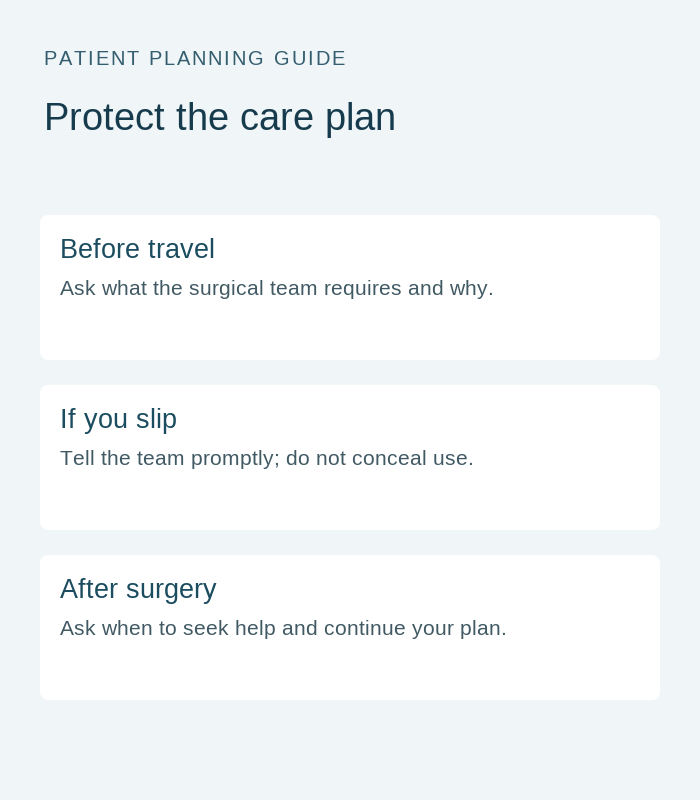
The purpose is to prevent surprises, not to secure a particular answer. A slip after a quit attempt is worth reporting. Give the clinician the date and product rather than deciding yourself that the operation must be canceled or that the exposure does not matter. Ask for an interpreter if you cannot comfortably explain a medication brand, a frequency or a symptom. Keep an English list and the packaging where practical, and request a written summary of the agreed plan.
Questions that can make this discussion concrete include: Does my planned operation require a tobacco-free period, a nicotine-free period, or both? Does the requirement apply to patches or gum? Who should I contact if I relapse or develop a cough? What will happen if I am not ready by the booked date? Who provides a written decision on whether to proceed?
What if I use nicotine replacement or quit medication?
Nicotine replacement therapy can help with withdrawal when quitting cigarettes. It may be offered as a patch, gum, lozenge or another form, and a trained clinician can help select an approach. NHS hospital guidance describes its use in surgical patients while also noting that some procedures have specific nicotine requirements. You need a single coordinated plan that your cessation clinician, surgeon and anesthesia clinician understand.
Ask whether the proposed aid fits your particular procedure, how it should be used while fasting, and whether it can be continued during your stay. Different products have different instructions; a patch is not interchangeable with something placed in the mouth when you have been told not to eat or drink. Do not infer an operating-day instruction from a different hospital's webpage. Ask what to do if the team asks you to be nicotine-free and you are concerned about cravings or relapse.
Prescription medicines used to support quitting also belong on the medication list. The anesthesia team can advise on the individual plan; do not discontinue them, or any regular medication, without speaking to the responsible prescriber. Arrange an appointment early enough that questions can be resolved before international travel rather than at admission.
A decision plan for an international trip
Before booking, ask for a consultation and written surgical assessment that addresses your actual tobacco and nicotine history. Confirm the expected preoperative assessment date, the clinician who can answer changes in symptoms, and whether an in-person evaluation could change the plan. A remote quote cannot confirm that your airway, dental health or other medical concerns have been fully examined.
Budget for the possibility that the operation or flight may need to change. Read deposit, cancellation and accommodation terms carefully and ask what happens if the surgical or anesthesia team recommends postponement. Check your travel insurance for elective surgery and complications in writing. Arrange a support person where the team recommends one and identify an appropriate urgent-care route in Korea rather than relying only on a messaging application.
Before returning home, obtain clear discharge instructions, a medication list and a contact method for the Korean team. Ask when you should be examined again, who will assess symptoms after travel and what records your local clinician will need. When the team assesses fitness to fly, explain any long journey, limited mobility or respiratory concerns. This conversation is separate from agreeing a date on a calendar.
When to pause and seek help
Call your treating team before surgery if you develop a new cough, fever, wheezing, breathlessness or another change in health, or if your tobacco and nicotine use differs from the plan you gave them. A clinician can advise whether you need an examination or a change of date. Do not stop a prescribed drug or change fasting instructions without the responsible clinician’s advice.
After surgery, ask the team which changes require an urgent examination and keep its written emergency instructions accessible. Severe breathing difficulty, significant uncontrolled bleeding, collapse or rapidly worsening symptoms are emergencies: seek local emergency help immediately. A cessation discussion does not replace assessment for an acute problem. For less urgent questions, give the team the symptom, onset, whether it is changing and the best number for a reply.
If you are finding it hard to stop, ask your own primary-care clinician, pharmacist or a stop-smoking service for support. A slip is information that helps the team plan. It should prompt an honest conversation, not silence or a rushed operation.
Clinic option for a focused consultation
Faceline’s facial bone-contouring page describes jaw-angle, mandibular-body and chin procedures, including V-line contouring. Its international service page identifies Dr. Jin-soo Lee as part of the facial-contouring team. These published service details make the clinic relevant to discussing the operation you are considering; they do not establish a comparative safety ranking or guarantee an outcome.
Use the consultation to ask how your proposed bone changes affect the anesthesia and healing plan, who will advise you about vaping or nicotine replacement, and what happens if you need to postpone. Review the clinic profile and its international service page, then request an individual assessment if it meets your needs. Confirm the current clinician, anesthesia arrangements and aftercare directly; do not assume that a clinic’s general page is a personalized medical clearance.
Questions patients commonly ask
Is vaping safer than smoking for surgery? These products expose you to different substances, and the effects cannot be treated as interchangeable. Neither a product label nor a general article establishes that vaping is safe for your operation. Tell the team exactly what you use and ask for an individual plan.
Can I use a nicotine patch? Some services use nicotine replacement to support quitting; some procedures require nicotine avoidance. Ask both the surgical and anesthesia teams before changing your plan. Never assume that a patch, gum and vaping are covered by the same instruction.
What if I smoked after the quit date? Tell the team as soon as possible, including what you used and when. They can assess the plan rather than guessing. A slip does not make it too late to ask for cessation support.
Can I hide smoking if my tests look normal? No. An assessment includes information that may not be apparent on a routine test, and withholding it can affect planning. Accurate information supports a safer anesthesia and recovery discussion.
Does stopping guarantee good healing? No. Stopping tobacco can reduce risk, but surgery and anesthesia still carry risks, and healing varies. Ask about alternatives, limitations, potential complications, and whether surgery is appropriate for you before giving consent.
Clinics and doctors to explore
These listed providers were selected because their published services and named care teams relate to the questions in this guide. Use their profiles to prepare a consultation and confirm the proposed operation and follow-up.
Faceline Plastic Surgery
Faceline lists jaw-angle, mandibular-body and chin contouring on its facial bone service page. These services make the clinic a relevant place to discuss the procedure and your own planning questions; the listing is not a comparative safety ranking.
Explore Dr. Lee Jin-soo’s profile ↗
Review the international website and ask about consultation ↗