Breathing or swallowing difficulty, rapidly increasing facial or neck swelling, or severe uncontrolled bleeding: seek emergency care immediately. In South Korea call 119.
When is bleeding after V-line surgery an emergency?
Severe or uncontrolled bleeding, difficulty breathing or swallowing, rapidly increasing facial or neck swelling, collapse or fainting needs immediate emergency assessment. Alert clinical staff at once if you are still in a facility; elsewhere, call local emergency services. In Korea the ambulance number is 119. Do not wait for a clinic message, photograph review, or a timed self-care attempt when severe symptoms are present. Tell responders you recently had facial bone surgery.
V-line surgery may involve jaw-angle contouring, chin bone surgery or a combination. A little blood-stained saliva may occur after some oral operations, but an article cannot tell you whether your own bleeding is safe. Get the surgeon’s written instructions and ask whom to contact after hours. When in doubt, seek prompt assessment. This guide is general education, not a diagnosis or individualized postoperative plan.
Further reading: www.cuh.nhs.uk ↗ · www.asph.nhs.uk ↗ · english.visitkorea.or.kr ↗
Bleeding and hematoma are not the same thing
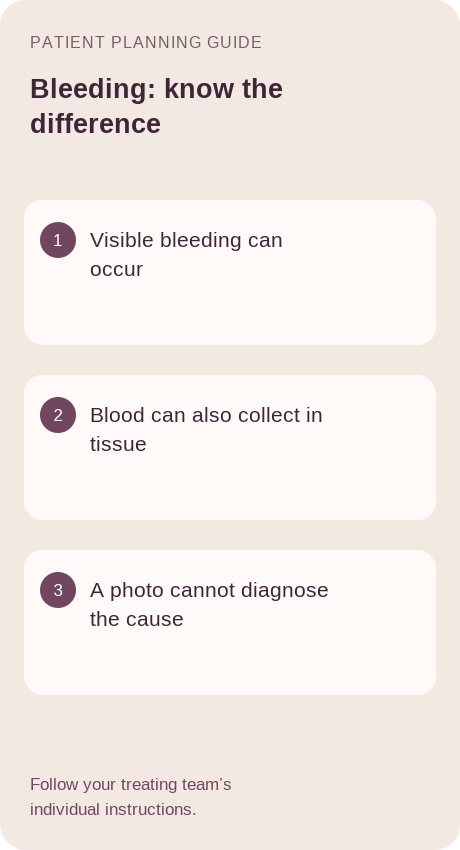
Bleeding means blood escaping from a vessel; it can be seen at an incision or collect deeper in tissue. A hematoma is a collection of blood within tissue. A review of postoperative maxillofacial care describes collections in the floor of the mouth or neck as potentially threatening the airway because of their location. A person may therefore have a serious problem even when little blood is visible outside the mouth. Location and progression matter, not just color on a tissue.
Bruising, swelling, bleeding and infection can overlap in appearance. A photograph cannot establish whether a swelling is a hematoma, whether it is stable, or whether it threatens the airway. Do not press on a growing lump, open a wound or attempt to drain it. Report a new or enlarging swelling promptly, and treat breathing or swallowing difficulty or rapidly increasing swelling as an emergency.
Further reading: pmc.ncbi.nlm.nih.gov ↗ · www.asph.nhs.uk ↗
Why the operation and setting matter
Facial bones and surrounding tissues have a blood supply. Published facial-contouring literature identifies bleeding and hematoma among possible complications of mandibular angle reduction. The chance and consequences depend on the actual surgical plan and individual circumstances. A study, a clinic advertisement, or another patient’s result cannot calculate your personal risk or prove a facility is prepared for an emergency.
Ask your surgeon which bones and tissues are involved, whether chin and jaw-angle procedures are combined, and what bleeding risks matter in your case. Ask the facility what monitoring is provided after surgery, who can examine you overnight, and how urgent transfer is arranged if needed. A written emergency pathway and available clinical staff are more informative than a general claim that a procedure is safe.
Further reading: pmc.ncbi.nlm.nih.gov ↗ · pmc.ncbi.nlm.nih.gov ↗
Before surgery: disclose bleeding history and medicines
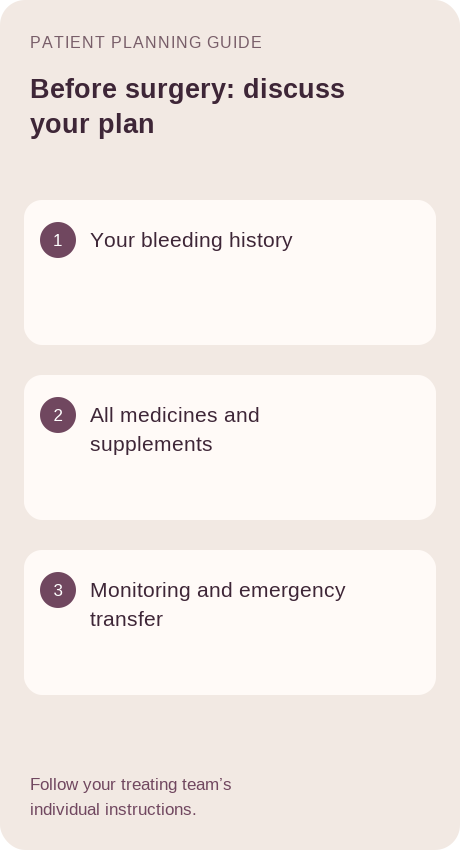
Tell the surgical and anesthesia teams if you have had prolonged bleeding after an operation, dental treatment, injury or childbirth, if you bruise unusually easily, or if a close relative has a known bleeding disorder. Mention prior transfusions and any condition your doctor has said affects clotting. The team can decide whether further assessment is appropriate; a normal-looking bruise history alone does not rule out a problem.
Bring a complete list of prescription medicines, over-the-counter products, vitamins, herbs and supplements, including doses and when you last took them. Anticoagulants and antiplatelet drugs have important purposes as well as bleeding implications. Do not stop or change a prescribed medicine on your own. Ask the surgeon and the prescribing clinician to agree on a written plan for any changes and for restarting treatment. Include allergies and previous reactions to anesthesia.
Further reading: www.cuh.nhs.uk ↗
What monitoring should I ask about?
Ask where you will recover immediately after surgery and where you will spend the first night. Who checks your breathing, swelling, pain and bleeding? How do you summon help if you cannot speak clearly? Is an appropriately trained clinician available to examine you urgently, and who can arrange a transfer? The answers should identify a real process, not just the name of a recovery room.
An observation plan may be changed if your recovery differs from expectations. A longer clinical stay is not necessarily evidence that something has gone wrong; it can be a response to an individual need. Conversely, discharge does not eliminate the possibility of a later complication. Ask what symptoms require calling the surgical team, what symptoms require emergency services, and what to do if the team cannot be reached.
Further reading: pmc.ncbi.nlm.nih.gov ↗ · www.cdc.gov ↗
A little blood-stained saliva versus concerning bleeding
Small amounts of oozing can occur after oral surgery, and blood mixed with saliva may look more dramatic than its volume. Still, color or a photograph alone cannot distinguish minor oozing from a significant bleed. Ask your own team what is expected after your precise procedure, how to assess a change and how to contact them at night. Increasing bleeding, repeated clots, weakness or a new swelling deserves prompt clinical attention.
Cambridge University Hospitals advises firm pressure with clean gauze or a clean handkerchief for persistent bleeding from an accessible oral wound after mouth or jaw surgery, with escalation if bleeding continues. This is general oral-surgery advice, not a validated protocol for every V-line incision. Follow your own team’s instructions if the wound is accessible and it is safe to do so. Do not reach into a difficult-to-access wound or delay emergency care for severe bleeding, breathing or swallowing difficulty, rapidly increasing swelling or fainting.
Further reading: www.cuh.nhs.uk ↗ · pmc.ncbi.nlm.nih.gov ↗
Why speed matters with swelling near the airway
Swelling after facial surgery can be expected, but a rapidly enlarging swelling of the mouth, jaw or neck needs immediate attention. Difficulty breathing or swallowing, trouble speaking, or a sense that the airway is narrowing should never be dismissed as routine recovery. Call local emergency services immediately. If you are with staff, alert them at once and stay where help can reach you.
A deep collection may need examination and treatment in a clinical setting. The maxillofacial care review describes potential airway compression from hematomas in certain locations; it does not mean that every postoperative swelling is a hematoma. Do not use a mirror, a home measurement or an online chat to decide that it is safe to wait. Your companion should know the same warning signs and the emergency location before you leave the facility.
Further reading: pmc.ncbi.nlm.nih.gov ↗ · www.nhs.uk ↗
What might the team do if bleeding occurs?
The response depends on where the bleeding is, how much there is, whether the airway is affected and your overall condition. A clinician may examine you, monitor your vital signs and decide whether further investigation or treatment is needed. Sometimes an intervention or hospital transfer is necessary. Ask your surgeon in advance how care is escalated and what resources are available. A drain, when used, does not make observation unnecessary or guarantee that bleeding cannot occur.
Do not interpret a general list of possible treatments as a promise that any particular intervention will be needed. If you take medicines affecting clotting, tell the team their names and the time of the last dose. If someone else accompanies you, they can bring the medicine list and operation details while you receive care. Financial and insurance arrangements matter, but must not delay emergency assessment.
Further reading: pmc.ncbi.nlm.nih.gov ↗ · www.cdc.gov ↗
Prepare a usable plan for Korea
Before the operation, save the clinic’s daytime and after-hours numbers, the address of your accommodation and the route to an appropriate emergency department. Ask whether an interpreter is available for an urgent call and how a transfer is initiated. Give a trusted companion the information you want them to have and a simple written description of the operation. Keep your phone charged, and use a method to call for help that works when speaking is uncomfortable.
In a life-threatening emergency in South Korea, call 119. Do not assume a recovery hotel, travel facilitator or online coordinator can provide clinical monitoring or emergency treatment. Ask who will follow you after discharge and who will act if the surgeon is unavailable. The CDC recommends that medical travelers obtain records and not delay care for suspected complications.
Further reading: www.cdc.gov ↗ · english.visitkorea.or.kr ↗
After returning home
A complication can become apparent after travel. Arrange in advance how to obtain an operative summary, medication list, imaging and emergency contact details in a language a clinician at home can use. If you seek care, explain the date and location of your operation and disclose all medicines and treatments received abroad. A local emergency clinician can assess you even if the original surgeon is in another country.
Do not board a flight with new significant bleeding, progressive swelling or breathing or swallowing difficulty. For severe uncontrolled bleeding, rapidly increasing facial or neck swelling, or difficulty breathing or swallowing, seek emergency care immediately; call local emergency services. In South Korea, call 119. Other concerning changes need prompt clinical assessment. A planned travel date or non-refundable ticket does not outweigh an emergency. Ask the operating team when they need to examine you before travel and how they will coordinate with a clinician at home if concerns arise.
Further reading: www.cdc.gov ↗
Questions to ask before choosing care
Ask: What procedures am I actually having? How do my health history and medicines change the bleeding discussion? Who is available overnight? How will you recognize and respond to a growing collection? Where would I be transferred, and who decides? What bleeding or swelling should trigger a call, and which symptoms mean calling emergency services immediately?
Ask for written answers and the after-hours number, then discuss anything unclear with your surgeon. You may choose to delay or decline elective surgery if you cannot obtain a credible plan. Comparing providers on the basis of a quote alone cannot tell you how an urgent complication will be managed. Take time to understand clinical coverage, the follow-up schedule and the process for sharing records.
Further reading: www.cuh.nhs.uk ↗ · www.cdc.gov ↗
Common questions
Does a hematoma always mean visible bleeding? No. Blood can collect in tissue, so visible bleeding is not required. Does normal swelling prove there is no problem? No. Only a clinician can assess the pattern and cause. Rapidly increasing facial or neck swelling, breathing or swallowing difficulty, or severe uncontrolled bleeding warrants immediate emergency care.
Should I stop my blood thinner before surgery? Never change it without the prescriber’s and surgical team’s plan. Does a drain prevent hematoma? No device provides a guarantee, and the decision to use one depends on the operation. Can I wait until morning if I am worried? Do not wait for severe symptoms; for a less urgent concern, contact the surgical team promptly using the after-hours plan and seek local assessment if you cannot get timely advice.
Further reading: www.cuh.nhs.uk ↗ · pmc.ncbi.nlm.nih.gov ↗
Clinics and doctors to explore
These listed providers were selected because their published services and named care teams relate to the questions in this guide. Use their profiles to prepare a consultation and confirm the proposed operation and follow-up.
Face Plus Plastic Surgery
Face Plus publishes a V-line service page that discusses bleeding and hematoma. Ask the team to explain its monitoring and emergency response for your specific plan.
Explore Dr. Jung Keun Park’s profile ↗
Review the international website and ask about consultation ↗