What should you check when choosing a V-line surgeon in Korea?
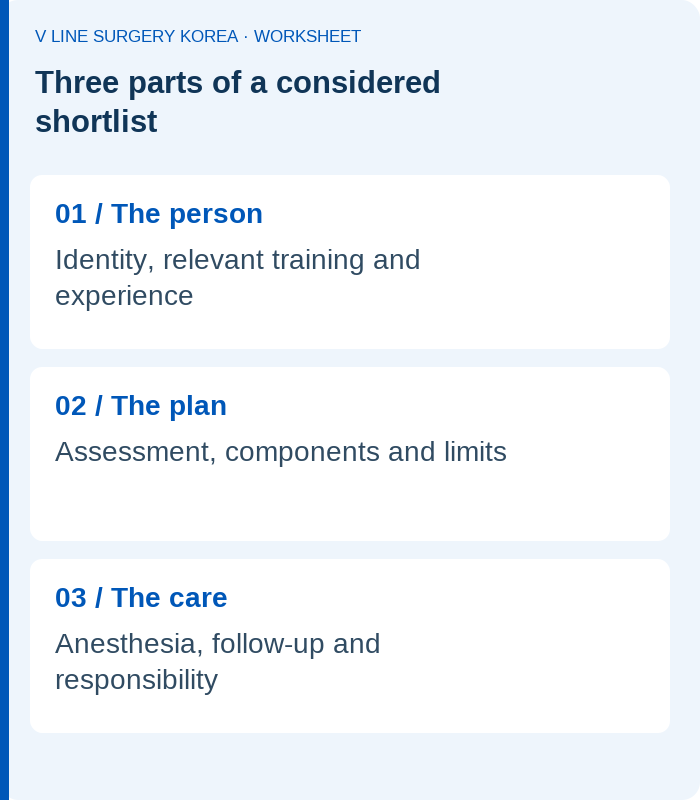
Check the surgeon’s identity, relevant specialty training and experience with the exact proposed procedures. Meet the operating surgeon, ask how your anatomy limits the plan, and clarify anesthesia, facility and follow-up responsibilities. Compare explanations and continuity of care rather than ranking clinicians by social followers, dramatic photographs or an unverified best-surgeon label.
Start with the exact procedure
V-line is broad enough to include different combinations of bone contouring and chin surgery. Ask which operations the clinician routinely performs and which are recommended for you. Relevant experience should match the proposed procedure, not merely cosmetic surgery in general. A surgeon who performs many unrelated treatments may still be appropriate, but the connection needs to be explained. The central question is whether the clinician can diagnose your concern and manage the risks of the specific plan.
Verify qualifications in context
Ask for the surgeon's full name, specialty training and relevant certification, and use appropriate Korean professional or institutional sources to verify the information where possible. Titles used in advertising may not explain the underlying qualification. International memberships and conference attendance are not substitutes for specialty training. Avoid assuming that a foreign certification checklist applies unchanged in Korea. What matters is a clear, verifiable account of the clinician's training and scope of practice.
Further reading: www.nhs.uk ↗
Meet the person responsible for the operation
A coordinator may organize the visit and explain logistics, but the operating surgeon should assess you and discuss the medical plan. Confirm who will perform each major component and how that identity is documented. Ask who will see you during postoperative reviews and who covers urgent concerns when the surgeon is unavailable. A polished consultation service is useful, but it should not obscure responsibility for clinical decisions and follow-up.
Further reading: www.rcseng.ac.uk ↗
Assess the quality of the explanation
The surgeon should distinguish bone, muscle and soft-tissue causes; review the bite when relevant; and explain the anatomical limits of reduction. Ask why the proposed technique is suitable and what a more conservative alternative would achieve. A thoughtful answer includes trade-offs and uncertainty. Be cautious if every patient receives the same package or if questions about sensation, asymmetry and revision are dismissed. Clear reasoning is more informative than a claim of an exclusive technique.
Use case photographs carefully
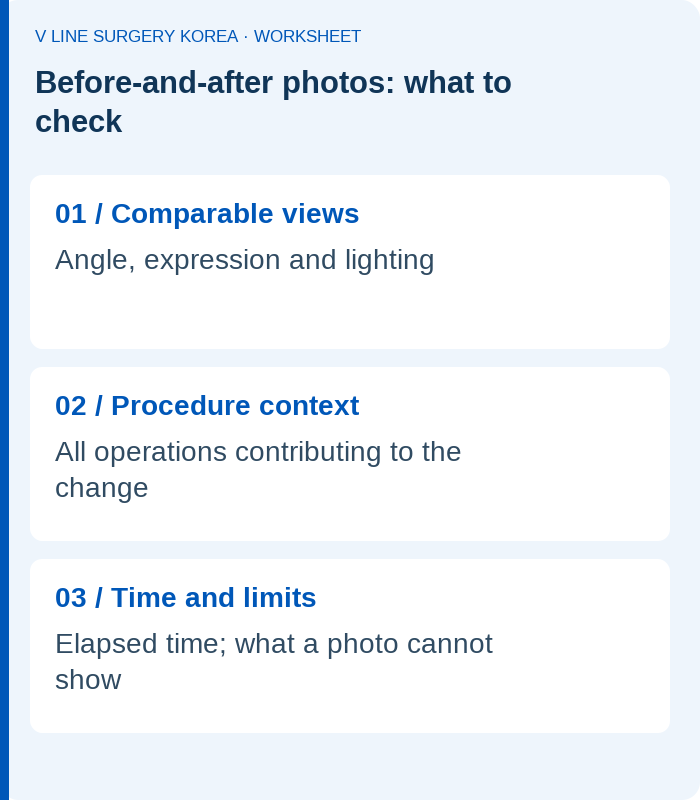
Ask to see cases with a similar starting concern and a clearly stated interval after surgery. Consistent lighting, head position and camera distance make photographs more useful. They remain selected examples, not a personal forecast. Ask what procedures were combined and whether the displayed change can be attributed to the operation you are considering. Avoid ranking surgeons solely by dramatic images, follower counts or reviews that do not establish the exact procedure and follow-up.
Compare the complete care pathway
Record the proposed operation, surgeon, anesthesia arrangements, facility, follow-up schedule and approach to complications. Ask for written terms covering additional treatment and revision-related costs. A lower quote may exclude services that another includes, while a higher price does not prove better care. If two recommendations differ substantially, obtain an explanation or another opinion. The goal is a plan whose diagnosis, technical rationale and continuity you can understand and evaluate.
Further reading: www.cdc.gov ↗
Begin with a question that a shortlist can answer
Write your main concern in a sentence before searching for a best-surgeon list. You might be trying to understand a broad jaw angle, a wide chin or an uneven lower-face outline. These descriptions help frame an assessment; they are not diagnoses. Keep any bite symptoms or previous operations beside the appearance concern. A shortlist is useful when it connects you with professionals who can assess that question, rather than simply collecting clinics with persuasive photographs.
Choose a manageable number of relevant consultations and identify what you need to learn from each. If your main uncertainty is whether bone surgery fits the concern at all, prioritize the quality of the assessment over a promise of a particular shape. If you have already had surgery, ask what records the clinician needs before discussing revision. The immediate goal is a better-informed decision. It is reasonable for that decision to be a more limited procedure, another assessment, a delay or no treatment.
Read qualifications without turning advertising into verification
Keep separate columns for the professional's name, specialty, training institutions and the source of each statement. A clinic biography is a useful starting point, but it is still the provider's own account. Ask how to verify the relevant qualification through an appropriate Korean professional or institutional source. Record any alternative English spelling and the Korean name if supplied, so that you do not mistake two profiles or transliterations for different people. Do not resolve uncertainty by assuming an impressive title means the same thing in every country.
For readers from the United States, United Kingdom or Australia, familiar board names and training pathways may not map directly onto Korea's system. Ask about the qualification relevant to the clinician's actual specialty and the proposed operation. Conference attendance, society membership and media appearances describe different things from specialty training. They should not be treated as interchangeable evidence. If verification remains unclear, request the underlying information and consider another opinion rather than filling the gap with a review score.
Further reading: www.nhs.uk ↗
Learn how the surgeon reasons about your particular anatomy
Ask the clinician to explain the difference between what you notice in a mirror and the structures responsible for it. Then ask how each proposed component addresses that assessment. If chin surgery is added to jaw-angle reduction, what problem does it solve? If the recommendation includes jaw repositioning or orthodontics, what functional finding makes that pathway relevant? You should be able to explain the outline of the plan in everyday language after the conversation.
Ask what is uncertain before imaging or examination and what remains uncertain afterwards. A useful plan identifies limits as well as opportunities. It may explain why a reference photograph does not translate to your bone structure or why removing more bone would not address a soft-tissue concern. Notice whether the explanation changes thoughtfully when you describe a feature you want to preserve. You are evaluating a clinical discussion, not asking the surgeon to agree with every requested change or reproduce someone else's face.
Confirm the responsibilities behind the clinic name
Ask who will perform each major part of the operation and whether that is the same person who evaluates you. Write down who will manage anesthesia, who supervises immediate recovery and who assesses concerns later. If care is shared, ask how information is handed over. A team approach can involve several people; what matters for your decision is that responsibilities are clear and that you know how to reach appropriate clinical care.
Ask where the procedure will take place and what arrangements apply if a higher level of care is needed. Do not infer a facility's capabilities from the size of its reception area or an equipment photograph. Request an explanation relevant to the proposed surgery and your medical history. If an answer is given through a coordinator, ask which points need confirmation from the surgeon or anesthesia clinician. Hospitality and translation services may make a visit easier, but they cannot replace a clear clinical plan.
Further reading: www.rcseng.ac.uk ↗
Use before-and-after photographs as structured questions
Choose a case with a starting concern similar to yours and ask which operations contributed to the change. Note whether the views, expression and lighting are comparable and whether the elapsed time is stated. A face that looks narrower after several combined procedures does not show what one component alone achieved. Ask what the picture cannot tell you, including sensation, recovery difficulties, satisfaction over time and whether further treatment occurred.
Look at the front, side and oblique views together rather than selecting only the most dramatic angle. If the clinic cannot share additional images because of patient privacy, that limit should be respected. The next step is a more detailed explanation of realistic outcomes, not a demand for private records. Use the platform's before-and-after collection to prepare questions, while remembering that selected cases do not provide a complete complication rate or predict your result. A consultation must still connect your own assessment to a proportionate proposal.
Compare the response to a difficult question
Choose one concern that could change your decision, such as persistent sensory change, residual asymmetry or a possible need for further treatment. Ask how it is discussed before surgery and assessed afterwards. A useful answer should help you understand the possible outcome and the care pathway, including what cannot be guaranteed. You do not need to demand a precise percentage when the available evidence cannot support one, but you should be able to discuss the risk without being dismissed.
Record unresolved points without turning the consultation into a numerical beauty or confidence score. If an important question receives only a slogan about technology, ask how that technology changes the plan and what risk remains. If two clinicians give different recommendations, ask each to explain the reasoning. A third opinion is most useful when you can name the unresolved issue. Repeatedly seeking the most reassuring promise may make comparison harder rather than producing better evidence for a decision.
Check the care pathway after your flight home
Before booking, identify the expected in-person reviews and ask what determines readiness to leave Korea. Clarify who handles a concern after departure, how quickly the clinic normally responds and when a local examination would be necessary. Ask what operative records and imaging you can obtain. A message channel is useful, but it is not equivalent to having a clinician nearby who can examine you. Make the distinction explicit in the plan.
Discuss the financial terms for unexpected visits, a longer stay, additional treatment or returning to Korea. Keep those terms separate from promises about appearance. A revision policy can describe payment arrangements without establishing that revision will be appropriate or that it will deliver a desired result. Read the policy before paying and ask how it applies if your concern is functional rather than aesthetic. Consider your own ability to arrange time, support and local care, not only the advertised duration of a package.
Further reading: www.cdc.gov ↗
A consultation summary you can use before paying
After the appointment, write a short summary under five headings: my concern, the assessment, the proposed components, the important trade-offs and the follow-up responsibilities. Add the named operating clinician and any unanswered questions. If the only details you can recall are the price and a projected shape, request another conversation. Ask for written confirmation of the plan so that translation or memory does not carry the entire decision.
Take time to compare the summary with your original priorities outside the clinic setting. Are the proposed changes the ones you wanted to discuss? Do you understand what will remain unchanged? Can you arrange the recommended recovery and reviews? A discount deadline does not answer those questions. If you are uncertain, explain what information is missing and pause until you have it. A consultation has been useful even when it helps you decide that surgery is not a good fit for you at this time.
Two listed clinics to explore for different assessment questions
Faceline Plastic Surgery's international service page lists jaw-angle and mandibular-body reduction together with chin procedures and identifies Dr. Lee Jin-soo. This is relevant when you want to ask how individual contouring components would be chosen or limited. Sinsa Oral & Maxillofacial Surgery identifies Dr. Ji-woong Jung and lists both facial contouring and double-jaw surgery, making it relevant when the distinction between a contour concern and a jaw-position concern needs assessment. These are service-based starting points, not a ranking or a guarantee of suitability.
Review the linked clinic and doctor profiles, then use the international websites to ask for an appropriate consultation. Confirm the location before booking: Sinsa is in Changwon, not Seoul. Send the same concise history and goals to each provider you contact. Ask who will assess you and what records are needed. The strongest next step is a discussion that makes the decision clearer, even if the eventual recommendation differs from the procedure you originally searched for.
Further reading: www.facelineplasticsurgery.com ↗ · www.sinsafacialsurgery.com ↗
Clinics and doctors to explore
These listed providers were selected because their published services and named care teams relate to the questions in this guide. Use their profiles to prepare a consultation and confirm the proposed operation and follow-up.
Faceline Plastic Surgery
Faceline lists jaw-angle reduction, mandibular-body reduction and chin procedures on its facial bone contouring service page, which identifies Dr. Lee Jin-soo. This makes it a relevant consultation option for asking how the proposed components, anatomical limits and sensory risks relate to your own plan. Review the profile and ask for an individual assessment; these service listings do not establish a comparative safety ranking.
Explore Dr. Lee Jin-soo’s profile ↗
Review the international website and ask about consultation ↗Sinsa Oral & Maxillofacial Surgery
Sinsa Oral & Maxillofacial Surgery lists Dr. Ji-woong Jung as chief director with facial contouring and double-jaw surgery among his specialties. For a reader unsure whether a contour concern also involves the bite, this provides a relevant starting point for discussing which pathway needs assessment. Sinsa is in Changwon; check its location before arranging travel. Review the international website and request a consultation to clarify suitability.
Explore Dr. Ji-woong Jung’s profile ↗
Review the international website and ask about consultation ↗Sources & further reading
- ASPS: questions for a chin-surgery consultation; US qualification context ↗
- NHS: choosing care and follow-up for cosmetic surgery abroad ↗
- CDC: medical tourism, records and continuity ↗
- Faceline: facial bone contouring service ↗
- Faceline: Dr. Lee Jin-soo ↗
- Sinsa: Dr. Ji-woong Jung ↗
- Royal College of Surgeons: choosing a surgeon and hospital ↗