Can V-line surgery cause permanent numbness?
Yes, jaw and chin contouring can cause temporary or persistent altered sensation in the lower lip, chin or teeth because relevant nerves lie close to the surgical area. Imaging helps planning but does not remove risk. New sensory changes should be reported and assessed; no fixed recovery date or universal percentage applies to every procedure.
Further reading: www.baoms.org.uk ↗
Why sensation deserves a detailed discussion
The inferior alveolar nerve travels through the lower jaw, and its mental branch supplies feeling to the lower lip and chin. Bone contouring near these structures can affect sensation through direct injury, stretching, compression or other operative effects. Symptoms can include numbness, tingling, altered touch or unpleasant sensations. A smooth external appearance does not establish normal nerve function. Sensory risk should therefore be discussed as a meaningful outcome in its own right, not only as a temporary inconvenience.
Further reading: pmc.ncbi.nlm.nih.gov ↗
Imaging defines boundaries but does not remove risk
Appropriate imaging helps the surgeon understand the course of the nerve canal in relation to proposed cuts. The canal can vary between people and between sides. Ask to see how it affects your plan and whether it limits the reduction you requested. A computer-guided plan or specialized instrument does not make nerve injury impossible. The important issue is how the team combines imaging, technique and conservative judgment to reduce risk while recognizing that uncertainty remains.
Further reading: pmc.ncbi.nlm.nih.gov ↗
Temporary and persistent changes
Some sensory changes improve as tissues recover, while others can persist. The course depends on the nature and severity of the injury, and an early symptom does not by itself reveal the eventual outcome. Avoid relying on a universal promise that all numbness resolves by a particular month. Ask how the clinic documents sensation before surgery and reassesses it afterward. Baseline information matters especially if you already have altered feeling from dental treatment or previous facial surgery.
Further reading: www.baoms.org.uk ↗
Do not borrow percentages from another operation
Risk figures from lower-jaw repositioning, wisdom-tooth surgery or implant placement cannot automatically be applied to your contouring plan. The anatomy, surgical exposure and patient populations differ. If a clinic provides a percentage, ask what procedure and follow-up period it represents and how persistent symptoms were defined. A meaningful explanation may use uncertainty rather than a precise number. The absence of a clinic-specific percentage should not be replaced with a falsely reassuring estimate.
What a management plan should address
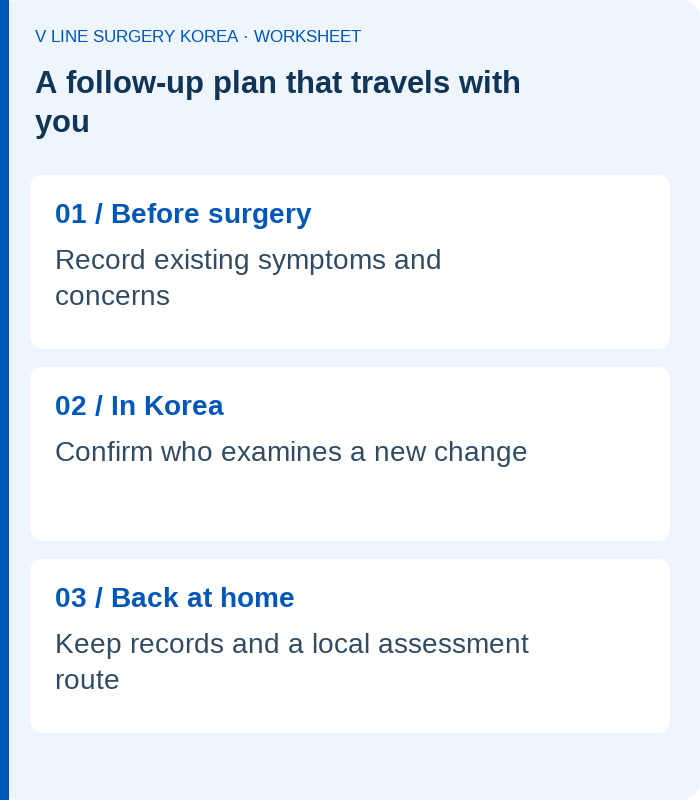
Ask whom to contact if sensation changes, how symptoms are examined and when a specialist assessment would be considered. Document the location and character of symptoms as instructed rather than repeatedly testing the area aggressively yourself. The clinic should distinguish routine follow-up from findings requiring prompt evaluation. For an international patient, the plan should also identify how records and imaging can be shared with a clinician after returning home. Continuity is particularly important when assessment extends beyond the initial stay.
Balancing benefit against sensory risk
Consider whether the desired contour change is worth the possibility of persistent altered feeling. That is a personal decision, but it requires an honest explanation of the proposed operation. Ask whether a more conservative reduction would meaningfully change the risk or aesthetic result. If an extreme request would cross a safe anatomical boundary, the appropriate response may be to limit or decline it. Preserving function should remain part of the definition of a successful outcome.
Numbness and movement weakness are different symptoms
Numbness describes altered feeling. The inferior alveolar and mental nerves discussed here are sensory pathways; they are not the same as the facial nerve branches involved in facial movement. If you notice a new change in lip movement, facial weakness or another neurological symptom, describe it separately and seek prompt clinical assessment rather than assuming it is ordinary chin numbness. A clinician needs to examine the pattern and decide whether further investigation is required.
Start by describing the change in ordinary language
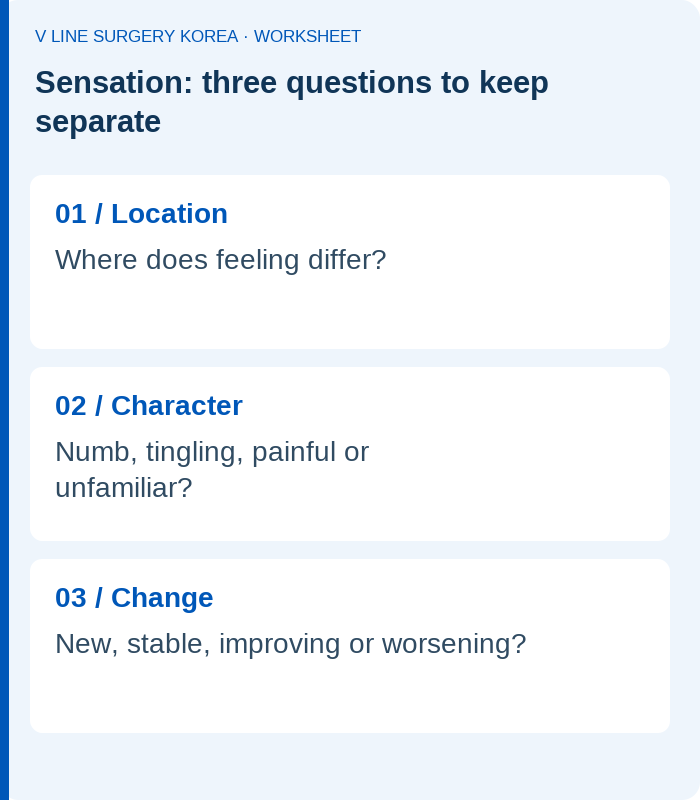
You do not need to know a nerve's name before telling the clinic something feels different. Describe where the sensation is, which side is involved, when you first noticed it and whether it is changing. A patch of reduced feeling, an intermittent unpleasant sensation and a change in movement are different observations. Use your own words before choosing a label from an online discussion. If you cannot tell whether the area is completely numb or merely feels unfamiliar, say that too.
A practical message might follow this structure: the operation and date; the area affected; what you notice during an ordinary activity; when the change began; and any other symptoms. This is a communication template, not an example of a diagnosed complication. Attach a photograph only if requested and useful. A photograph can identify a location but cannot demonstrate how touch feels or replace a sensory examination. Ask whether the team needs to see you in person rather than assuming an image settles the question.
Understand what published research can and cannot tell you
A 2014 report reviewed 588 Korean patients who had different combinations of mandibular contouring, chin surgery and cheekbone reduction performed by one surgeon. Sensory deficits were reported, including some persisting at longer follow-up. This establishes that altered sensation warrants discussion; it does not supply your personal probability. The study's mixed procedures, single-practice setting and average follow-up of 14 weeks limit generalization. Its findings cannot rank today's clinics or demonstrate that a particular marketed technique eliminates the risk.
When reading a risk claim, identify the denominator: does the number refer to all operations, only people who answered a survey, or a subgroup with a particular procedure? Then ask what the authors measured. Reduced touch, painful altered feeling and a patient saying their lip feels unusual may be counted differently. A percentage without the procedure, definition and follow-up period is incomplete information. Take the original source to the consultation and ask how closely its patients resemble the operation being proposed for you.
Further reading: pubmed.ncbi.nlm.nih.gov ↗
Prepare a baseline before deciding on surgery
Write down any existing altered feeling around your lower lip, chin, gums or teeth, even if it seems minor or comes and goes. Include previous dental treatment and facial procedures with approximate dates. The aim is to give the surgeon a starting point, not to prove that a prior treatment caused a problem. If records are missing, name the clinic or dentist that may hold them and ask which documents would help. An old operative report may answer a different question from a photograph.
Ask whether sensation will be documented during the examination and how later findings will be compared. If you already have a symptom that worries you, put it near the beginning of the appointment rather than mentioning it after agreeing on a shape. A useful consultation separates your existing concern from a new risk associated with the proposed operation. You can then discuss whether further assessment, a different plan or delaying treatment would be appropriate before committing to an irreversible change.
Ask what a more conservative plan would mean
Instead of asking only how much narrower your face could become, ask what the surgeon would preserve and why. Invite a comparison between the proposed plan and a smaller intervention: which visible changes might differ, which structures would still be approached and which uncertainties would remain? A smaller operation is not automatically risk-free. The question is whether its likely benefit and trade-offs better match your priorities after a proper assessment.
Write down the features you would prefer to keep as well as the ones you hope to change. This makes it easier to discuss a result that is less dramatic but more acceptable to you overall. If a clinician explains that a requested change should not be attempted, ask for the anatomical reason in plain language. You do not need to bargain toward the maximum reduction. Choosing no surgery remains a valid response when the possible benefit does not justify the risks for you.
Make the follow-up plan specific before you travel
A plan that says only to send a message if concerned leaves important details unresolved. Ask which contact channel is monitored, who reviews symptom reports and how an in-person appointment is arranged. Clarify what happens outside ordinary opening hours and what to do if you cannot reach the usual coordinator. Keep the instructions in a form you and your companion can understand. Save an offline copy alongside the clinic address and your operation details.
For the return home, ask what records can be supplied to a local clinician, whether an interpreter will be needed for medical documents and how the two teams can communicate. A remote conversation may help coordinate care, but it cannot perform a physical examination. Agree on a route to local assessment rather than relying on a future flight to Korea as the only option. Ask about likely administrative and financial arrangements without assuming that a surgery package includes every later investigation or referral.
Further reading: www.cdc.gov ↗
Keep a useful record without repeatedly testing yourself
Choose a brief, consistent description rather than constantly checking the area. Note the date, location, type of change and effect on ordinary activities, along with the advice you received. Bring the record to scheduled reviews. It can help you remember whether a symptom is new, unchanged or becoming more troublesome when appointments are separated by travel or time zones. Ask the clinician what information is useful; more detail is not always more helpful.
Do not turn the diary into an at-home nerve test or use sharp objects, strong heat or repeated pinching to seek reassurance. Ask the team how to protect an area with reduced feeling and whether any particular care is needed during meals or mouth hygiene. Avoid starting supplements, massage, electrical devices or exercises promoted as nerve repair without discussing them with the treating clinician. A claim that a product helped someone online does not show what caused their symptom or whether the same approach suits you.
Further reading: www.gloshospitals.nhs.uk ↗
Questions patients commonly ask
Does tingling prove that a nerve is recovering? A single sensation cannot establish the outcome. Describe the pattern to the clinician and ask how it fits the examination. Does a normal-looking result rule out a sensory problem? No; appearance and sensation answer different questions. Is it reasonable to report symptoms before a planned review? Yes: follow your team's escalation instructions, and contact them when a new or concerning change needs clarification rather than waiting for an arbitrary recovery deadline.
Can a second opinion help? It may be useful when the assessment or follow-up plan remains unclear. Bring the operative information and existing records so the clinician can understand what was done. Ask a defined question, such as what further assessment is appropriate, instead of expecting a new clinician to predict recovery from photographs alone. If symptoms include difficulty breathing or swallowing, seek emergency assessment; do not treat those symptoms as a routine numbness question or wait for a reply to an online message.
Further reading: www.nhs.uk ↗
Clinics and doctors to explore
These listed providers were selected because their published services and named care teams relate to the questions in this guide. Use their profiles to prepare a consultation and confirm the proposed operation and follow-up.
Faceline Plastic Surgery
Faceline lists jaw-angle reduction, mandibular-body reduction and chin procedures on its facial bone contouring service page, which identifies Dr. Lee Jin-soo. This makes it a relevant consultation option for asking how the proposed components, anatomical limits and sensory risks relate to your own plan. Review the profile and ask for an individual assessment; these service listings do not establish a comparative safety ranking.
Explore Dr. Lee Jin-soo’s profile ↗
Review the international website and ask about consultation ↗Sources & further reading
- BAOMS: genioplasty and sensory complications ↗
- Mandibuloplasty complications: 588-case retrospective report (2014) ↗
- CDC: medical tourism and continuity of care ↗
- Faceline: facial bone contouring ↗
- Nerve anatomy and mandibular contouring ↗
- Gloucestershire Hospitals: mouth surgery and altered feeling ↗
- NHS: swallowing problems ↗